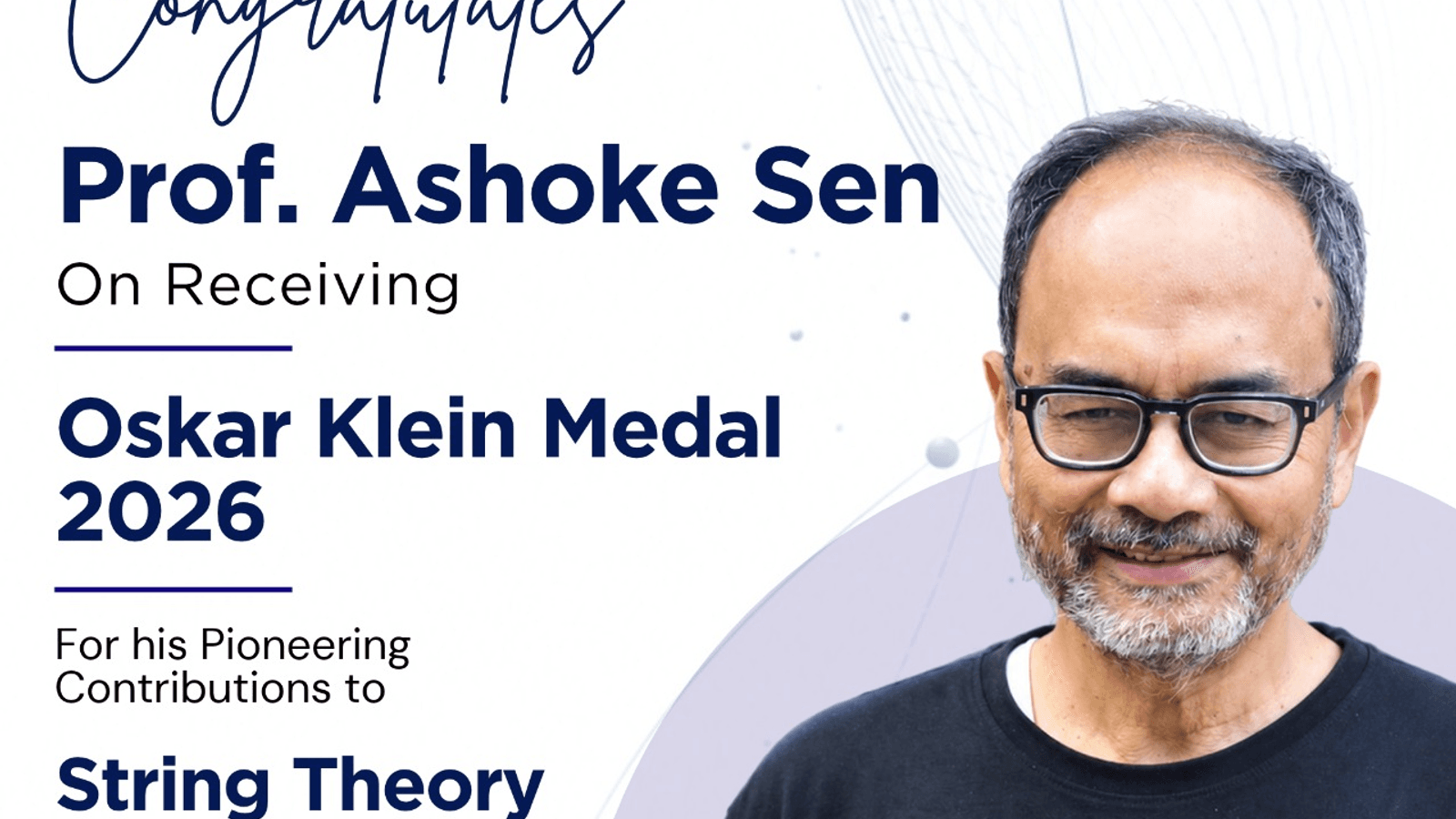
There is a short list of institutions in physics whose approval carries real weight, and the Nobel Committee for Physics sits at the top of it. On 22 October 2026, the committee's parent body and a Swedish university handed their annual medal to an Indian theorist — and no Indian had ever been on that list before.
The physicist is Ashoke Sen, and the prize is the Oskar Klein Medal. Here is what the honour actually signals, and why a medal named after a Swede from a century ago is a milestone for Indian science. More on the deeper significance below.
The Office of the Principal Scientific Adviser to the Government of India congratulates Dr. Ashoke Sen, @ictstifr-Infosys Madhava Chair Professor, Bengaluru, on receiving the Oskar Klein Medal for 2026. He is the first Indian physicist to receive this prestigious honour.
— Office of Principal Scientific Adviser to the GoI (@PrinSciAdvOff) October 23, 2026
Prof.… pic.twitter.com/WBYKnPiGCZ
1st
Indian physicist ever to win the Oskar Klein Medal
2012
Year Sen won the Breakthrough Prize in Fundamental Physics
2014
Year Sen won the Dirac Medal
22 Oct 2026
Oskar Klein Memorial Lecture, Stockholm
Who hands out this medal — and why that matters
The Oskar Klein Medal is not a popularity contest. It is awarded annually by Stockholm University and the Nobel Committee for Physics of the Royal Swedish Academy of Sciences. That second name is the one to read twice: it is the same committee that selects the Nobel Prize in Physics each October.
So when they pick a laureate for the Klein medal, they are signalling the kind of work they regard as foundational. The winner gives the Oskar Klein Memorial Lecture in Stockholm, which is less a victory lap than an induction into a specific lineage of theoretical physics.
Sen delivered that lecture, titled "Gravity from Strings and Strings from Gravity," at Stockholm University's AlbaNova Centre on 22 October 2026. The title is the whole thesis of his career compressed into six words: the two-way street between gravity and the strings that may underlie it.
What Sen actually did
Sen is recognised for his pioneering work on three things: S-duality, the precision counting of black-hole entropy, and string field theory. Each sounds abstract, so here is the plain version.
S-duality is the idea that two theories that look completely different — one describing weak forces, one describing strong ones — can secretly be the same theory wearing a different costume. That insight helped stitch five separate versions of string theory into one framework. It is a large part of why string theory is even discussed as a single subject rather than five rival ones.
Black-hole entropy is the strangest. A black hole has a temperature and an entropy, which implies it has microscopic parts you can, in principle, count — like counting the ways you can arrange a deck of cards. Sen worked on counting those arrangements with precision, matching a number derived from pure gravity to a number derived from string theory. When two wildly different calculations spit out the same figure, physicists take it as evidence the underlying picture is right. (For a recent example of what it looks like when an abstract mathematical problem finally yields a definitive answer, see our breakdown of OpenAI's Navier–Stokes result.)
String field theory is the attempt to write string theory in the clean, systematic language that ordinary particle physics already enjoys. Together, these are the load-bearing walls of the field, which is exactly the profile the Klein committee rewards.
A career of medals, now capped
The Klein medal lands on top of a stack. Sen received the Breakthrough Prize in Fundamental Physics in 2012 for his contributions to establishing the unifying structure of string theory, and the Dirac Medal in 2014. India's own state recognised him earlier still, with the Padma Shri in 2001 and the Padma Bhushan in 2013.
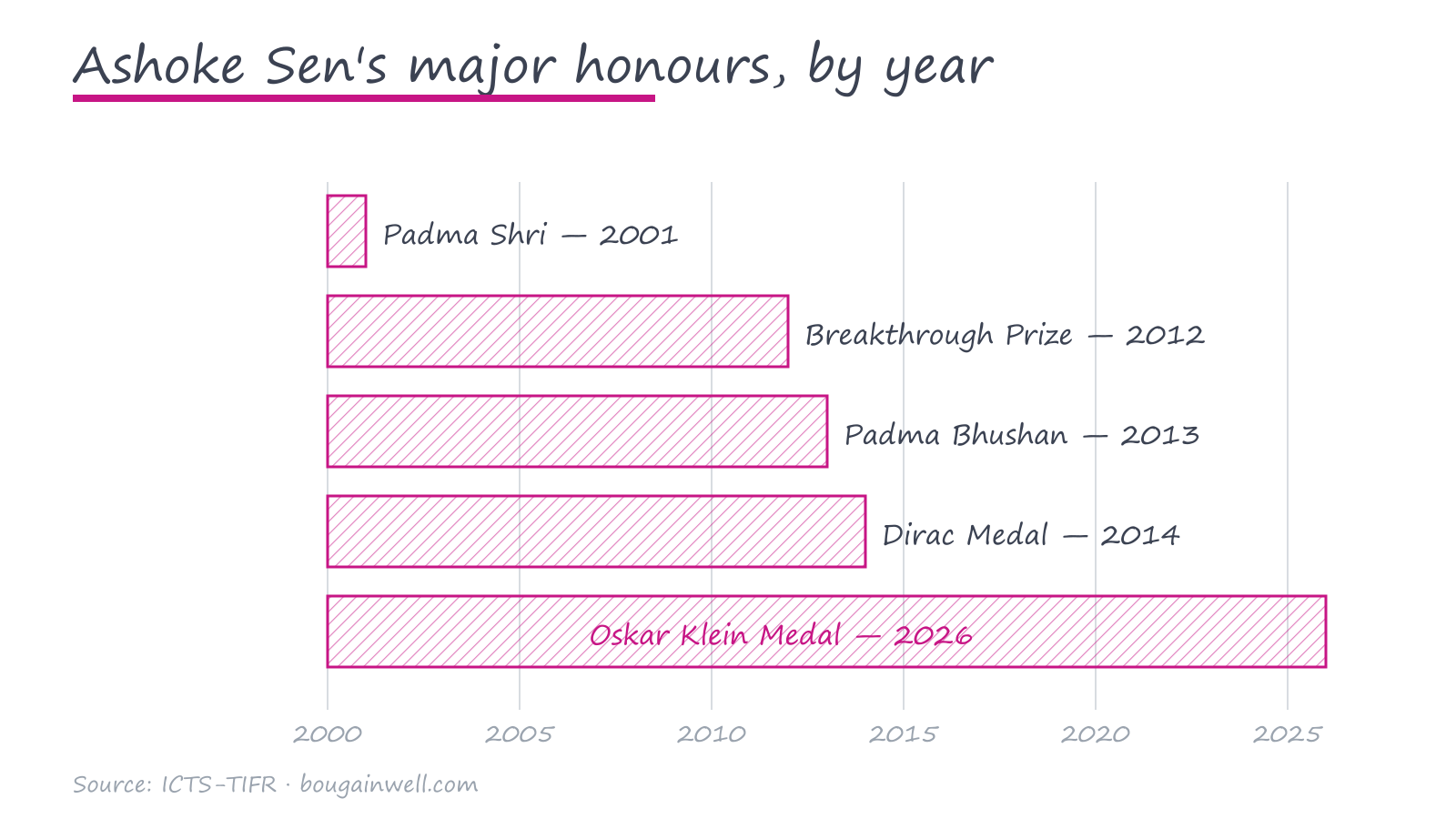 Sen collected a civilian honour and two of the field's top prizes in the 25 years before the Klein medal. (Chart: BougainWell · Data: ICTS-TIFR)
Notice the gap being closed. The Breakthrough Prize came in 2012 and the Dirac Medal in 2014 — twelve and fourteen years, respectively, before this medal. The international physics establishment has rated Sen's work for well over a decade. What was missing was this particular stamp, from this particular committee. Now it is there.
The open loop: why "first Indian" is the real headline
Early on I promised the deeper significance. Here it is. The number that matters is not any single prize year — it is the word first.
Plenty of great physics has come out of India. What the Oskar Klein Medal certifies is that the work was judged, by the body closest to the Nobel Prize in Physics, to be among the foundational contributions of the era — and that this is the first time that judgement has gone to an Indian physicist. That is a ceiling being touched for the first time, not just another line on a CV. India's scientific institutions are drawing growing international attention; separately, India's macroeconomic momentum is the backdrop against which those institutions are expanding.
It also lands at a real institution. Sen is an ICTS-Infosys Madhava Chair Professor at the International Centre for Theoretical Sciences in Bengaluru. Centre Director Rajesh Gopakumar put it plainly: "On behalf of all of us, very warm congratulations to Ashoke. It has been no less than wonderful having Ashoke with us and setting the tone for excellence here at ICTS."
That last phrase — setting the tone — is the point. A medal like this is not just a reward for one person; it is a signal to every graduate student in the building about what the top of the field looks like, and that it is reachable from where they sit.
What to Take Away
- Ashoke Sen is the first Indian physicist ever to win the Oskar Klein Medal, awarded jointly by Stockholm University and the Nobel Committee for Physics of the Royal Swedish Academy of Sciences.
- The prize recognises foundational string-theory work: S-duality, precision counting of black-hole entropy, and string field theory.
- He delivered the Oskar Klein Memorial Lecture, "Gravity from Strings and Strings from Gravity," at Stockholm's AlbaNova Centre on 22 October 2026.
- It caps a long run of recognition — Breakthrough Prize (2012), Dirac Medal (2014), Padma Shri (2001) and Padma Bhushan (2013).
- The headline is the word first: the committee closest to the Nobel Prize in Physics has, for the first time, placed an Indian physicist among the field's foundational figures.
Chart(s): BougainWell, built from ICTS-TIFR. This article is for general information only and is not investment advice.
Sources
All analysis and opinions in this article are BougainWell's own.
Cover image: Office of Principal Scientific Adviser to the Government of India (@PrinSciAdvOff), via their post on X (23 October 2026).