Most corporate giving is a line item. Anthropic just made its giving a stake in itself. On October 18, 2026, the company said it is committing a portion of its own shares to the Anthropic Public Benefit Fund, a new wholly owned entity built to channel equity — not spare cash — toward the public good. The move sits alongside the broader AI-governance push that figures like Demis Hassabis have been calling for.
The headline number is small and the mechanism is the story. The fund starts at 5% of shares, then grows automatically as Anthropic grows. Combined with earlier commitments, the company says this puts roughly 20% of its equity on the public-benefit side of the ledger. There is a catch in how that 20% is counted — more on that below.
We’re committing a portion of Anthropic’s shares to the Anthropic Public Benefit Fund, a new wholly owned entity dedicated entirely to the public benefit.
— Anthropic (@AnthropicAI) October 18, 2026
It will start off with 5% of our shares. For every 50% increase in the company’s value over a set baseline, we can…
Why they pledged stock instead of a budget
A donation budget is a number a company sets and can quietly cut. A share is a claim on the whole future of the business. By routing value through equity, Anthropic ties the size of the public pot to its own success: if the company is worth little, the fund is worth little; if it becomes one of the most valuable companies on earth, the fund scales with it.
In Anthropic's own framing, the pledge is this: We're committing a portion of Anthropic's shares to the Anthropic Public Benefit Fund, a new wholly owned entity dedicated entirely to the public benefit. The structure matters because it removes the annual temptation to trim generosity in a lean year.
How the escalator actually works
Here is the clever part. The commitment is not static. As Anthropic's board tells it, 5% of Anthropic's shares will be committed today, with an additional 2% added at the board's discretion for every 50% increase in the company's value above a set baseline.
So the committed share ratchets up in steps. Clear the first milestone and the stake moves to 7%. Clear the next and it reaches 9%, then 11%, and so on. Each rung costs the company a sliver of ownership only after the pie has grown by half again.
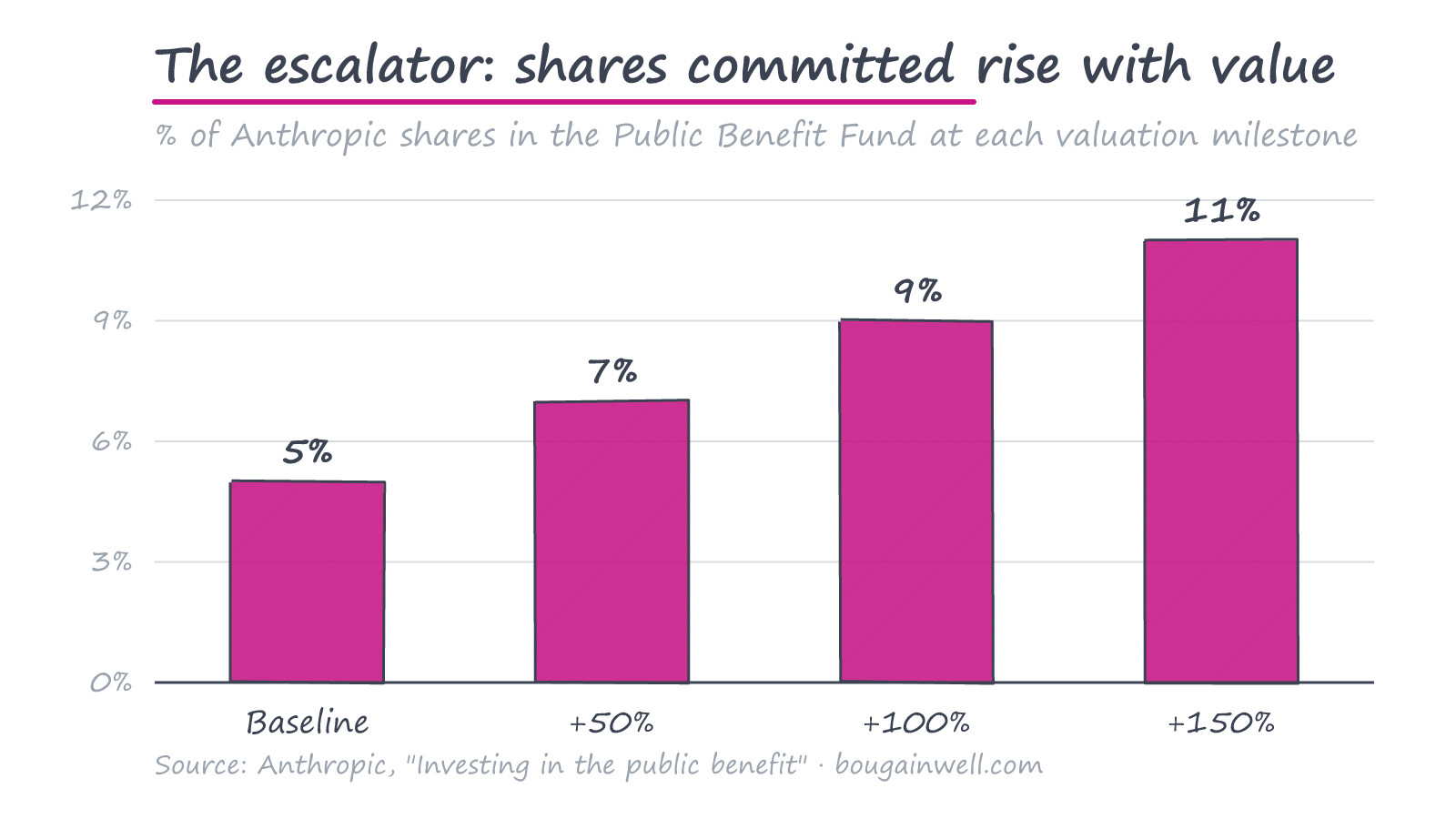 The stake steps up 2 points for every 50% the company gains in value. (Chart: BougainWell · Data: Anthropic, "Investing in the public benefit")
The elegance is that nobody loses on a down year. A 2% slice is handed over only when value has already climbed 50% past the line. Measured in dollars, each new 2% slice of a company that has already grown by half again can be worth far more in dollars than the entire base stake was at the start.
The catch in the "roughly 20%"
Read the share clause alone and you will not get to 20% any time soon — it would take many 50% doublings of value to stack 15 extra points on top of the base 5%. That is why the number deserves a second look.
The ~20% is a combined figure. Anthropic says that when combined with today's announcement, roughly 20% of Anthropic shares will be dedicated to the public good, plus whatever the valuation milestones later add. In other words, the fresh fund is one layer on top of commitments the company had already made. Treat 20% as the running total of several pledges, not as something this one escalator produces on its own.
What the fund is pointed at
The target is the part of the AI story that keeps economists up at night: what the technology does to work and livelihoods. Anthropic says it has already committed $200 million to studying and addressing this issue — the kind of economic-impact research that tries to get ahead of disruption rather than clean up after it. The company's own economic-scenarios modelling for 2030 shows why the scale of the bet matters: the worst-case paths it sketched are brutal for knowledge workers, and no single grant cycle can address a multi-decade shift.
That $200 million is the tell for why a share pledge makes sense here. A problem this large will not be solved by one grant cycle — a fixed sum, however large, gets spent and is gone, while labour markets keep shifting for years. Anthropic concedes as much, noting that given the pace of AI progress, bolder approaches may be needed. An equity engine that compounds with the company is the bolder approach.
Who wins, and what to watch
If this works as designed, the winners are the research and public-benefit efforts that inherit a stake that grows with one of the fastest-scaling companies in tech. The risk is in the soft edges: approval that has not happened yet, additions that are discretionary, and a baseline valuation Anthropic has not disclosed. Without that baseline, nobody outside the company can say what the first milestone is worth in dollars.
The signal to watch is governance follow-through — whether stockholders approve the 5%, and whether the board actually pulls the 2% lever when milestones hit. A pledge is a promise; the escalator only matters if someone keeps climbing it. How Anthropic's models develop from here — including Claude Fable 5 and whatever follows — will determine how much that climbing is ultimately worth.
What to Take Away
- Anthropic is committing 5% of its shares to a new wholly owned Public Benefit Fund, with an extra 2% added for every 50% rise in company value above an undisclosed baseline.
- The stake steps up over time — 5%, then 7%, 9%, 11% — so the public pot grows only after the company does.
- The roughly 20% headline is a combined total with prior commitments, not what this one clause alone produces.
- It is pointed at AI's impact on jobs, building on $200 million already committed to that research.
- The fine print is real: stockholder approval is still pending, the 2% top-ups are discretionary, and the baseline valuation is secret.
Chart(s): BougainWell, built from Anthropic, "Investing in the public benefit". This article is for general information only and is not investment advice.
Sources
Cover image: Anthropic, via their announcement post on anthropic.com/news/public-benefit-fund.
All analysis and opinions in this article are BougainWell's own.