xAI just put a new voice model at the top of the leaderboard, and the launch comes with two numbers that pull in opposite directions. Grok Voice 3 debuted at #1 on the Artificial Analysis Speech-to-Speech Index at 86.9 — a genuine frontier result. But the figure that actually decides whether a developer builds on it is quieter: $0.08 a minute. One of those numbers wins headlines; the other wins deployments. There's a catch in how the two fit together — more on that below.
Introducing Grok Voice 3.0, the world’s most intelligent speech-to-speech model.
— SpaceX Super Intelligence (@SpaceXSI) October 14, 2026
It excels at resolving customer calls, responds in under a second, and costs less than other frontier models. pic.twitter.com/cfDRrkQPEc
What xAI actually shipped
Andrew Milich, who leads the team, framed it plainly: Grok Voice 3 launches today, our frontier speech-to-speech model. The phrase to notice is speech-to-speech. This is not a chain of a transcriber, a text model, and a separate voice generator bolted together. It is one model that hears audio and speaks audio directly — which is why latency and natural turn-taking are the whole game here, not an afterthought.
The independent confirmation matters more than the marketing. Artificial Analysis, which runs the benchmark, reported that Grok Voice 3 is the new leading Speech to Speech model, debuting at #1 on the Artificial Analysis Speech to Speech Index at 86.9, while also being competitive on latency. When the people who own the scoreboard say you're #1, that carries more weight than a vendor saying it about itself. It is worth noting that xAI is not alone in chasing this space: OpenAI launched its own full-duplex voice models with GPT-Live earlier this year, and the rivalry is now directly reflected in independent benchmarks.
Read the two scores honestly
The launch leans on two benchmarks, and they measure genuinely different things. The headline 86.9 is the overall Speech-to-Speech Index — a blended measure of how good the model is at the whole job. The second number, 97% on Full Duplex Bench, is narrower and arguably more revealing: it measures how naturally the model handles pauses, turn-taking, and interruptions.
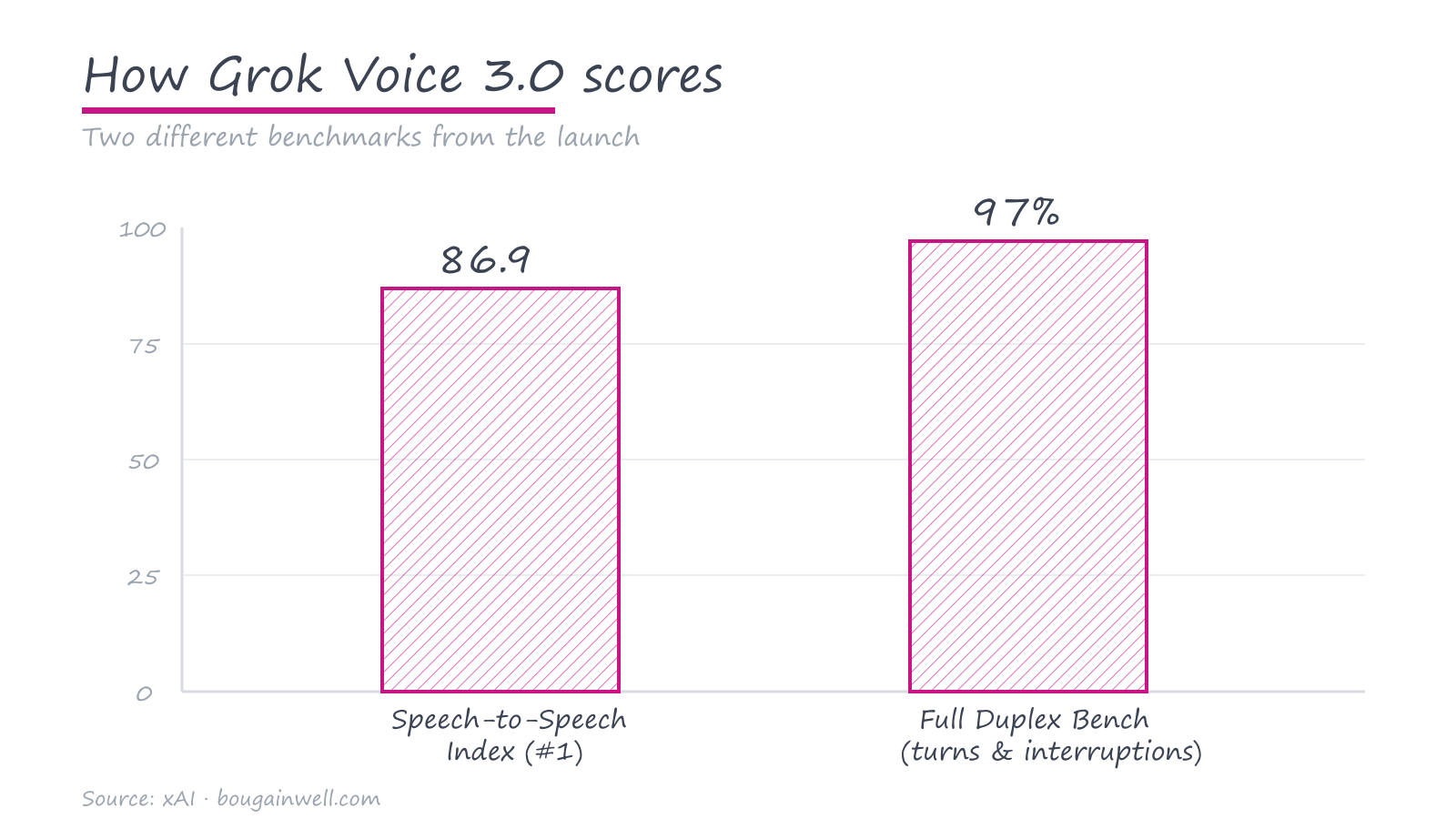 The headline rank is the Index; the 97% duplex score is what makes it feel like a conversation. (Chart: BougainWell · Data: xAI)
Full duplex is the unglamorous thing that separates a demo from a product. A model that can't be interrupted — that keeps talking over you after you've already answered — feels like a machine no matter how smart the words are. Scoring 97% on that specific axis is why xAI can credibly aim this at live phone support rather than voice-note dictation. The always-on agent model that OpenAI is building around GPT-6 Astra faces exactly the same test: turn-taking quality is the gating factor for whether an ambient agent feels natural or intrusive.
The number that decides adoption: $0.08 a minute
Now the quiet one. Grok Voice 3 is available today in the Voice Agent API at $0.08 per minute. For anyone pricing out a voice agent, per-minute is the only unit that matters, because a phone line is billed by time, not by tokens or requests.
Run it out and it gets tangible. At $0.08 a minute, an hour of continuous conversation costs $4.80. That is the figure to hold in your head when you model a call center: not a benchmark, but the cost of keeping one voice line talking for sixty minutes. xAI's own pitch, via SpaceX Super Intelligence, is that the model excels at resolving customer calls, responds in under a second, and costs less than other frontier models. For a price comparison with another frontier offering, GPT-6 Astra's launch benchmarks and pricing provide a useful adjacent data point.
The proof is already running: Starlink
The strongest line in the launch isn't a benchmark — it's a workload that already exists. Starlink call centers use Grok Voice to answer 20,000 customer calls every day across multiple languages. That's not a pilot; that's production volume on a model xAI is now selling to everyone else.
The resolution rate is the part worth sitting with. Roughly 70% of those calls are resolved with no human in the loop, and one in four sales calls ends in a purchase before the caller hangs up.
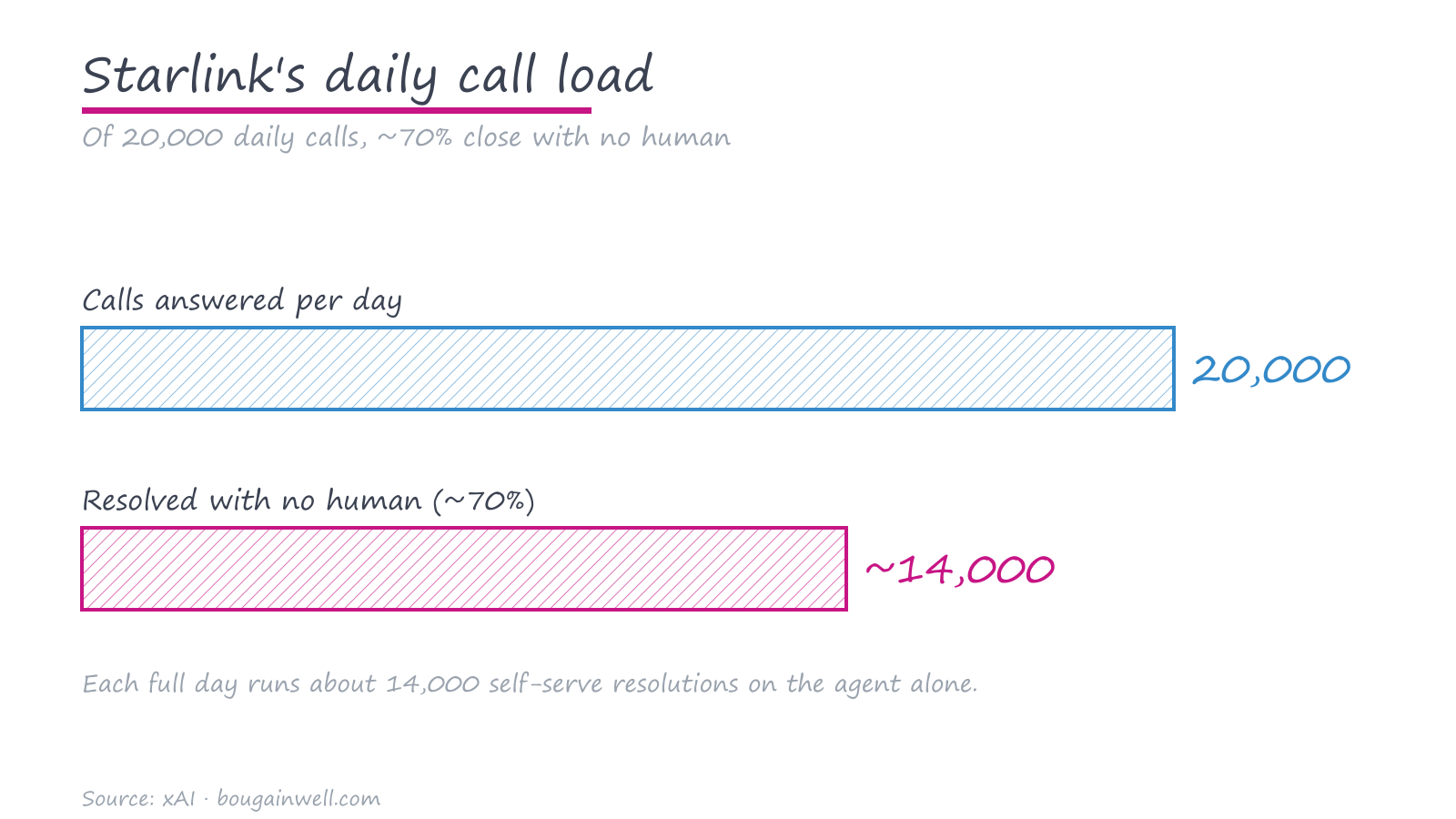 Of 20,000 daily calls, roughly 14,000 are closed by the agent alone. (Chart: BougainWell · Data: xAI)
Do the arithmetic and the scale lands: 70% of 20,000 is about 14,000 calls a day closed without a person ever picking up. That is the single most useful proof point in the whole announcement, because it's a real company absorbing real call volume — not a staged benchmark on a quiet dataset.
The catch, as promised
Here's the open loop closed. The 86.9 and the 97% tell you the model is good; the $0.08/min and the Starlink numbers tell you it's cheap and proven. But none of those figures tells you how it compares, in price or score, to a specific named rival — and you should be suspicious of anyone who hands you that comparison without sourcing it. The honest read is narrower and stronger: Grok Voice 3 is independently ranked first today, priced in plain per-minute terms, and already carrying production load. That's enough to prototype on. It is not a licence to assume it beats every alternative on your particular workload — that's a test you run yourself, on your own call transcripts.
What to Take Away
- Grok Voice 3 debuted #1 on the Artificial Analysis Speech-to-Speech Index at 86.9 — an independent leaderboard result, not a vendor claim.
- It scores 97% on Full Duplex Bench, the measure of natural interruptions and turn-taking that separates a usable phone agent from a talking demo.
- The adoption number is the price: $0.08/min, or $4.80 an hour of continuous conversation — per-minute, the unit that actually matters for voice.
- It's already in production: Starlink runs 20,000 calls a day through it, with about 14,000 resolved with no human.
- Benchmarks and price tell you it's worth prototyping; they don't replace testing it on your own calls before you trust it live.
Chart(s): BougainWell, built from xAI. This article is for general information only and is not investment advice.
Cover image: xAI, via x.ai/news/grok-voice-3.
Sources
- SpaceX Super Intelligence (@SpaceXSI) on X — Introducing Grok Voice 3
- Andrew Milich (@milichab) on X — Grok Voice 3 launches today
- Artificial Analysis (@ArtificialAnlys) on X — Grok Voice 3 debuts #1 on Speech to Speech Index
All analysis and opinions in this article are BougainWell's own.