The man who ran the lab that cracked protein folding just asked governments to put a speed bump in front of his own industry. On July 14, 2026, Google DeepMind CEO Demis Hassabis published a long-form essay on X titled "A Framework for Frontier AI and the Dawning of a New Age" — and its core proposal is that frontier AI models should have to pass an independent safety exam before they are allowed to reach American users.
That is a striking thing for a frontier lab boss to campaign for. It's the equivalent of a carmaker lobbying for crash tests. So what does Hassabis actually believe is coming, and why does he think the usual playbook won't hold?
— Demis Hassabis (@demishassabis) July 14, 2026
The bet behind the ask
Everything in the essay flows from one conviction: that artificial general intelligence is, in Hassabis's words, "probably only a few short years away." He frames the change ahead as roughly 10× the impact of the Industrial Revolution, arriving at about 10× the speed — a century's worth of economic and scientific rearrangement compressed into a decade.
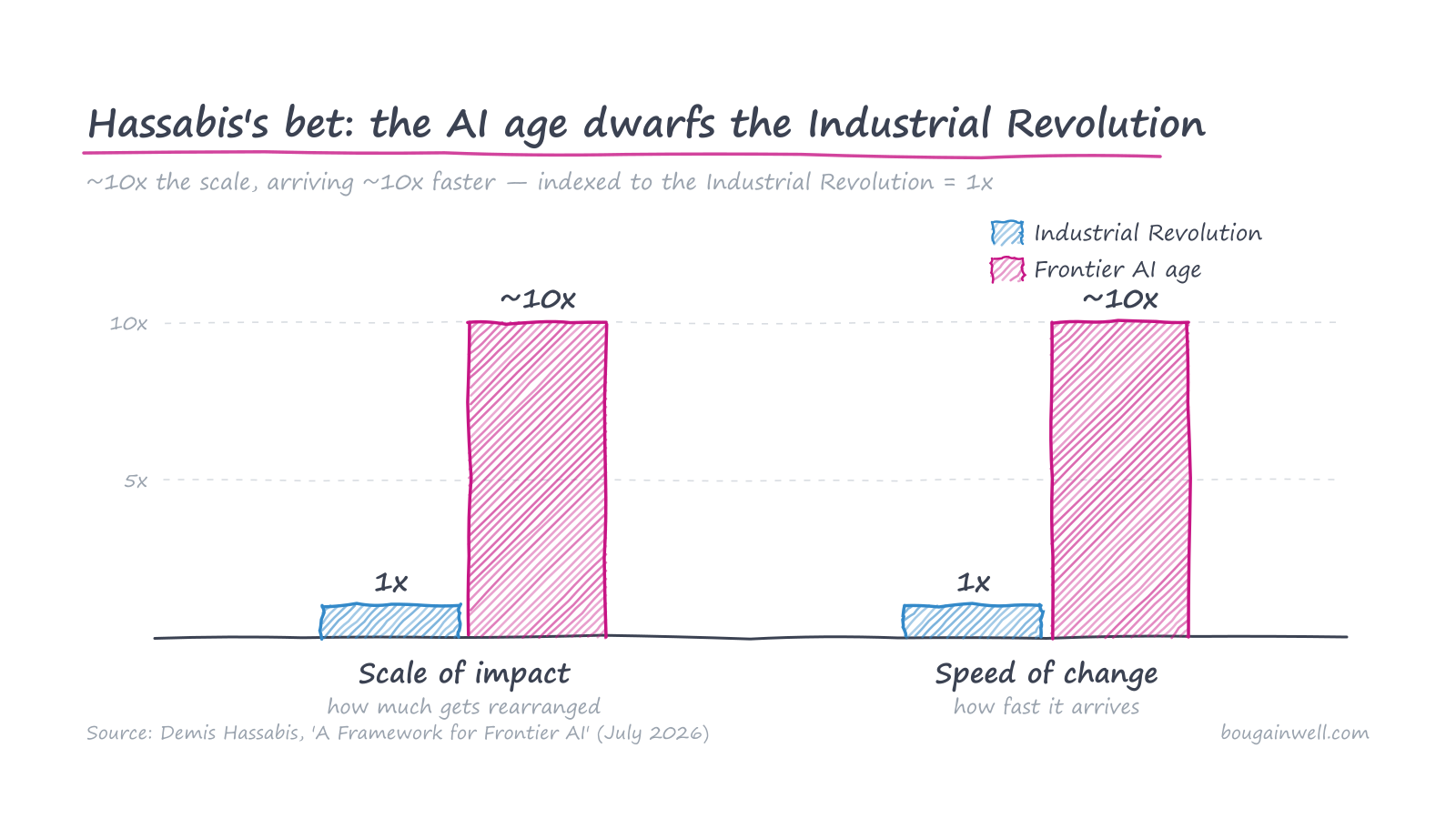
Hassabis's thesis in one picture: a bigger transformation, delivered far faster than the last one. (Chart: BougainWell · Data: Demis Hassabis, "A Framework for Frontier AI," July 2026)
Hold that number in your head, because it does two jobs at once. On the upside, Hassabis points to accelerated drug discovery, clean energy, and new materials — the ingredients of what he has elsewhere called radical abundance. On the downside, the same speed is exactly why he thinks light-touch, after-the-fact regulation is the wrong tool. If the transformation really moves ten times faster than the last one, the window to build guardrails is roughly ten times narrower.
What he's actually afraid of
The essay is unusually specific about the danger. "We've already seen the challenges frontier models pose for cybersecurity," Hassabis writes, "and other threats including nuclear and bio risks may soon emerge." These are the classic dual-use problems: the same model that helps a chemist can coach a bad actor, and the same coding skill that patches software can find the hole to break into it.
The tell here is the word soon. Cyber risk, in his telling, is already real; bio and nuclear misuse are on the horizon. That ordering matters, because it's the argument for acting now rather than waiting for a disaster to write the rules for us — the pattern that has governed almost every safety regime in history, from aviation to pharmaceuticals.
The FINRA blueprint
Here's the part that makes the proposal concrete instead of hand-wavy. Hassabis doesn't ask for a giant new government agency. He points to FINRA — the Financial Industry Regulatory Authority — as the model.
FINRA is worth understanding, because the analogy is the whole idea. It isn't a government department. It's a private, industry-funded body that writes and enforces the rules for American brokerages, operating under the oversight of the Securities and Exchange Commission. The firms it polices pay for it; the government backs its authority. It's a referee hired by the league but answerable to the state.
Mapped onto AI, Hassabis wants a standards body that is a "federally overseen public-private partnership with a board composed of independent technical experts, open-source representatives, and government officials." The AI labs would fund it. Independent experts would run the tests. The federal government would stand behind the results. The body would probe new models for dangerous cyber, biological, and deception capabilities, test whether safety guardrails can be bypassed, and check things like watermarking of AI-generated images.
The catch: voluntary until it isn't
Now the loop I opened at the top. The plan has two phases, and the gap between them is where the real leverage sits.
In phase one, frontier labs would voluntarily hand over new models for review up to 30 days before release. Nice and collegial. But phase one is a trial run. Once the testing protocol is shown to work, Hassabis wants it to become mandatory — a model would have to pass before it could be deployed in the US market. Voluntary today; a gate tomorrow.
There's also a timing signal most readers will miss: Hassabis reportedly wants the organization operational before the end of 2026. That is fast for anything involving governments. It tells you he sees the AGI clock, not the political calendar, as the binding constraint.
Why a lab boss wants a leash
The obvious question is why. Why would the head of a leading AI lab want a body that can block his own launches?
Three reasons, and they're not mutually exclusive. First, race dynamics: if everyone is sprinting to ship, no single lab can afford to slow down alone — a shared referee lets all of them slow down together without losing ground. Second, legitimacy: recent government reviews of frontier models have been ad hoc and criticized for lacking technical depth, and a credible, expert-run standard is better for business than a patchwork of panicky national rules. Third, who writes the rules: a body designed with industry input will look very different from one written by legislators after a scare. Getting in early is how you shape the exam.
None of that makes the proposal cynical. It makes it aligned — the rare case where a company's interest and the public's interest point the same way. Whether it survives contact with real politics is another question entirely.
What to Take Away
- The whole argument rests on one number: ~10× the Industrial Revolution at ~10× the speed. If you believe the speed, you probably accept the urgency; if you don't, the rest reads as overkill.
- "FINRA for AI" is the shorthand to remember — an industry-funded, government-backed referee that tests products before release, not a new federal mega-agency.
- Watch the voluntary-to-mandatory switch. A 30-day pre-release review that starts optional and becomes a deployment gate is the actual mechanism; everything else is framing.
- When an industry asks to be regulated, ask what it's racing. Here it's the AGI timeline: a shared brake lets rivals slow down without any one of them falling behind.
- Dual-use is the core risk word. Cyber is treated as here-and-now; bio and nuclear as "soon." That ordering is the case for building the guardrails before the headline, not after.
Chart: BougainWell, built from Demis Hassabis, "A Framework for Frontier AI and the Dawning of a New Age" (July 2026). This article is for general information only and is not investment or policy advice.
Sources
All analysis and opinions in this article are BougainWell's own.