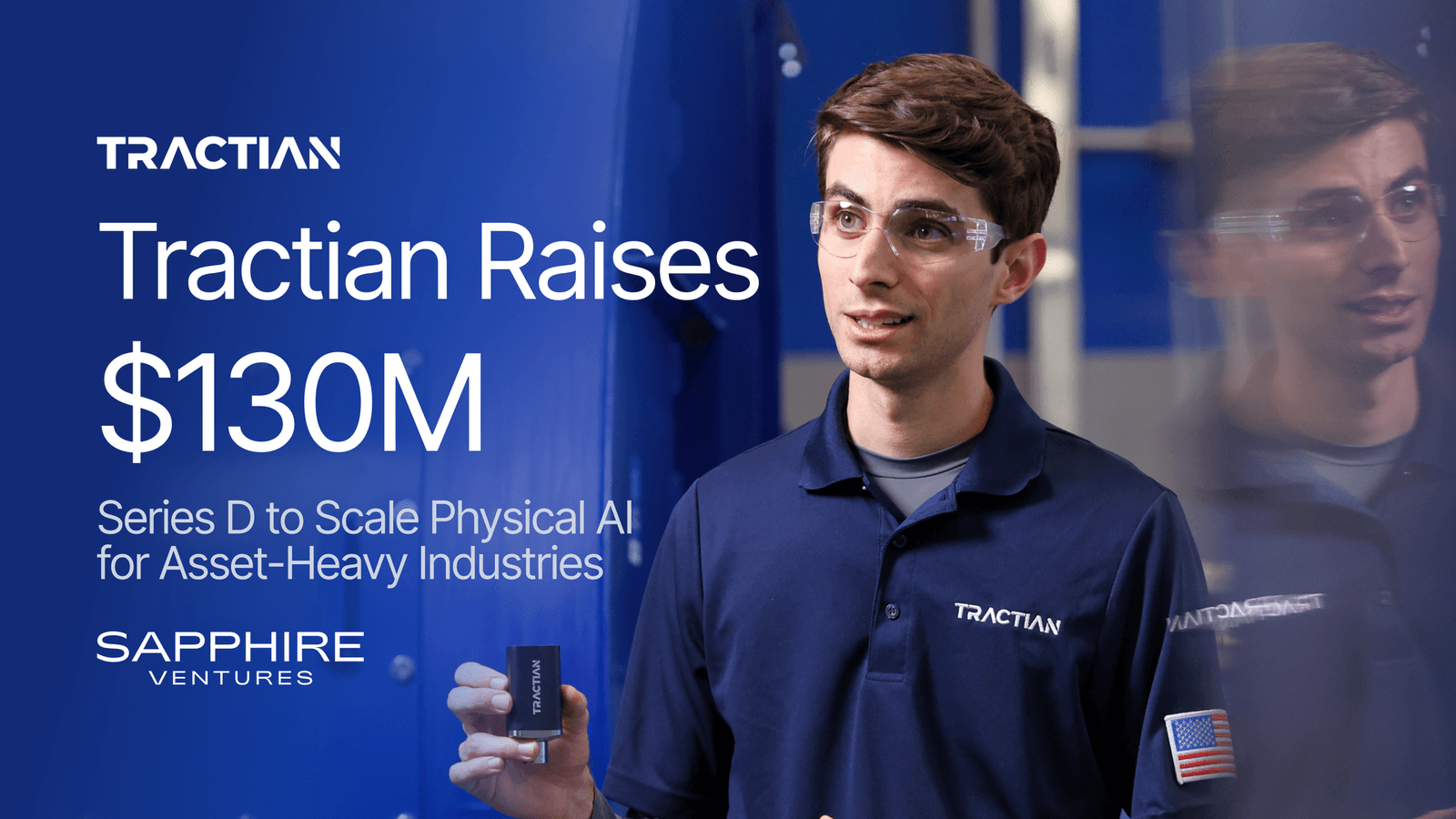
A factory rarely finds out a motor is dying until it stops. That single blind spot — equipment that runs with no instrumentation at all — is what Tractian just raised a fortune to kill. The company closed a $130M Series D that values it at $1.4 billion, graduating a Y Combinator startup into the small club of industrial unicorns.
The headline is the valuation. The more interesting number sits in the problem statement, and I'll get to why it dwarfs everything else below.
Congrats to @igmarinelli, Gabriel, and @Tractian (W21) on their $130M Series D at a $1.4B valuation!
— Y Combinator (@ycombinator) October 22, 2026
Tractian builds sensors and AI that predict when industrial machines will fail, before they do.
Most industrial equipment has no instrumentation at all, so factories find out… pic.twitter.com/eevWLl1LkU
$130M
Series D round raised
$1.4B
Post-round valuation
2,000+
Critical facilities using it
700+
Employees worldwide
What "physical AI" actually means here
Most AI you read about lives in a browser. Tractian's lives on a machine. Y Combinator put it plainly: Tractian builds sensors and AI that predict when industrial machines will fail, before they do.
The trick is in the data source. According to the company, its platform leverages vibration, ultrasound and other sensor modalities to sample machine data across a vast array of variables at once. A failing bearing or a misaligned shaft gives itself away long before it breaks — it hums at a slightly wrong frequency, it runs a few degrees hot. Humans miss those signals. A sensor sampling continuously does not.
Think of it as a heart-rate monitor for a pump. The pump looks fine from across the floor; the waveform says a valve is three weeks from failure. That shift — from reacting to a breakdown to seeing it coming — is the whole pitch. Mecka is chasing an adjacent version of the same insight: its Series B bet that robots need richer physical-world data to navigate reliably rests on the same premise that the physical world is chronically under-instrumented.
The number that makes $1.4 billion look small
Here is the figure the company is really selling against. Unplanned downtime costs the world's 500 largest industrial companies about $1.4 trillion a year (per Siemens' True Cost of Downtime report, January 2026).
Sit with that. Tractian's entire $1.4 billion valuation is a rounding error against the annual bill it wants to cut. The round it just raised — $130M — wouldn't cover a single morning of that global loss. When a market is that large, a vendor doesn't need to dominate it; capturing a sliver is enough to justify a far bigger valuation than this one.
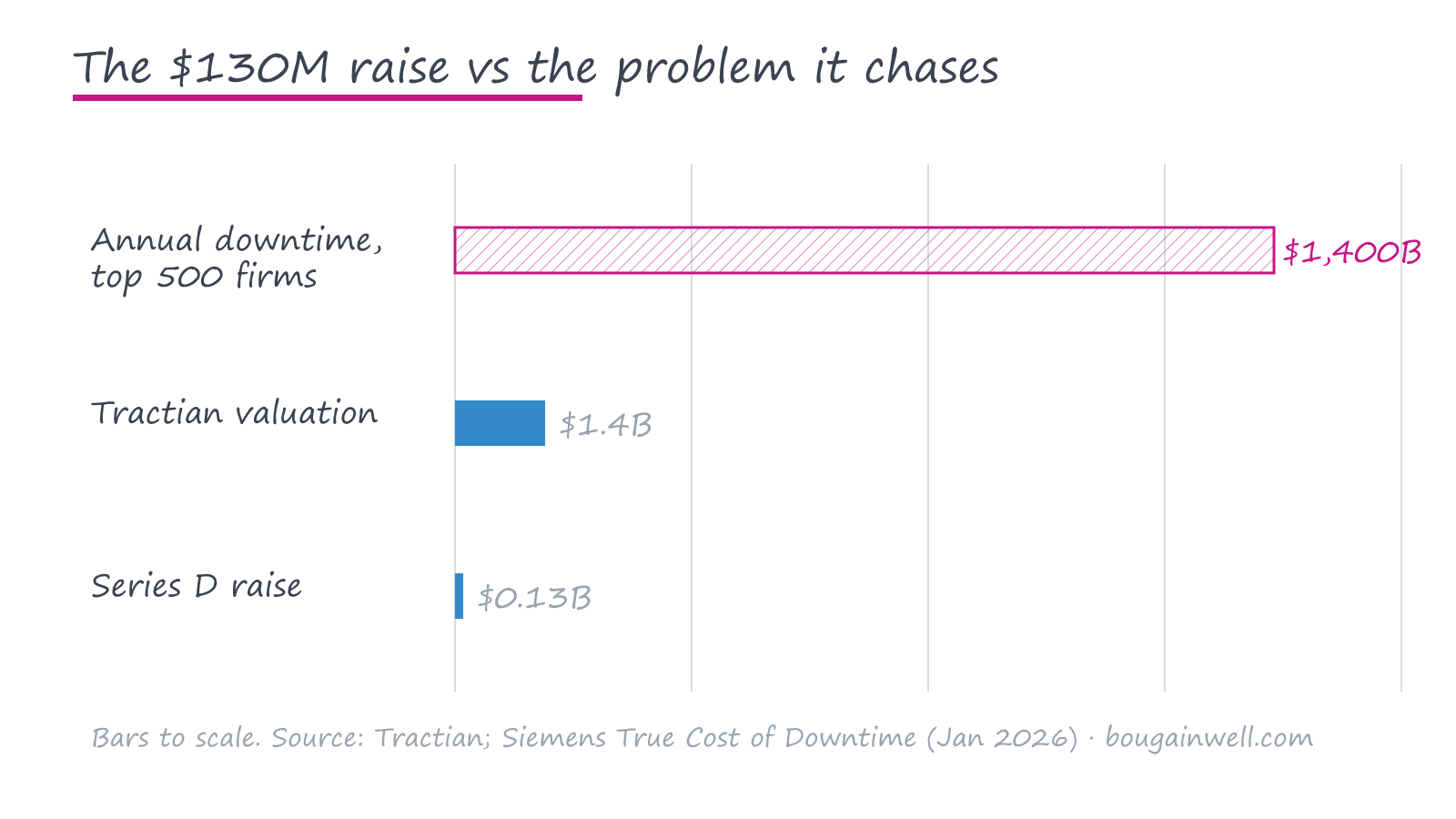 The prize is three orders of magnitude bigger than the company chasing it. (Chart: BougainWell · Data: Tractian; Siemens True Cost of Downtime, Jan 2026)
That scale is why the money showed up.
Who is writing the checks — and why it matters
The round was led by Sapphire Ventures and co-led with M&G's Catalyst. That pairing tells you something. Sapphire is an enterprise-software specialist; M&G's Catalyst is a long-horizon capital arm. Neither is a tourist chasing a consumer-AI hype cycle. They are the kind of backers who underwrite slow, sticky, infrastructure businesses — the ones that compound over a decade rather than spike over a quarter.
Industrial software is exactly that: hard to win, brutal to rip out once installed. A sensor platform wired into 2,000-plus facilities becomes part of how those plants run. Churn in that world is low because switching means re-instrumenting the floor. Oxide Computer drew the same kind of long-horizon capital when it raised $445M to bring on-premises infrastructure back under enterprise control — patient money betting on physical infrastructure that is genuinely hard to replicate.
From a paper mill to a unicorn
The founding story is unusually literal. CEO and founder Igor Marinelli grew up watching the problem firsthand.
I grew up watching my father work as a maintenance technician at a paper mill, and I saw how backwards the tools were for the people keeping those machines alive.
He and co-founder Gabriel took that frustration through Y Combinator's W21 batch. Five years on, the company says more than 2,000 critical facilities worldwide rely on its technology, and it employs more than 700 people. That is not a lab experiment; it is a deployed fleet of hardware and software running inside live operations.
Why this round is a signal, not just a milestone
The broader read: capital is rotating toward AI that touches the physical world. For two years the money chased chatbots and copilots. A sensor company winning a $130M round at a $1.4B valuation says investors now want AI with a plant floor underneath it — where the data is proprietary, the moat is physical, and the savings land on a CFO's spreadsheet as avoided downtime.
That is a harder business to build than a web app. It is also much harder for a rival to copy once the sensors are bolted on.
What to Take Away
- Tractian raised $130M at a $1.4 billion valuation, turning a Y Combinator W21 startup into an industrial unicorn.
- The company's pitch is physical AI — vibration, ultrasound and other sensors feeding models that predict machine failure before it happens.
- The market it chases is enormous: unplanned downtime costs the top 500 industrial firms about $1.4 trillion a year, making the valuation look modest against the prize.
- Sapphire Ventures and M&G's Catalyst led the round — enterprise and long-horizon money, not hype capital.
- With 2,000+ facilities and 700+ employees, this is a deployed fleet, so track installed base and churn, not the headline valuation.
Chart(s): BougainWell, built from Tractian and Siemens (True Cost of Downtime, Jan 2026). This article is for general information only and is not investment advice.
Sources
All analysis and opinions in this article are BougainWell's own.
Cover image: Tractian, via their Series D announcement post.