An AI agent can write your code, draft your email and book your travel — but it has no idea what was decided in last week's strategy call, or why your team killed a feature in March. Scuba, which left stealth on October 13 with $34 million in total funding, is a bet that the missing piece in the agent era is not a smarter model. It is memory.
Introducing Scuba, the shared context engine for teams and their agents.
— Scuba (@withscuba) October 13, 2026
Never lose a great idea. Capture anything, share what matters, and keep your people and agents aligned as you move faster together.
We’re emerging from stealth with $34M. pic.twitter.com/UB0D10hPVn
The founders tell you the thesis
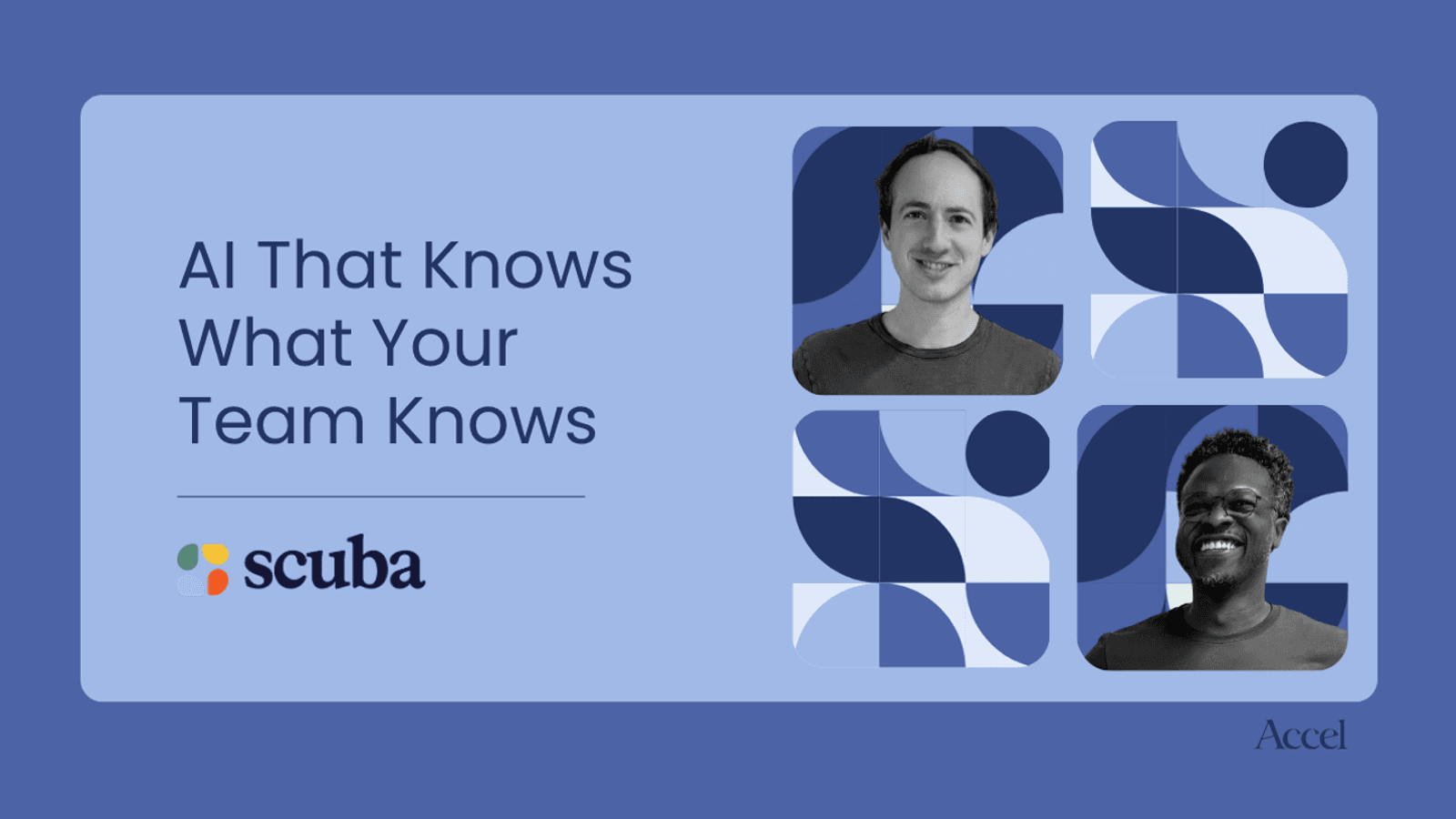
Scuba's two founders spent years inside the tool most teams use to talk to each other. Noah Desai Weiss was Chief Product Officer at Slack; Dolapo Falola was Head of Engineering at The Browser Company, and before that also worked at Slack. Two people who built the rooms where teams coordinate are now betting those rooms have a blind spot.
The blind spot is this: the chatter, the half-decisions and the institutional why all live in people's heads and scattered threads. A human colleague picks that up over months. An AI agent starts every task from zero. Scuba's pitch — in its own words, the shared context engine for teams and their agents — is to close that gap for both sides at once.
What a "context engine" is, and what it is not
The word engine is doing real work here, and it is worth separating from two things it sounds like.
A note-taking app stores what you deliberately write down. The burden is on you: open it, title the note, file it, remember it exists later. Most team knowledge never survives that tax, which is why wikis rot.
A vector database is the plumbing underneath — it turns documents into math so a model can retrieve the nearest match to a question. Useful, but dumb on its own: it only knows the documents you have already fed it, and it has no view of who decided what, when, or whether the decision still holds.
A context engine sits above both. Scuba says it captures that context in one click and makes it available when people need it — the capture is low-effort by design, and the payoff is that the same memory serves a human looking something up and an agent about to act. That is the distinction that matters: not another place to store notes, but a live layer that both your people and your software read from.
Why investors wrote a $34M check before the public saw the product
Accel led the pre-seed round, and the full $34 million arriving at stealth exit is unusually large for a company most people had never heard of a day earlier — the kind of pre-product conviction bet that has lately gone to teams like Oxide, which raised $445M to sell computers you own. Two things explain the size.
First, the founders. A former Slack CPO and a former Browser Company engineering lead are a known-quantity team in exactly the workflow-software problem Scuba is attacking — the kind of pairing that gets funded on reputation before a demo.
Second, the thesis. Scuba's founders argue that as AI agents move from demos into live team workflows, the binding constraint shifts from model capability to grounding — giving the agent the specific, current, team-level facts it needs to be trusted. Whoever owns that memory layer owns a position between every team and every agent it runs. That is what a large early round is paying for.
The signal worth watching: usage, not the headline number
The $34 million is the number everyone will repeat, but it is not the one that tells you whether this works. The number to watch is that hundreds of early beta users already rely on Scuba — to develop company and product strategy, track customer feedback and cut down on meetings.
That last use is the tell. If a context layer genuinely reduces meetings, it is doing the expensive human work of keeping everyone aligned — the exact problem Slack's founders spent a decade on. It also speaks to a gap Scuba is implicitly targeting: the one where AI lifts a single power user but not the whole team. Funding is a bet; retention from real teams is evidence.
What to Take Away
- The agent bottleneck is moving from models to memory. Scuba's entire $34M bet is that the hard part is no longer how smart the model is, but whether it knows what your team knows.
- A context engine is not a notes app or a vector database. It captures context with near-zero effort and serves it to humans and agents from the same layer — that dual audience is the whole point.
- Founder pedigree moved this round. An ex-Slack CPO and a former Browser Company engineering lead got a large pre-seed, Accel-led, largely on track record in workflow software.
- Watch usage, not the check. Hundreds of beta teams already using it — and the claim that it cuts meetings — is the real early signal; the funding figure is just the entry ticket.
All analysis and opinions in this article are BougainWell's own.
Cover image: Accel, via its announcement "AI That Knows What Your Team Knows."