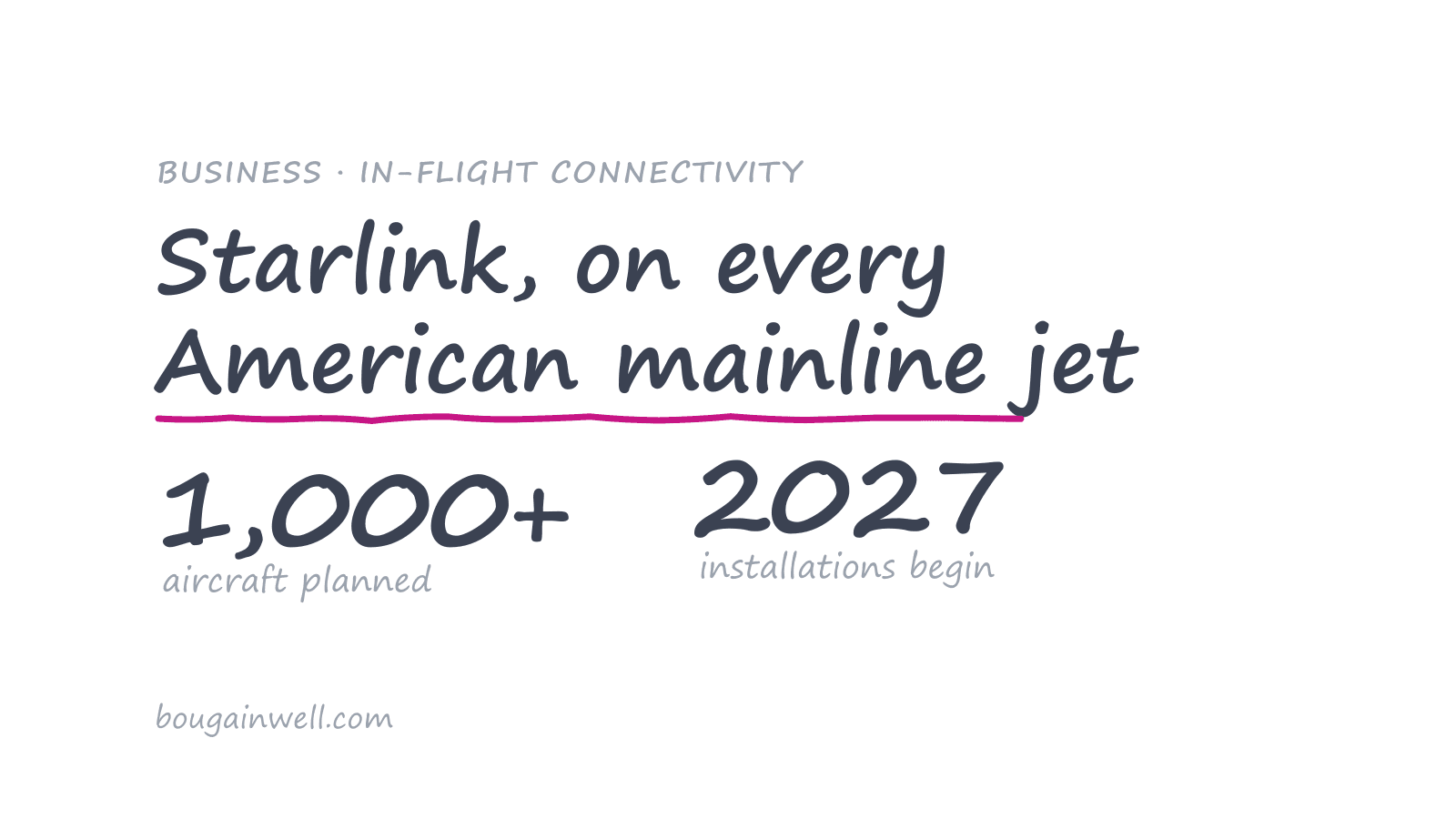
American Airlines just made in-flight Wi-Fi a whole-fleet decision. It will fit SpaceX's Starlink to its entire mainline fleet — more than 1,000 aircraft — with installation beginning in 2027. Airlines usually roll connectivity out cabin by cabin and route by route. Committing the whole fleet at once is a different kind of move, and that is the story.
Full fleet. Full speed. Full connection. ✈️
— americanair (@AmericanAir) October 8, 2026
We're bringing Starlink to our entire mainline fleet, and will be one of the world's largest Starlink-connected airlines. With more than 1,000 aircraft planned for installation beginning in 2027, we're taking connectivity to new… pic.twitter.com/oRoYyCI1Q2
From a feature to a standard
Here is the quiet pivot worth noticing. Airlines usually treat connectivity as a feature you add to some cabins and some routes — business class first, long-haul first, and the rest whenever the budget allows. Fast Wi-Fi has been something you check before you book, not something you assume.
Extending Starlink across the entire mainline fleet of more than 1,000 aircraft reclassifies Wi-Fi from a feature into a baseline. The signal is simple: American no longer wants connectivity to be a differentiator you shop for. It wants it to be a thing you assume, the way you assume the plane has seatbelts and a tray table.
That is a different kind of bet. A feature can be rolled out slowly and quietly dropped. A standard has to work on the oldest narrowbody and the newest widebody alike, which is why committing the whole fleet — not the premium slice of it — is the harder and more telling move.
Why the scale is the signal
The number that matters is the scope. Committing more than 1,000 aircraft to a single connectivity platform is not a trial and not a premium-cabin perk — it is a declaration that American intends to be, in its own words, one of the world's largest Starlink-connected airlines.
Airlines do not commit a fleetwide retrofit on a whim. The hardware, the certification path per aircraft type, and the installation slots all have to line up before a program of that size can even start. Choosing to equip the entire mainline fleet, rather than hedging with a partial rollout, says the economics and the customer reaction were convincing enough to go all in.
Why low-earth-orbit changes the pitch
The reason American can even talk about a full-fleet standard is that the underlying technology finally makes a fleetwide promise plausible instead of aspirational. Low-earth-orbit satellite internet closes the gap that made plane Wi-Fi a punchline for two decades: high latency and thin bandwidth from distant geostationary satellites.
Once one large carrier makes fast, free-feeling connectivity a fleet default, it stops being a differentiator and starts being table stakes. Rivals then face a choice between matching it and explaining to customers why they didn't. That competitive logic is what turns a single airline's hardware decision into a sector-wide expectation.
The cost backdrop every airline is flying through
A fleetwide Starlink retrofit is a capital decision made in a tight-margin business, and right now the margins are being squeezed from the fuel side. The clearest public read on that pressure comes from Delta Air Lines' most recent quarter.
Delta reported earnings of $1.72 per share for the September 2026 quarter while absorbing more than $500 million of higher fuel costs than it had guided to in early July. Its adjusted fuel price of $3.61 per gallon rose 60% year-over-year. These are Delta's own official figures, and they are not a comment on American — but they sketch the environment every U.S. carrier is operating in.
That is the tension sitting underneath the announcement. Connectivity upgrades compete for capital with everything else, in an industry where a single quarter's fuel swing can run past half a billion dollars. An airline choosing to equip its entire fleet in that climate is making a bet that connectivity drives enough loyalty, booking preference and ancillary value to earn its place in the budget.
Who this is really aimed at
Free, fast, everywhere Wi-Fi is a loyalty play dressed as an amenity. The traveler who notices it most is the frequent flyer — the one who works in the air, whose employer or whose own habit sends them through an airline's hub dozens of times a year, and who will quietly re-route around a carrier whose Wi-Fi is unreliable.
Make connectivity a fleet constant and you remove a reason to defect. That is the mechanism. The passenger doesn't experience it as a strategy; they experience it as it just works, every flight. The airline experiences it as stickiness. Over a fleet of more than 1,000 aircraft flying millions of passengers, small stickiness compounds.
What to Take Away
- The scale is the signal. American is putting Starlink on its entire mainline fleet — more than 1,000 aircraft — not a premium slice, which turns connectivity into something passengers assume rather than shop for.
- This reclassifies Wi-Fi from feature to baseline. A standard has to work on the oldest and newest jets alike, which is why a whole-fleet commitment is harder and more telling than a partial rollout.
- It's a capital bet made into fuel-cost headwinds. Delta's quarter — $1.72 EPS, fuel at $3.61 per gallon, up 60% year-over-year and more than $500 million above its own July guidance — shows the cost climate any carrier is spending into right now.
- Watch the timeline, not just the press release. Installation begins in 2027; a fleetwide retrofit of 1,000-plus jets is a multi-year job, so "connected" is a destination, not a launch date.
Cover image: BougainWell title card. This article is for general information only and is not financial advice.
Sources
All analysis and opinions in this article are BougainWell's own.