Goldman Sachs reported net revenues of $18.68 billion for the third quarter of 2026 — and the market had been penciling in $16.71 billion. That is a beat of about 11.8%, which in a business this large is not a rounding error. The more interesting question is where the money actually came from.
The easy narrative is that dealmaking is back. The real story is that the trading floor did the heavy lifting.
GOLDMAN SACHS $GS JUST REPORTED Q3 EARNINGS
— WOLF (@WOLF_Financial) October 13, 2026
- Revenue: $18.68B, beating est. of $16.71B 🟢
- EPS: $17.01, beating est. of $13.02 🟢
- Equities: $6.44B (+72% YoY)
- FICC: $3.47B (flat YoY)
- IB Fees: $3.22B (+21% YoY)
- Provision for Credit Losses: $368M (+9% YoY)
- Banking &… pic.twitter.com/DCHMBH78ZA
$18.68B
Net revenues, Q3 2026 — up 23% year over year
$17.01
Diluted EPS, a ~31% beat on the $13.02 estimate
+72%
Equities revenue growth versus Q3 2025
$4,097B
Total assets under supervision
The beat, in plain terms
Two numbers framed the quarter. Revenue of $18.68 billion topped the $16.71 billion estimate, and diluted EPS of $17.01 crushed the $13.02 that analysts expected — a beat of roughly 31%. When earnings per share come in nearly a third above consensus, it usually means costs behaved and a volatile line item ran hot. Here, it was the second.
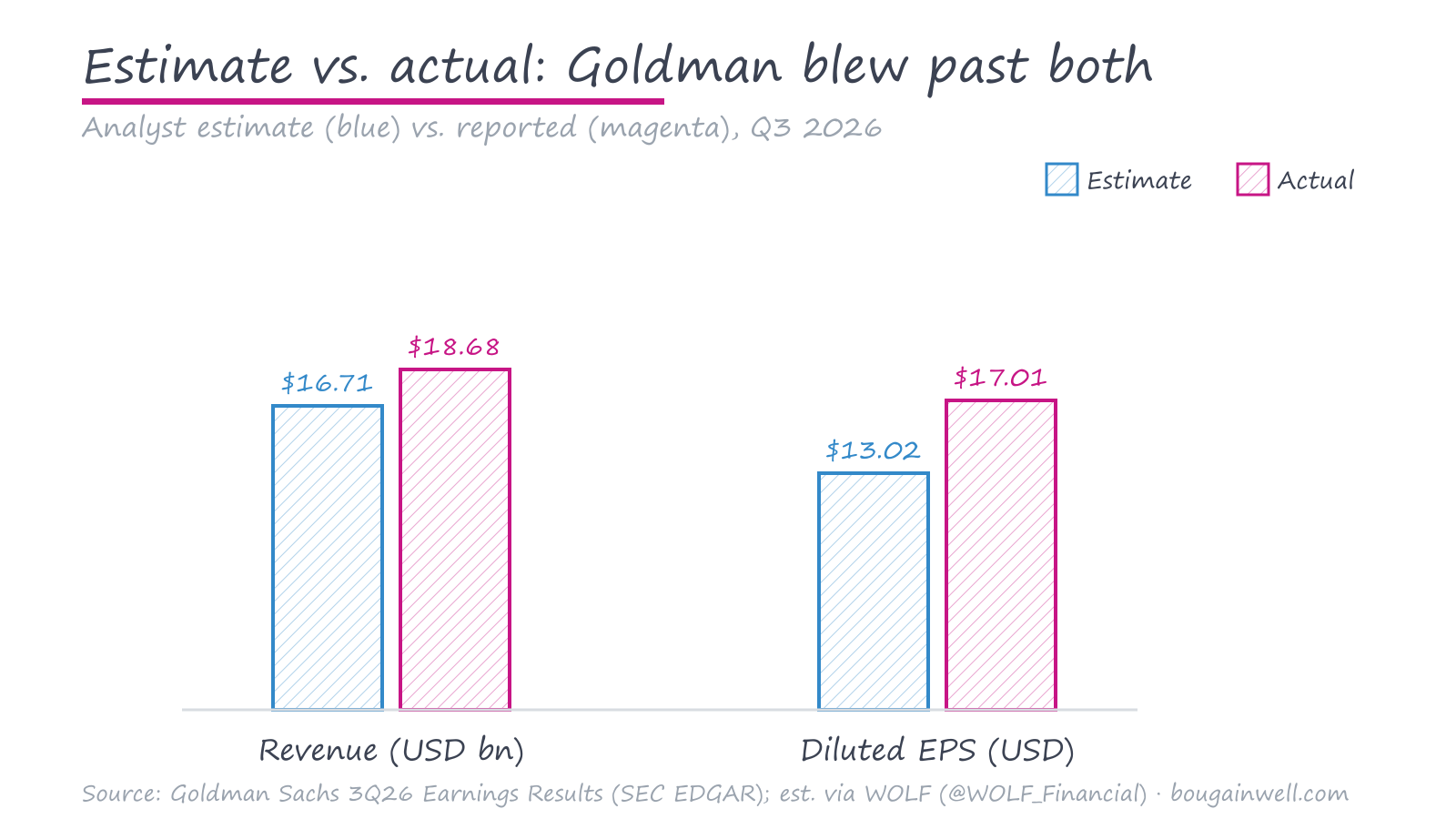 Goldman cleared both bars comfortably, with the EPS gap wider than the revenue gap. (Chart: BougainWell · Data: Goldman Sachs 3Q26 Earnings Results, SEC EDGAR)
Revenue up 23% from a year earlier is strong. An EPS beat that outruns the revenue beat tells you the extra dollars landed in a high-margin business — one where a good quarter drops almost straight to the bottom line. That business was trading.
Why equities, not advisory, is the real headline
Net revenues in Equities were $6.44 billion, 72% higher than the third quarter of 2025. That single line is the engine of the quarter. For comparison, Fixed Income, Currency and Commodities (FICC) brought in $3.47 billion and was essentially flat year over year.
Put those side by side and the pattern is obvious: client activity in stocks surged while the bond-and-rates side idled. Equities alone made up about 48% of the $13.46 billion Goldman earned across its entire Global Banking Markets division.
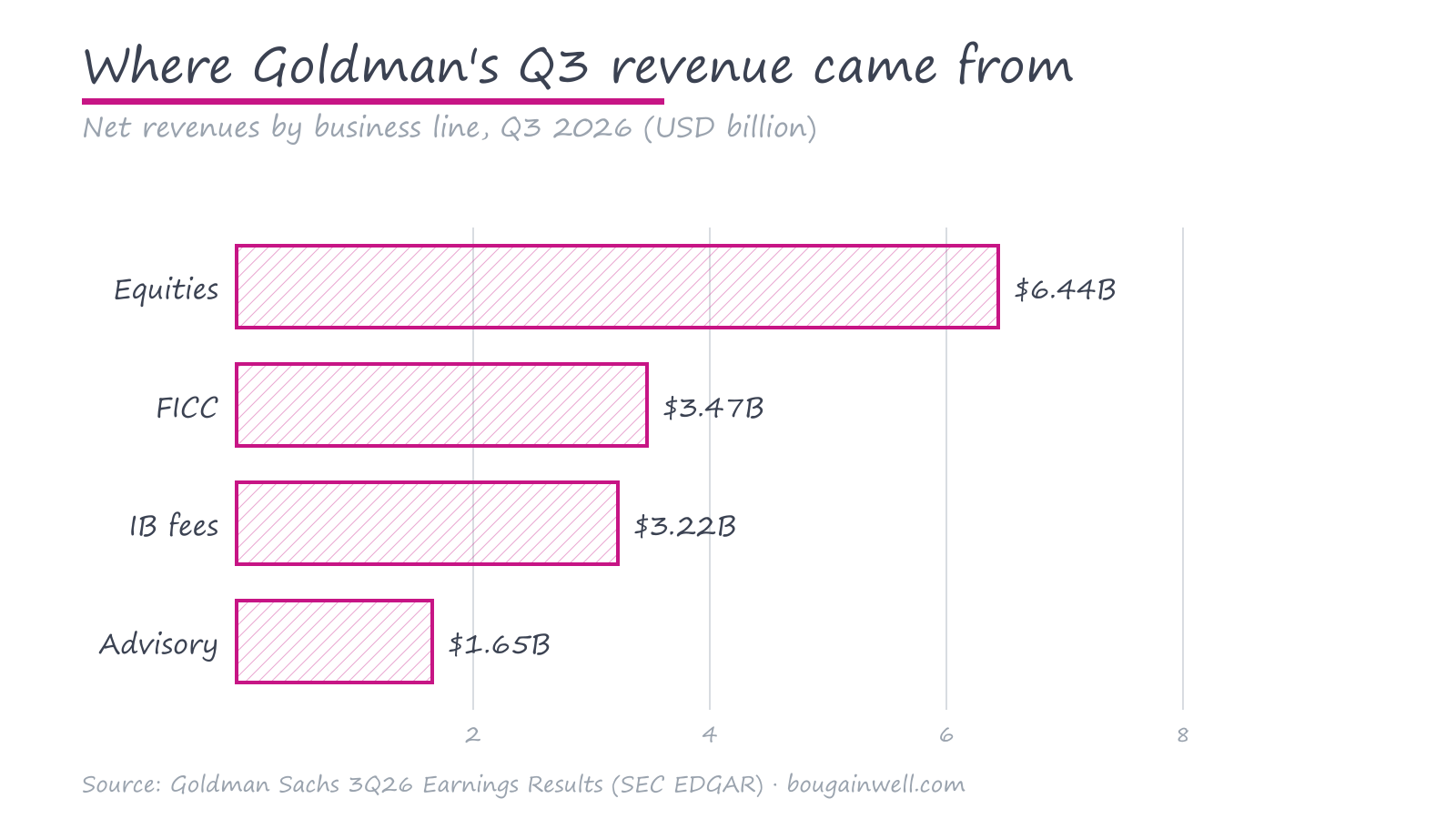 Equities dwarfed every other revenue line, bringing in nearly four times what advisory did. (Chart: BougainWell · Data: Goldman Sachs 3Q26 Earnings Results, SEC EDGAR)
Here is the catch I flagged up top. Advisory — the fees Goldman earns for guiding mergers and acquisitions — grew a far more modest 18% to $1,654 million. That is healthy, but it is not the breakout line. Investment banking fees overall reached $3.22 billion. Solid, steady, and dwarfed by a trading desk that nearly doubled its take.
So is the M&A machine really roaring back?
You will read that Wall Street's dealmaking cycle is back at full throttle. The IMF's October 2026 growth outlook frames the macro backdrop: uneven growth across regions shapes the deal pipeline Goldman depends on. Read that as one interpretation of these numbers, not a forecast. The data supports a more careful reading: advisory and banking fees are recovering at a double-digit clip, which is good, while the explosive growth is in trading — a business that lives and dies by market volatility and is far harder to extrapolate.
A back-of-envelope check makes the point. Equities grew 72% year over year; advisory grew 18%. If you want a durable, fee-based recovery story, the smaller, steadier number is the one to watch — because trading revenue of this size tends to arrive in bursts, not in a straight line.
The wealth side kept compounding quietly
Away from the trading floor, Goldman's asset and wealth franchise kept gathering money. Total assets under supervision reached $4,097 billion — $4.097 trillion — at September 30, 2026.
Why it matters: fee income on supervised assets is the opposite of trading revenue. OpenAI's move to put ChatGPT directly into investment banking workflows points to where wealth and asset management costs may compress next — another tailwind for firms that manage at this scale. It is sticky, recurring, and barely moves quarter to quarter. The more of Goldman's revenue that leans on this base, the less the whole firm swings with the mood of the markets. A quarter where both the volatile engine and the steady one fired is about as clean as a bank print gets.
What to Take Away
- Goldman's Q3 2026 revenue of $18.68 billion beat estimates by about 11.8%, and EPS of $17.01 beat by roughly 31% — the EPS gap being wider is the tell that a high-margin line did the work.
- That line was Equities trading: $6.44 billion, up 72% year over year, versus a flat $3.47 billion in FICC.
- Advisory grew a steadier 18% to $1,654 million and banking fees to $3.22 billion — a recovery, but not the quarter's main event.
- Equities made up roughly 48% of Global Banking Markets revenue, concentrating the upside in the firm's most volatile business.
- Assets under supervision hit $4.097 trillion ($4,097 billion), the quiet, recurring counterweight to a loud trading quarter.
Chart(s): BougainWell, built from Goldman Sachs Third Quarter 2026 Earnings Results (SEC EDGAR). This article is for general information only and is not investment advice.
Sources
All analysis and opinions in this article are BougainWell's own.
Cover image: Goldman Sachs, via WOLF (@WOLF_Financial) on X.