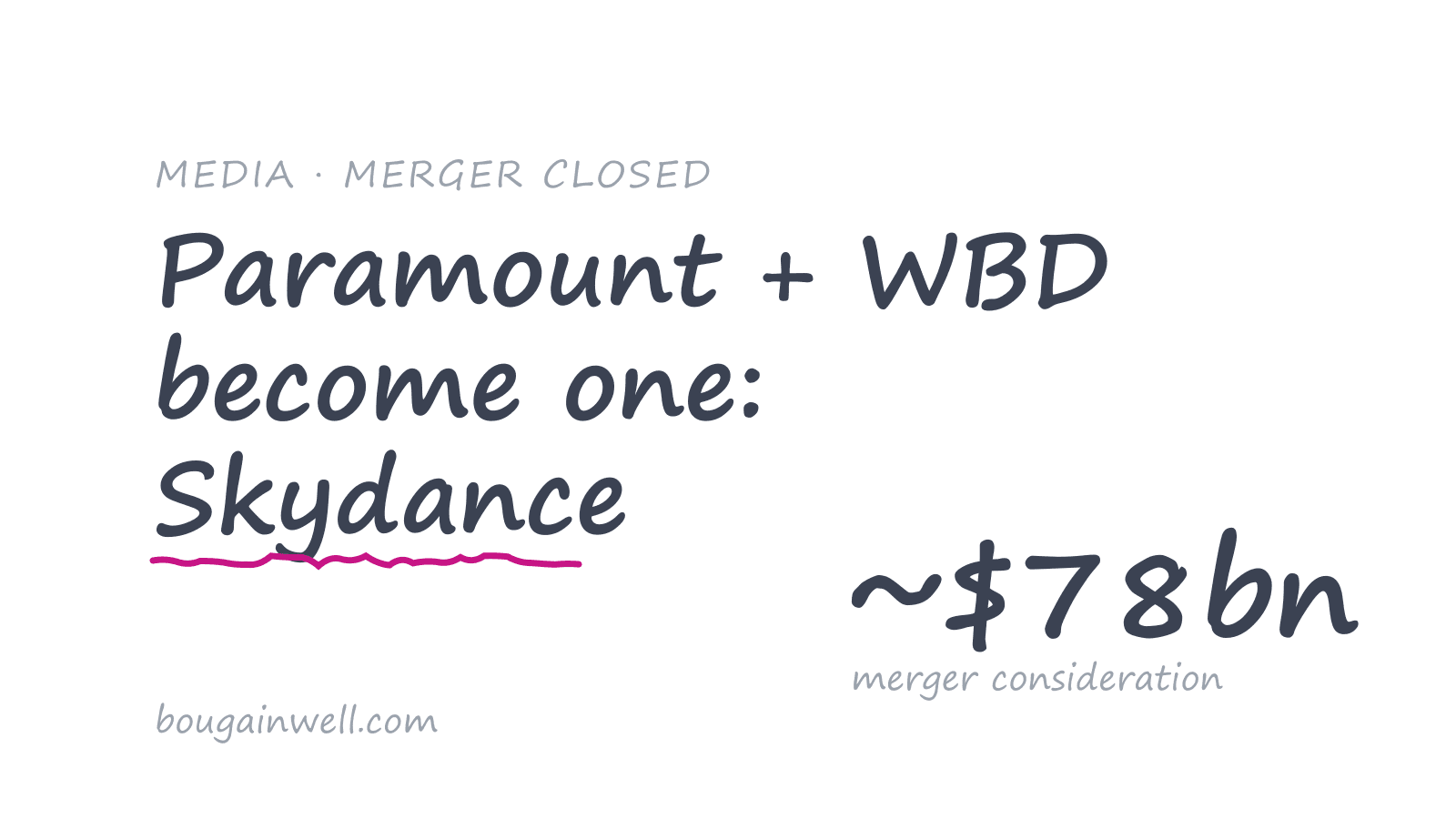
Two of the most storied names in Hollywood stopped being competitors on October 6. On that day Paramount Skydance completed its acquisition of Warner Bros. Discovery, and the merged business began life under a single name: Skydance. The combined company starts with nearly $70 billion in revenue, which puts it among the largest media and entertainment groups on the planet.
The headline is the brand swap. The number that tells you what really happened is the aggregate price the buyers agreed to pay — roughly $78 billion for a business that earns less than that in a year.
Today, we are Skydance. One team with a shared ambition to entertain, inspire, and inform the world through extraordinary storytelling. https://t.co/hdAJCYt0wm pic.twitter.com/Uoc99Y9srG
— Skydance (@Skydance) October 6, 2026
What Actually Closed
Mechanically, this was an acquisition that swallowed the larger brand. Warner Bros. Discovery became a wholly owned subsidiary of the acquirer, and the parent — formerly Paramount Skydance Corporation — now simply calls itself Skydance. WBD shares stopped trading on NASDAQ the same day, and Skydance Class B shares began trading on the New York Stock Exchange under a new ticker symbol, SKYD.
That ticker is just an identifier here. What matters for a business reader is that a two-step reshuffle is now one balance sheet, one strategy, and one management team answering to one board.
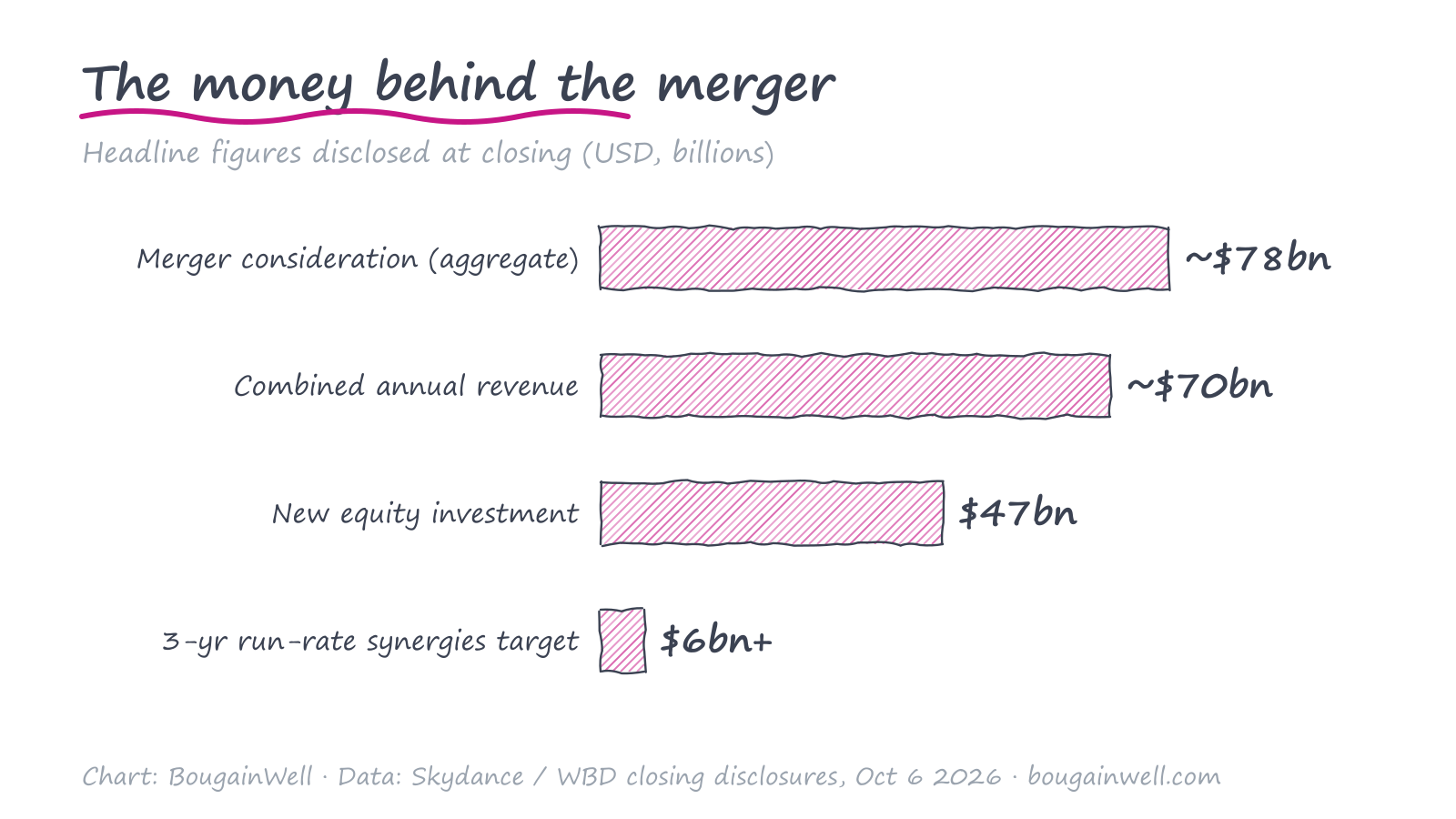 Four numbers frame the deal. The consideration paid is larger than the revenue the business generates in a year. (Chart: BougainWell · Data: Skydance / WBD closing disclosures)
The Price Tells You What the Buyers Are Really Paying For
Warner Bros. Discovery shareholders received a cash payment under the merger terms. Multiply that out across WBD's entire equity base and the aggregate merger consideration comes to approximately $78 billion, funded by a combination of equity and debt financing.
Note the shape of that. The price paid is larger than the roughly $70 billion of revenue the combined company produces in a year. Buyers are paying for the library, the franchises, and the future — not this year's sales. When a price runs ahead of annual revenue, the bet is on what the assets throw off for years to come, not on what they booked last quarter.
Who Put Up the Cash
A deal this size does not get financed on hope. The transaction included $47 billion of new equity investment in Class B Common Stock, with the Ellison family, RedBird, Saudi Arabia's Public Investment Fund, L'IMAD, the Qatar Investment Authority and LionTree among the backers.
The takeaway for anyone watching media consolidation: in our read, the capital behind the new Skydance is notably global, with sovereign wealth funds among the named backers. At this scale, top-tier entertainment is increasingly financed like strategic infrastructure.
Why Regulators Let It Through
Mega-mergers in media usually die in antitrust review or get hacked apart with divestitures. This one cleared cleanly. The company says the transaction received unanimous approval from competition authorities covering nearly 70 jurisdictions worldwide.
Seventy jurisdictions signing off without a fight tells you how regulators now see the market. The competition that worries them is no longer studio-versus-studio; it is traditional media against the streaming and technology giants that dwarf both Paramount and WBD — the same Meta and OpenAI whose spending now sets the pace across entertainment and software alike. Against that backdrop, two legacy studios combining reads to regulators as a stronger challenger forming, not a monopoly closing.
The Plan: One Streaming Service, Eventually
Here is the forward-looking part, and it needs to be read as a stated plan rather than a settled outcome. The company says consumers can expect improvements to its direct-to-consumer streaming products, which will unify into a single service over time. It is not promising it tomorrow; it is naming a direction.
Why does that matter? Because the hardest problem in streaming is not making shows — it is the cost of running duplicate technology stacks, duplicate marketing, and duplicate subscriber-acquisition machines. Skydance starts with 200+ million streaming subscribers across platforms. Collapsing several apps into one is how you stop paying twice for the same customer, and it is where much of the promised efficiency is meant to come from.
On that efficiency: the company says it is targeting $6 billion-plus in run-rate synergies over the next three years. Synergies is a word to treat with caution — across deals of this kind it can mean genuine duplication savings or headcount reductions — but the figure signals how much overlap management believes exists between two organisations that until last week were doing many of the same things in parallel.
What the Company Says It Will Make
Scale only matters if it turns into output. The company has set enhanced output commitments: a minimum of 30 high-quality theatrical films per year and 180+ television shows and series. For context, those are the production targets of a group that now controls one of the deepest film and television libraries in the business.
David Ellison, Chairman and CEO of Skydance, framed the close in historic terms. In the company's statement he said: "Today is a historic day, not just for Skydance but for our entire industry." The ambition the company describes is to bring two legacy studios together into a single competitor with the reach to distribute across every platform.
So What? The Consolidation Signal
Step back from the paperwork and the pattern is clear. The entertainment industry spent a decade fragmenting into a dozen streaming apps, each burning cash for subscribers. The Skydance-WBD close is the counter-move: consolidation, on the theory that one large, well-capitalised competitor beats two mid-sized ones fighting the same tech platforms.
Whether that theory holds depends entirely on execution over the next three years — on whether a single streaming service actually materialises, and whether the promised synergies arrive as savings rather than as friction. The deal is done. The harder half of the story is just beginning.
What to Take Away
- The close is real and dated. Paramount Skydance completed its WBD acquisition on October 6, forming a single company named Skydance (NYSE: SKYD) with nearly $70 billion in revenue; WBD is now a wholly owned subsidiary.
- The price runs ahead of the revenue. The aggregate merger consideration of roughly $78 billion is larger than the combined company's annual revenue, which tells you the buyers are paying for the library and the franchises, not last year's sales.
- Scale over rivalry. The deal cleared competition authorities in nearly 70 jurisdictions, a sign regulators now see the real contest as legacy media versus streaming and tech giants, not studio versus studio.
- The streaming plan is a direction, not a date. The company says its direct-to-consumer products will unify into a single service over time, and is targeting $6 billion-plus in run-rate synergies over three years — targets to track, not results to bank.
- Follow the capital. The $47 billion of new equity came partly from sovereign wealth funds, a reminder that top-tier entertainment is now financed like strategic infrastructure.
Chart: BougainWell, built from Skydance and WBD closing disclosures. This article is for general information only and is not investment advice; nothing here is a recommendation to buy, hold or sell any security.
Sources
All analysis and opinions in this article are BougainWell's own.