For as long as chat assistants have existed, the deal was simple. You type a question, you get back a wall of text, and what you do with it is your problem. OpenAI just started quietly rewriting that deal. With GPT‑6 and Intelligent UI, the model — not you — now builds the format of an answer around the task instead of forcing every request into text.
That is a bigger change than another point on a benchmark, and it is the part worth thinking hard about.
GPT-6 and Intelligent UI, now rolling out in ChatGPT for everyone.
— OpenAI (@OpenAI) October 7, 2026
Intelligent UI in ChatGPT delivers fast, interactive answers that make everyday questions more visual, complex topics easier to grasp, and interactive tools for your task available on the spot. pic.twitter.com/XL2gDCPBwG
What's Actually Rolling Out
OpenAI announced that GPT‑6 and Intelligent UI are now rolling out in ChatGPT for everyone. In its own words: "Intelligent UI in ChatGPT delivers fast, interactive answers that make everyday questions more visual, complex topics easier to grasp, and interactive tools for your task available on the spot."
Strip the marketing and the mechanic is this: a response is no longer locked to one shape. With Intelligent UI, GPT‑6 can combine prose with graphics, tappable buttons, forms, charts and other interactive elements. The chat window stops being a transcript and starts being a surface.
The rollout is staged by who is paying. The release reaches Plus, Pro, Business and Enterprise users globally first, in the Chat tab, with Free and Go following the next day. Enterprise access remains subject to workplace admin settings — so if you are on a company account and don't see it, that is a toggle someone else controls.
The Shift Nobody's Naming: Who Chooses the Format
Here is our read, and it is the one to sit with. Until now, the interface contract put you in charge of form. You asked; the model answered in prose; if you wanted a table or a chart you said so. Intelligent UI inverts that. GPT‑6 now builds the format of an answer around the task instead of forcing every request into text.
Read that again. The model is choosing the container, not just the contents.
The feature list makes the inversion concrete. GPT‑6 chooses between side-by-side comparisons, diagrams, maps or a plain answer, and when plain text is the right call, it can still just give you text. The point is that the model is now making that choice on your behalf.
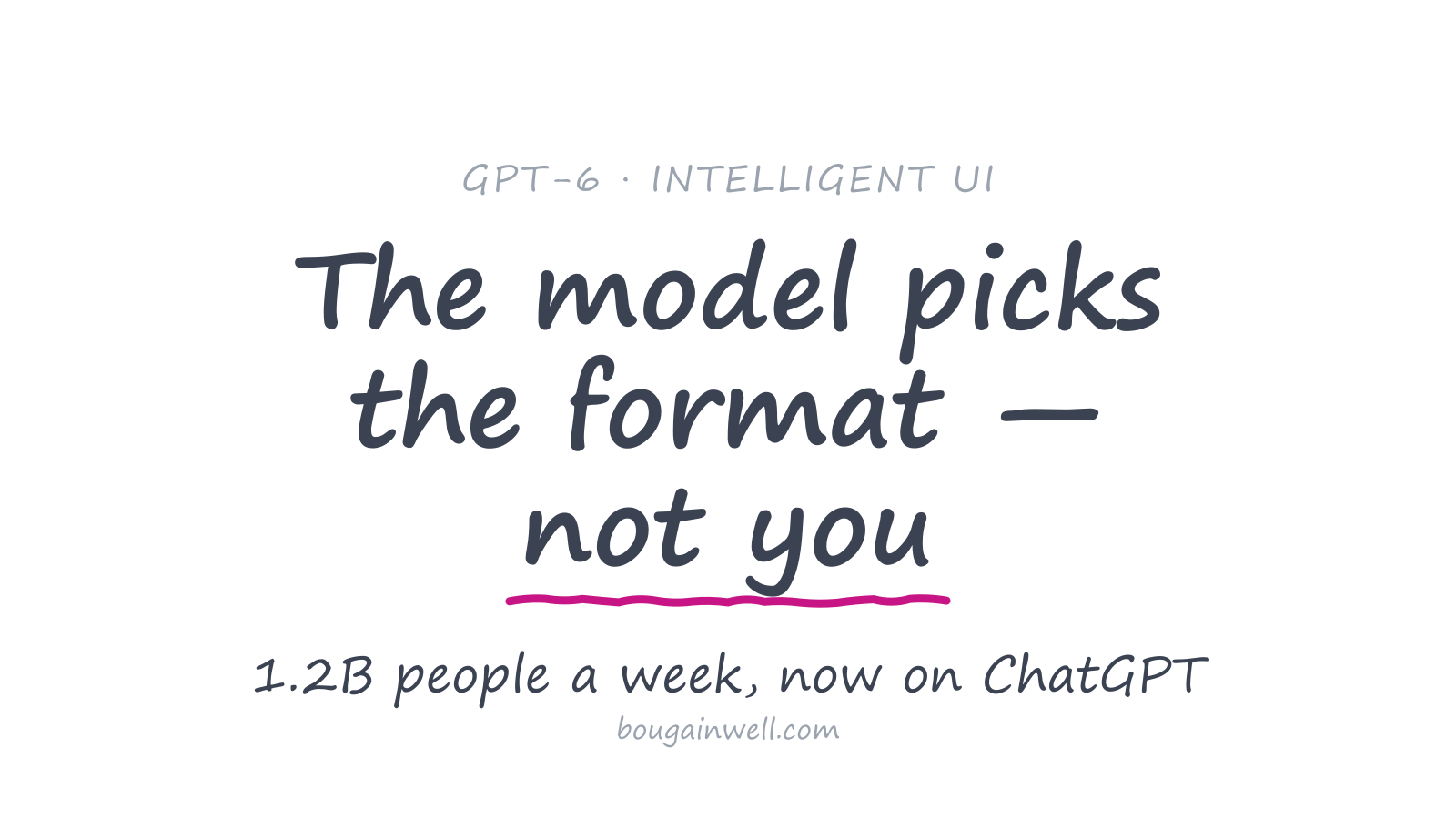 The quiet change: form moves from the user's hands to the model's. (Illustration: BougainWell)
Why does this matter beyond novelty? Because form is not neutral. A side-by-side comparison nudges you toward weighing options; a single highlighted number nudges you toward a decision; a form nudges you toward supplying more input. When the thing answering your question also frames how you see the answer, it gains a soft kind of editorial control over your thinking. That is not a swipe at OpenAI's intent — it is simply what happens when the generator and the presenter become the same system. We would watch it carefully rather than cheer or condemn it.
From Answers to Mini-Apps
The most eye-catching piece is that the conversation can now spin up working tools. Intelligent UI can create on-demand tools such as savings calculators, bill splitters and in-chat games.
Call them mini-apps. The significance is not any single one — it is that the unit of output is drifting from a text answer toward something you can operate. It is the same direction of travel we flagged when ChatGPT learned to listen while it talks: the assistant keeps gaining new shapes for a reply. A calculator you can poke at beats a paragraph explaining compound interest, for the same reason a map beats directions read aloud. If that holds up in practice, the mental model shifts from querying an oracle toward asking the assistant to build the small tool you needed.
Two Engines Behind One Feature
GPT‑6 in ChatGPT is not a single model. Paid tiers use GPT‑6 Sol, while Free and Go use GPT‑6 Luna, with both tuned for everyday conversation. Same feature name, two engines underneath, split along the paying line. (For the raw-capability side of the same family, see our read on GPT‑6 Astra and where its benchmarks run out.)
Our take: naming the two variants is more honest than pretending one model serves everyone, and it sets expectations — a free account and a Pro account share a surface but not necessarily the same engine. It also means any judgment about how good GPT‑6's Intelligent UI really is has to specify which engine drew the answer.
Why It Can Feel Fast
A format-choosing assistant has an obvious failure mode. If the model has to finish thinking, then design a layout, then render it, you would stare at a spinner. The described answer is to overlap the steps. GPT‑6 can start answering while it continues to think, interleaving reasoning with a series of useful partial responses intended to remain cohesive. Underneath, a compiler processes an interface while the model generates it, so the response appears progressively on web and mobile without waiting for the entire answer.
The payoff is about perceived speed, which is the only speed users feel. Streaming text already taught everyone that partial output arriving early feels faster than a complete answer arriving late. Extending that from words to whole interface elements — a chart drawing itself in as the model reasons — is how you make a richer, heavier response still feel immediate. It is a tacit admission that generating a live interface is expensive, and that the fix is as much psychological as technical.
The Scale That Makes This a Standard, Not an Experiment
One number reframes everything above. OpenAI is rolling GPT‑6 out across ChatGPT to a weekly audience of more than 1.2 billion people.
At that scale this stops being a feature and starts being a default. When more than a billion people a week are shown answers whose shape was chosen by a model, the idea that the AI picks the format quietly becomes the normal way a huge slice of the planet meets information. Interface conventions that reach a billion people tend to become the baseline everyone else is measured against. That is why we would file this launch as a change to the interface contract first and a model upgrade second — the model is the enabler, but the shift in who chooses the format is the story.
What to Take Away
- The headline isn't GPT‑6 — it's who picks the format. Intelligent UI moves the choice of text versus chart versus form versus tool from you to the model. That is a change in the interface contract, not just a new model.
- Form carries persuasion. When the system that answers you also frames the answer, it gains soft editorial control over how you read it. Useful, but worth noticing.
- Output is becoming tools, not text. Model-generated calculators, bill splitters and games signal a drift from an answer toward a small thing that does the task. Verify what a generated tool tells you before trusting it.
- Same feature, two engines. Paid tiers get GPT‑6 Sol; Free and Go get GPT‑6 Luna. Judge the experience by which one you are on.
- Scale makes it a standard. Reaching more than 1.2 billion weekly users, this is less an experiment than a new default for how people meet information.
Illustration: BougainWell. Cover image: OpenAI, via its Intelligent UI announcement. This article is for general information only.
Sources
All analysis and opinions in this article are BougainWell's own.