Every voice assistant you've ever used — Siri, Alexa, and until this week, ChatGPT — has a dirty secret: it's a walkie-talkie. You talk, it waits. It talks, you wait. Interrupt it and the illusion of conversation collapses.
OpenAI's new GPT-Live models, announced July 8 and rolling out in ChatGPT now, attack exactly that. The pitch is one word buried in the technical description — full-duplex — and it's worth understanding, because it's the difference between talking at a machine and talking with one.
Introducing GPT-Live, a new generation of voice models for natural human-AI interaction.
— OpenAI (@OpenAI) July 8, 2026
Rolling out in ChatGPT starting today.
You’ll want to turn the sound on for this one. pic.twitter.com/WzoQFvA5ir
The Launch at a Glance
Two versions are shipping: GPT-Live-1 becomes the default voice model for paid ChatGPT users, while GPT-Live-1 mini serves the free tier — across iOS, Android, and ChatGPT on the web.
What "Full-Duplex" Actually Means
The term comes from telecoms: a half-duplex channel (a walkie-talkie) carries sound one direction at a time; a full-duplex channel (a phone call) carries both directions at once.
Applied to AI, it means GPT-Live listens while it speaks. In practice, per OpenAI's description:
- It can murmur "mhmm" or "yeah" while you're talking — the little acknowledgement sounds linguists call backchannels, which signal "I'm following"
- You can cut it off mid-sentence and it adjusts, instead of bulldozing on
- It handles rapid back-and-forth exchanges
- And — the underrated one — it can stay quiet when you pause to think, rather than pouncing on every silence
So what? Human conversation is mostly timing. The words matter, but the rhythm — knowing when to jump in, when to hold back — is what makes an exchange feel natural or robotic. Until now, voice AI nailed the words and flunked the rhythm. Full-duplex is a bet that fixing the rhythm matters more for daily use than another few IQ points.
The Clever Part: A Receptionist With Specialists on Call
There's a real engineering tension in voice AI: the model must respond in a few hundred milliseconds to feel conversational, but deep reasoning takes seconds or minutes. You can't have both in one model — so GPT-Live doesn't try.
OpenAI says that for questions needing web search or heavier reasoning, GPT-Live delegates to the company's latest frontier model behind the scenes and weaves the answer back into the conversation when it's ready. Think of it as a receptionist with specialists on call: the voice you talk to is fast and personable, and the hard questions get quietly handed to the expert in the back office.
That architecture — a fast front-end model plus delegated heavyweight reasoning — is quietly becoming the standard pattern across the industry (it's the same shape as agent-and-sub-agents in coding tools). Expect every serious assistant to work this way within a year.
Voice mode also gains visual cards — weather, stocks, sports and similar topics now come back as rich on-screen panels alongside the spoken answer, which fixes voice AI's other classic weakness: some answers are just better seen than heard.
The Two Constraints: Timing and Price
Voice has a harder job than text on both ends. On timing: a chat reply that takes three seconds feels fine, but a three-second silence in a conversation feels broken — a voice model must think, decide and start speaking in a fraction of the time a text model gets. Full-duplex helps precisely here: because GPT-Live listens while it speaks, it can begin forming its response before you've fully finished, the way people actually converse.
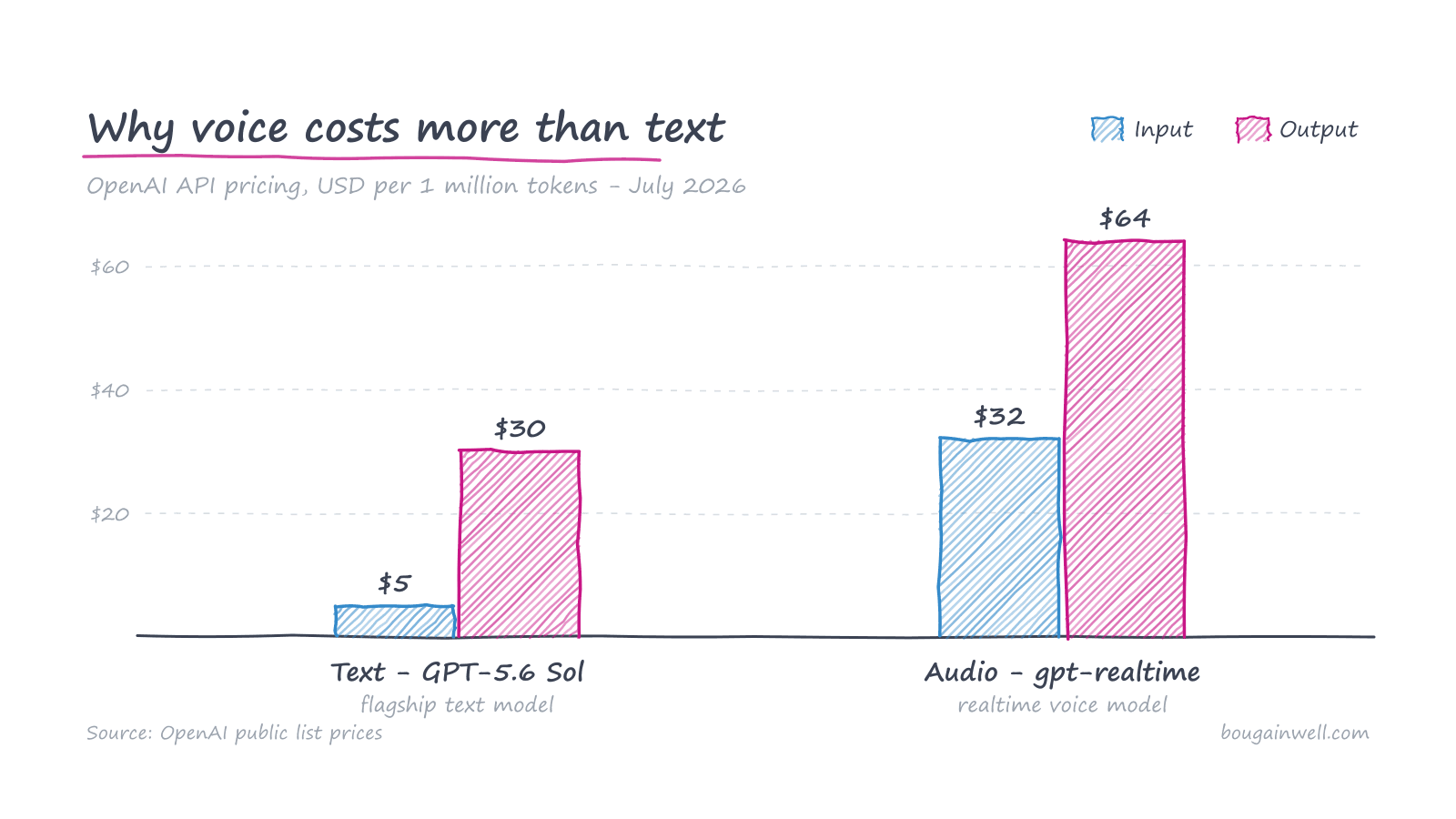
On price: OpenAI's own list prices tell the story. Audio tokens on its realtime voice model run $32 in / $64 out per million, against $5/$30 for its flagship text tier — speech carries far more data per word, and serving it live costs real compute. Keep that roughly 6× gap in mind; it quietly explains most of voice AI's product decisions, including the one in the next section.
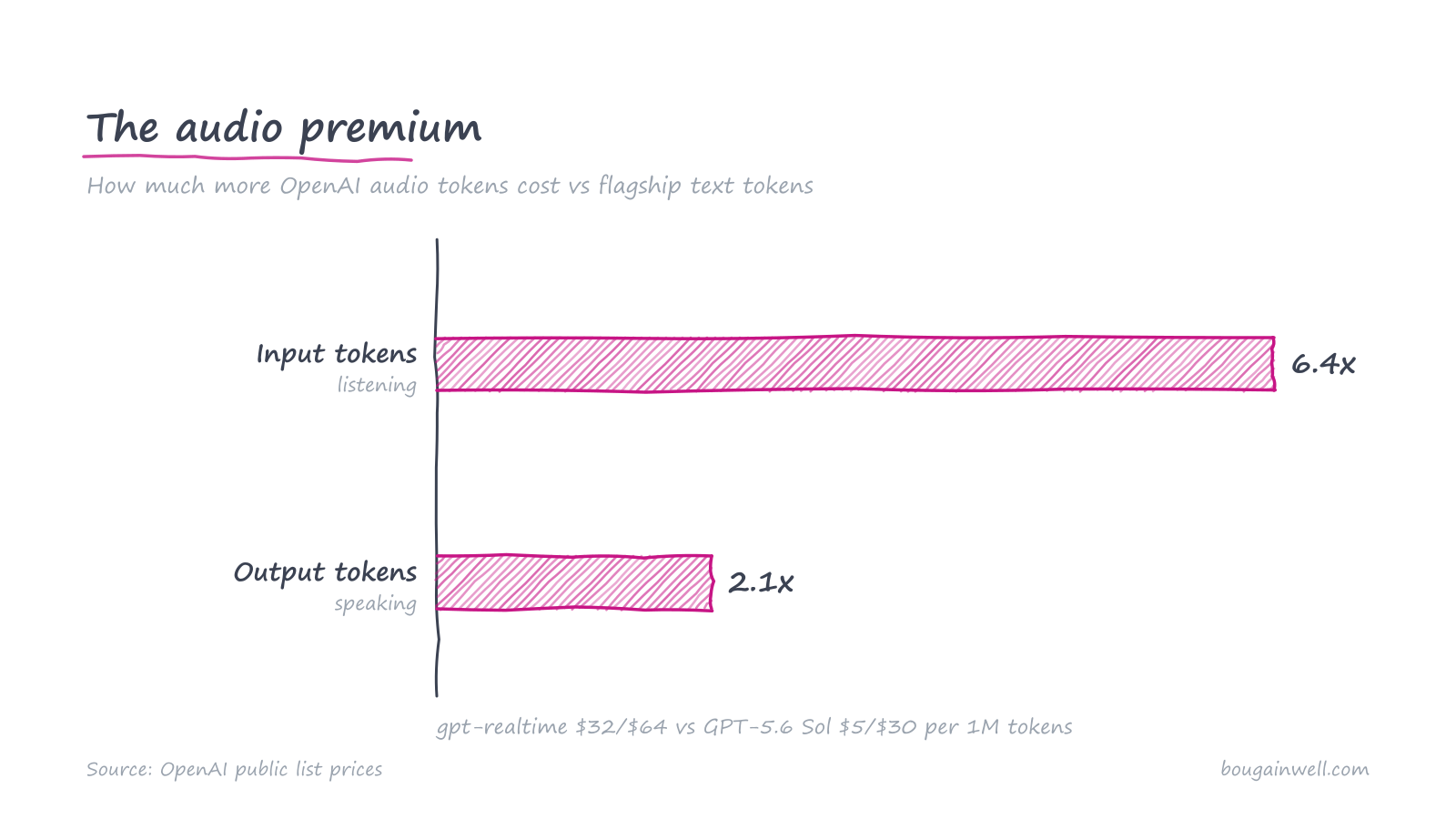 The surprise is on the input side: listening costs 6.4× text, speaking only 2.1×. (Chart: BougainWell · Data: OpenAI public list prices)
| Old voice mode | GPT-Live | |
|---|---|---|
| Turn-taking | Half-duplex (speak, then listen) | Full-duplex (both at once) |
| Interruptions | Awkward | Handled mid-sentence |
| Hard questions | Answered by the same model | Delegated to a frontier model |
| Visual answers | No | Cards for weather, stocks, sports |
| Who gets it | — | Paid: GPT-Live-1 · Free: mini |
One Catch for Developers
If you build voice products, note the fine print: GPT-Live is a ChatGPT feature only for now — there's no API. OpenAI says API access is coming "soon" with a sign-up list; in the meantime developers remain on the existing Realtime API, where audio is priced at $32 per million input tokens and $64 per million output tokens on the current gpt-realtime model.
That sequencing is strategic, not accidental: the consumer app gets the breakthrough first, making ChatGPT itself the demo. The audio token prices also hint at why — voice is expensive to serve, and OpenAI will want the compute story settled before opening the firehose to developers.
GPT-Live is rolling out gradually, so it may take days to reach your account, and launch-week latency and behavior claims come from OpenAI and early reports — real-world performance varies with network and region. If you're building on voice, benchmark the Realtime API yourself rather than waiting on "coming soon."
What to Take Away
- Full-duplex is the word to remember: the AI listens while it speaks — a phone call, not a walkie-talkie. Timing, not vocabulary, was voice AI's missing half.
- The receptionist pattern is the future of assistants: a fast voice model up front, a frontier reasoning model delegated to in the back. Speed where you feel it, depth where you need it.
- Full-duplex is a bet that timing beats brains for everyday voice use — expect every rival to copy the listen-while-speaking architecture within months.
- Free users get mini, paid users get GPT-Live-1 — the two-tier pattern (flagship for subscribers, distilled model for everyone) is now the default playbook for consumer AI launches.
- No API yet is a signal: audio tokens cost real money ($32/$64 per million on the current Realtime API), so expect consumer-first rollouts whenever serving costs are steep.
Chart: BougainWell, built from OpenAI's public list prices. This article is for general information only and is not investment advice.
Sources
All analysis and opinions in this article are BougainWell's own.