For three years, the deal with AI assistants was simple: you ask, it answers, you do the actual work. OpenAI's new ChatGPT Work tears up that deal. You hand it a goal; it goes away — for hours if it needs to — and comes back with the work done.
The announcement is short, but one phrase in it deserves more attention than the rest: ChatGPT Work is "powered by Codex and GPT-5.6." Codex is OpenAI's coding agent. Why would an assistant for everyday office work be built on a programmer's tool? Hold that question — the answer explains where this is all going.
Introducing ChatGPT Work, a new agent in ChatGPT powered by Codex and GPT-5.6.
— OpenAI (@OpenAI) July 9, 2026
It can take action across your apps and files, stay with a project for hours if needed, and turn a goal into finished work.
It’s a whole new way to get work done. pic.twitter.com/uGbvjU1LsV
The Launch at a Glance
The basics: ChatGPT Work lives inside ChatGPT on web, mobile and desktop. It launched for Pro, Enterprise and Edu plans first, with Plus and Business following within days. It rides on the newly released GPT-5.6 family and exposes adjustable effort levels, so a quick task doesn't burn flagship-level compute. And on desktop, Codex now lives inside the same ChatGPT app — chat, Work and Codex are one application on macOS and Windows.
From Answers to Deliverables — the Real Shift
Every AI product until now has mostly sold you better answers. ChatGPT Work sells you a different unit entirely: the finished deliverable. "Take action across your apps and files, stay with a project for hours, turn a goal into finished work" — that's not a chatbot's job description. That's a colleague's.
So what? The moment the unit of AI changes from answers to deliverables, the skill that matters changes too. Prompting was about phrasing a question well. Delegation is about something managers have always done: define the goal, provide the context, set the constraints, and review the result. The people who get the most out of this generation of AI won't be the best prompt-writers — they'll be the best delegators.
| Classic assistant | ChatGPT Work | |
|---|---|---|
| You give it | A question | A goal |
| It returns | An answer | Finished work |
| Time scale | Seconds | Minutes to hours |
| It touches | The chat window | Your apps and files |
| Your job | Do the work | Review the work |
Why It's Built on a Coding Engine
Now the question from the top: why is an office-work agent powered by Codex?
Because under the surface, almost all knowledge work is secretly file manipulation — and software is the universal tool for manipulating files. A spreadsheet is data plus formulas. A report is a structured document. "Update these figures across nine files" is, functionally, a batch-processing job. Coding agents spent the last two years learning exactly the skills this requires: operating for hours without losing the plot, using tools, checking their own output, and recovering from errors.
In other words, the coding agent was never really about code. Code was simply the training ground — the one domain where an agent's work could be automatically tested, which is how these systems learned to be reliable. ChatGPT Work is that reliability graduating from the terminal to the office. Expect every serious AI lab to follow the same route: prove the agent on code, then point it at everything else.
What "Effort Levels" Really Mean: a Cost Dial
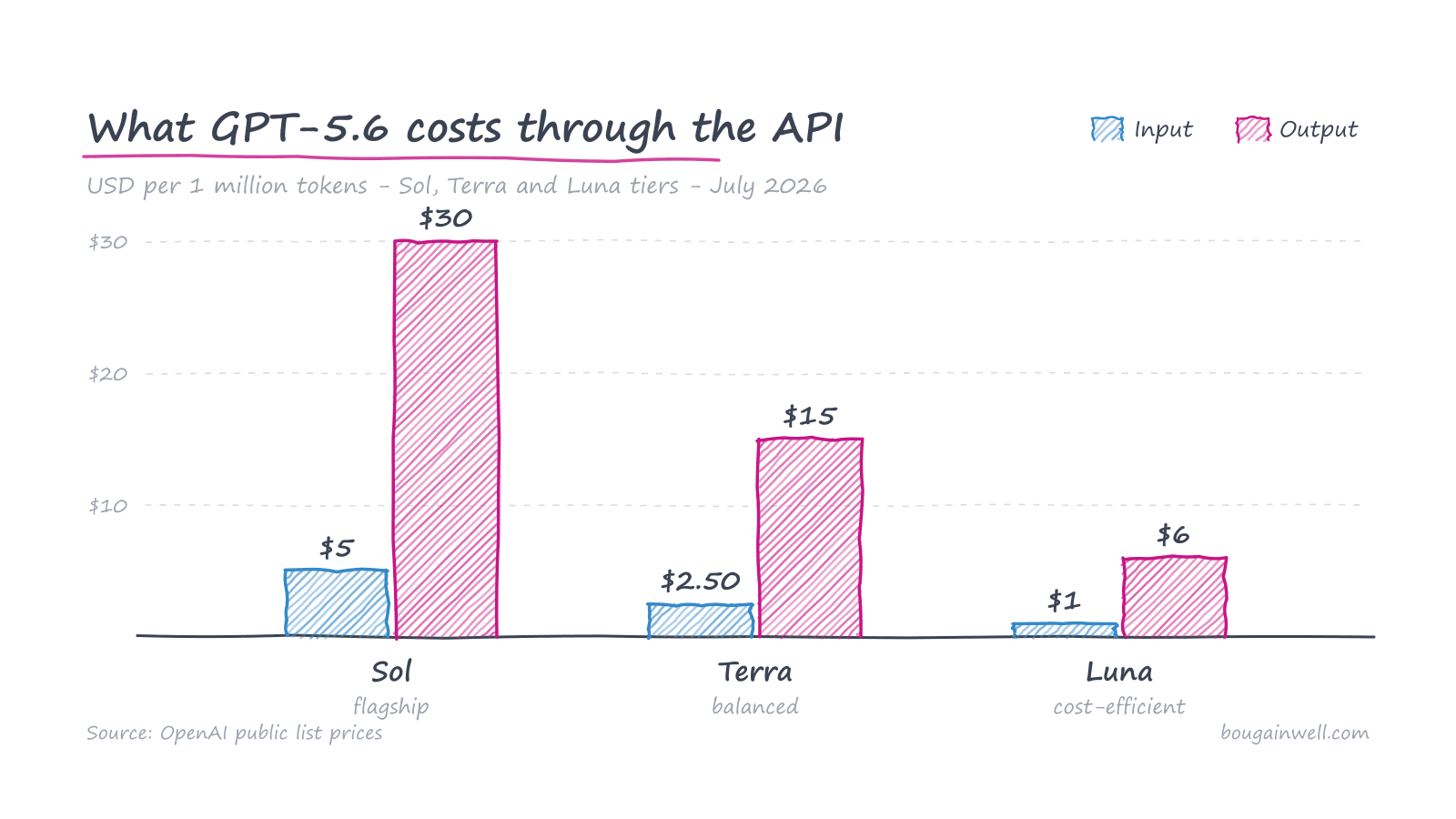
ChatGPT Work exposes adjustable effort and access to the GPT-5.6 model tiers — Sol (flagship), Terra (balanced) and Luna (cost-efficient). The public API prices show the spread: Sol runs $5 per million input tokens and $30 per million output; Terra $2.50/$15; Luna $1/$6.
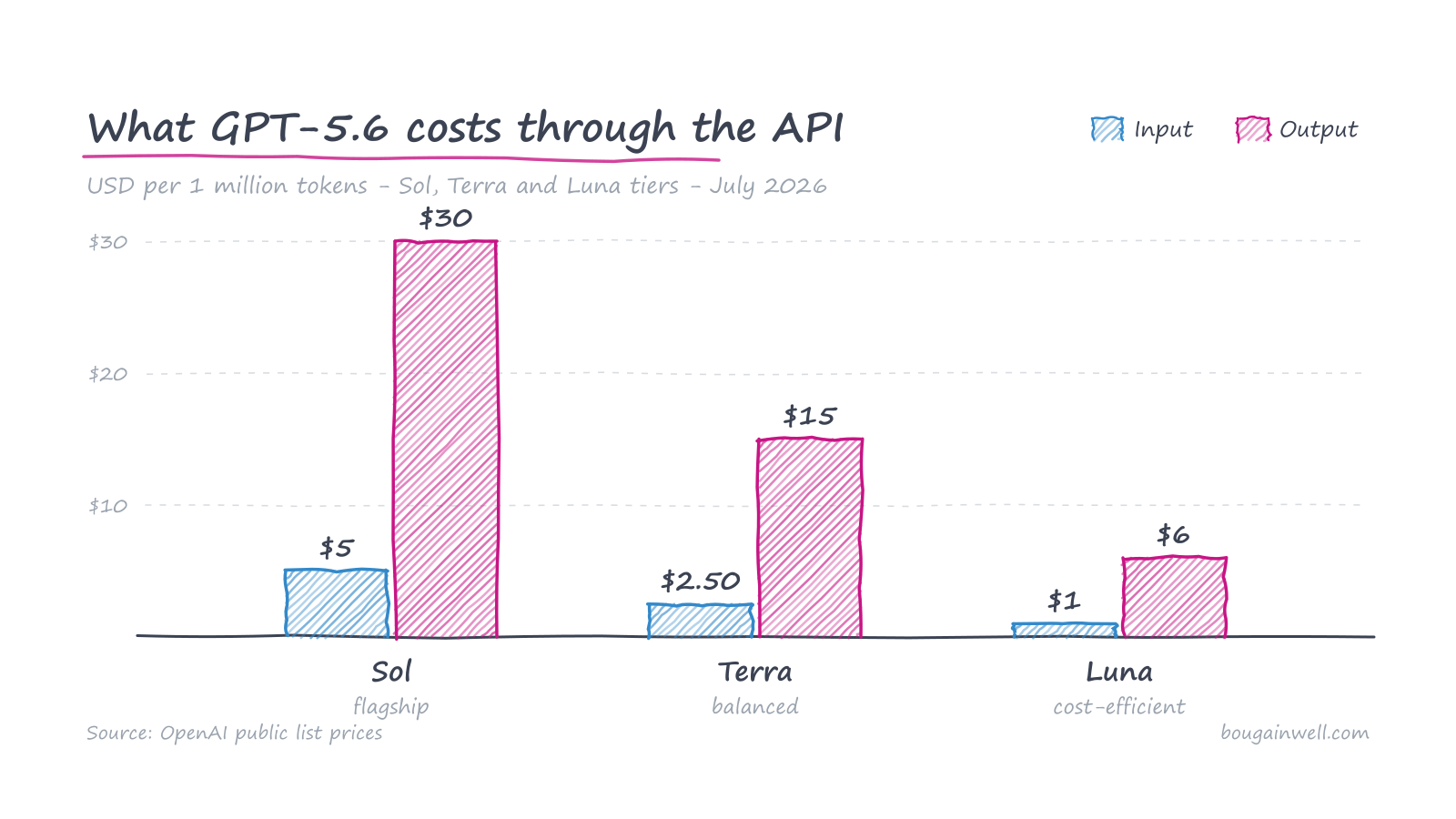 The effort dial is a price dial: a 5× spread from Luna to Sol. (Chart: BougainWell · Data: OpenAI public list prices)
That's a 5× price range between tiers — and a quiet lesson in how agentic AI will be priced. A back-of-envelope: an agent that grinds for a couple of hours and produces half a million output tokens costs about $15 on Sol — or $3 on Luna. The effort dial isn't a quality gimmick; it's the knob that decides whether delegating a task costs less than a coffee or less than lunch. Learning which tasks deserve which tier is about to become a genuine workplace skill.
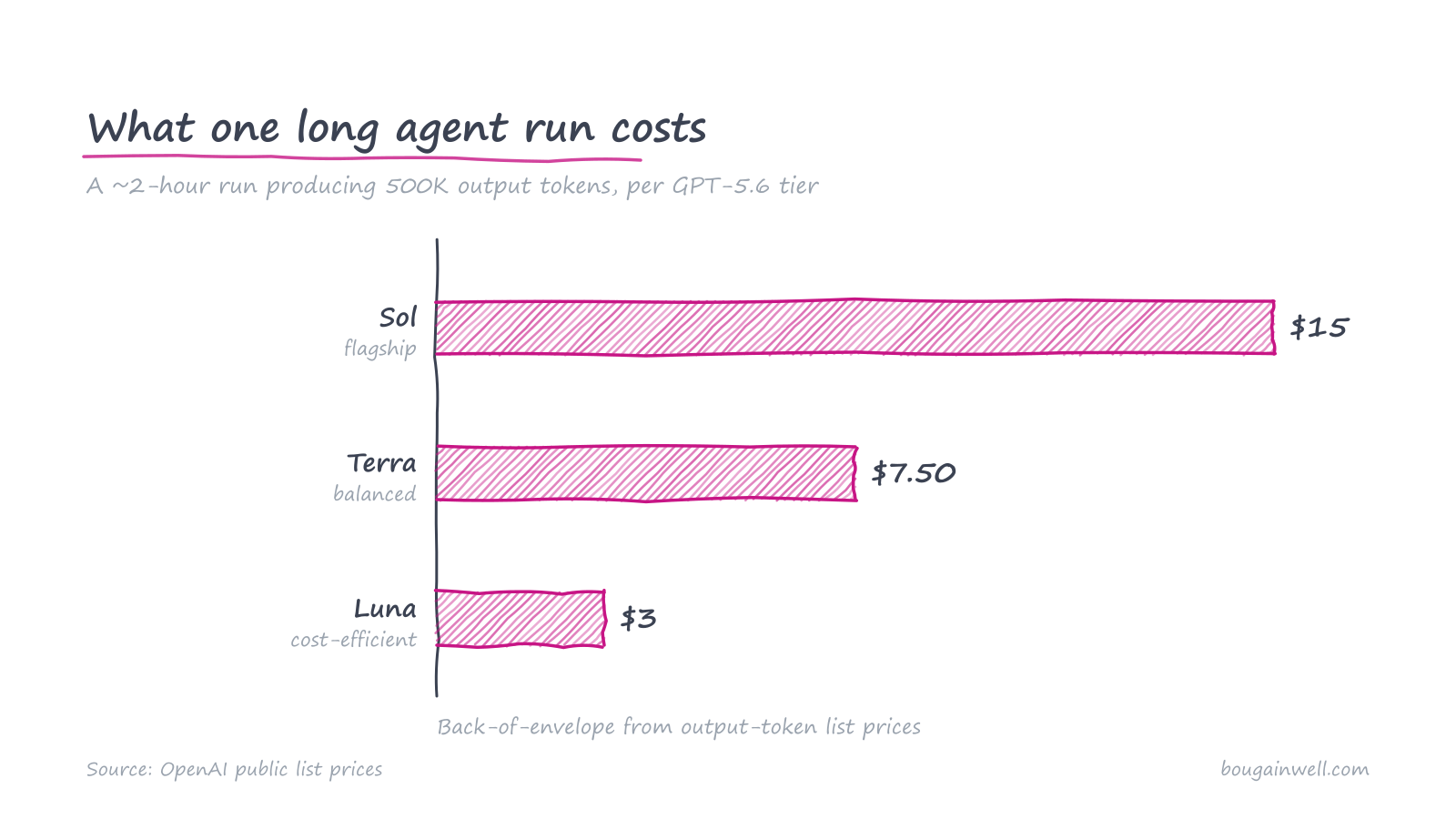 Same job, three prices: the effort dial decides whether a long agent run costs a coffee or lunch. (Chart: BougainWell · Data: OpenAI public list prices)
"Takes action across your apps and files" is the feature — and the risk. An agent with hands needs permissions, and hours-long autonomy means mistakes can compound before you see them. Start with low-stakes tasks, grant the minimum access necessary, and review the work product before it goes anywhere that matters — the same way you'd onboard a new hire.
The Week the Agents Arrived
Zoom out and the calendar tells its own story. In a single week, Meta launched Muse Spark 1.1 — an agentic model with parallel sub-agents and computer use — and OpenAI shipped GPT-Live, a voice interface that quietly delegates hard questions to a frontier model in the background. Now ChatGPT Work puts a long-running agent in front of hundreds of millions of ChatGPT users.
Three launches, one direction: the industry has collectively decided that the next battleground isn't smarter answers — it's AI that completes work while you do something else. When rivals converge this precisely, it usually means the internal numbers all point the same way.
What to Take Away
- The unit of AI just changed from answers to deliverables. Judge agent products by the finished work they hand back, not by how clever their replies sound.
- Delegation is the new prompting. Goal, context, constraints, review — manager skills, not magic words, are what extract value from agents.
- Code was the training ground, not the destination. Agents learned reliability where output could be tested automatically; now that reliability is being pointed at ordinary work.
- The effort dial is a price dial — a 5× spread across GPT-5.6's tiers (Sol $5/$30, Terra $2.50/$15, Luna $1/$6 per million tokens). Matching task to tier is the new expense skill.
- Autonomy needs guardrails. Hours of unsupervised action across your files is power and risk in equal measure — grant minimum access, review everything, scale trust gradually.
Chart: BougainWell, built from OpenAI’s public list prices. This article is for general information only and is not investment advice.
Sources
All analysis and opinions in this article are BougainWell's own.