Mark Zuckerberg hadn't posted on X since 2023. On July 9 he dusted off his old @finkd handle for exactly one announcement: Muse Spark 1.1, Meta's new agentic AI model — and the first AI model Meta has ever charged money for.
(1) Today we're releasing Muse Spark 1.1 -- a strong agentic and coding model at a very low price. It's available through our new Meta Model API and in Meta AI.
— Mark Zuckerberg (@finkd) July 9, 2026
The model is interesting. The business move behind it is bigger. And the choice of venue — a rival's platform, after three years of silence — was not an accident. We'll come back to why he posted there, of all places, at the end.
The Numbers That Matter
What Muse Spark 1.1 Actually Is
Muse Spark 1.1 is built for agentic work — tasks where an AI doesn't just answer a question but completes a series of steps on your behalf. In Zuckerberg's own words, the model is "strongest at agentic performance, tool use, and computer use." Concretely, that means:
- Coding and tool use as the headline skills, with the model trained to operate computer interfaces across desktop, mobile and web browsers
- A 1-million-token context window that the model actively manages — compacting older detail while keeping what a long-running job still needs
- Parallel sub-agents, so one task can fan out into several workers running simultaneously
- Multimodal input — images, video and documents in a single call
- A reasoning dial (
reasoning_effort, from minimal to xhigh) that trades answer depth against speed and cost
If that feature list sounds familiar, it should. Long-horizon agents, million-token context, sub-agents, computer use — this is the exact battleground where OpenAI and Anthropic have been fighting all year. Meta didn't invent a new category; it walked into the hottest one.
(2) Muse Spark 1.1 is strongest at agentic performance, tool use, and computer use. It does well on long-running tasks with 1M token context window, can delegate execution to sub-agents running in parallel, and is trained to use computer interfaces on desktop, mobile, or browser. pic.twitter.com/I3v82YohtR
— Mark Zuckerberg (@finkd) July 9, 2026
The Real Story: Meta Is Charging for AI Now
For a decade, Meta's AI identity was open source. Its Llama models shipped with downloadable weights under permissive licenses; the pitch was "our AI is free, and that keeps us relevant." Muse Spark 1.1 reverses that: closed weights, accessible only through Meta's apps or the paid Meta Model API — the company's first paid developer platform, launched in public preview for US developers with $20 in free credits.
The timing fits the leadership: this is Meta's first major model strategy set under Alexandr Wang, its Chief AI Officer since 2025 — a founder who built Scale AI into a business, not a research lab. And notice what isn't in the announcement: any bridge from Llama. Open weights you download and closed weights you rent are fundamentally different deployment models — there is no migration path between them. That's a clean break, not an evolution.
So what? Frontier models now cost so much to train and serve that even the industry's loudest open-source advocate concluded that giving away the best stuff is no longer a viable strategy. Open weights will likely survive at Meta for smaller models and goodwill — but the frontier is now behind a meter. When the last major holdout starts charging, that tells you where the economics of AI actually stand.
Reading the Price Tag
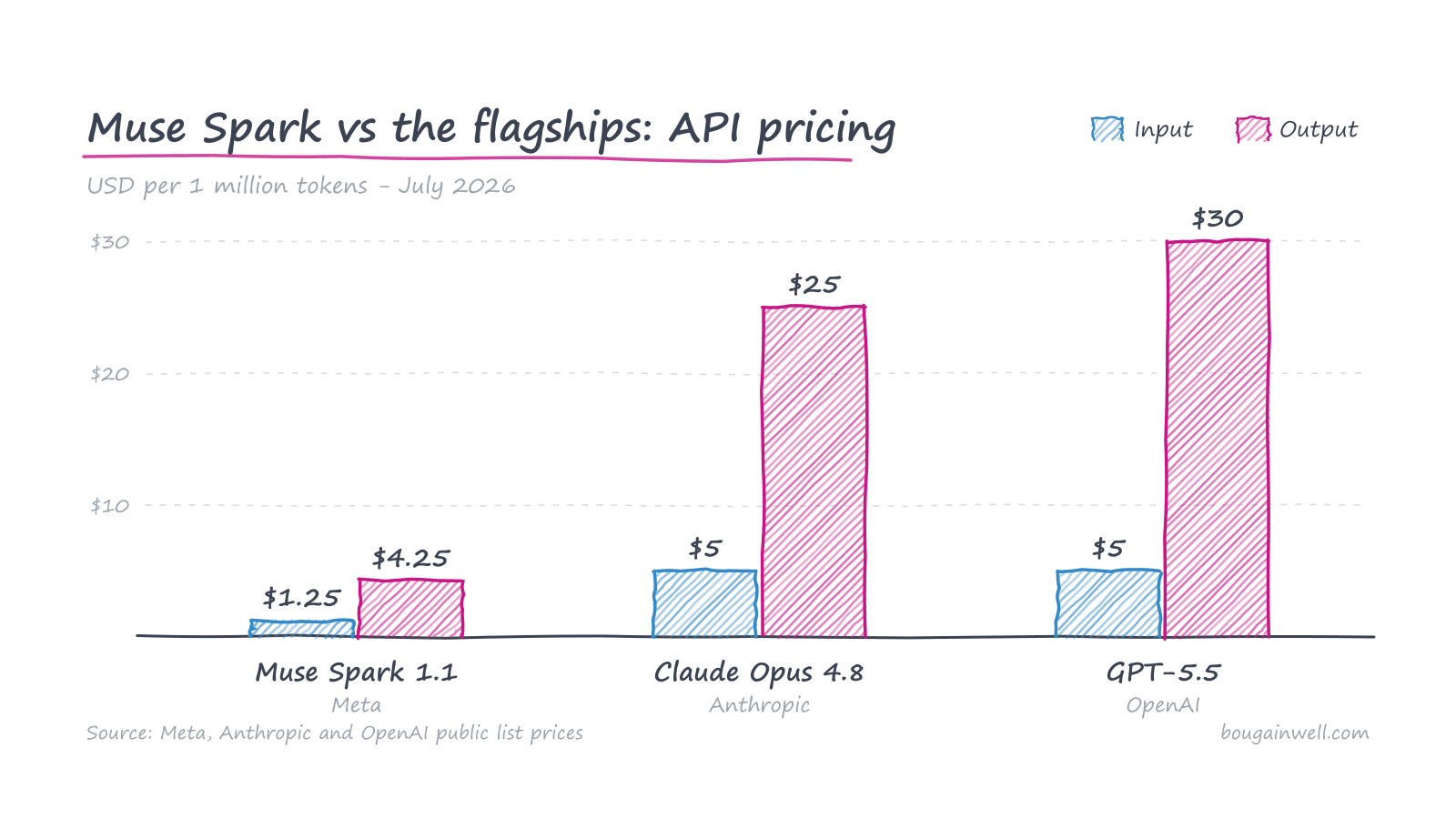
Zuckerberg used the phrase "very low" twice in his three-post thread — "a very low price," then "strong agentic and multimodal models at very low cost." Whether that's true depends entirely on what you compare it against:
| Model | Input / Output (per 1M tokens) |
|---|---|
| Muse Spark 1.1 | $1.25 / $4.25 |
| Claude Opus 4.8 (Anthropic) | $5 / $25 |
| GPT-5.5 (OpenAI) | ~$5 / $30 |
Against the flagships it's chasing, Muse Spark costs roughly a quarter on input and a sixth on output — that's the comparison Meta wants you to make, and on that axis "very low" is fair. Against entry-level models like GPT-5 mini or Claude Haiku 4.5, it's the pricier option. Read together, the positioning is clear: Meta isn't competing for cheap chat — it's trying to make flagship-grade agent work affordable enough to run at scale, the one segment where output tokens (and therefore costs) balloon fastest.
Three details in the fine print are worth more than the headline numbers:
| Detail | Why it matters |
|---|---|
| Output costs 3.4× input | Agentic work produces a lot of output — including "reasoning tokens," which are billed as output. Long-thinking tasks will cost more than the sticker suggests. |
| API speaks OpenAI + Anthropic formats | Switching becomes a one-line change of base URL. Meta is buying away the switching costs that protect incumbents. |
| $20 free credits | At $1.25/M, that's roughly 16 million input tokens — on the order of 120 novels' worth of text — enough for a developer to seriously evaluate the model before paying a cent. |
That middle row is the strategic one. Every developer already using OpenAI's SDK or Anthropic's Messages format can point their existing code at Meta's endpoint and be running in minutes. In a price war, compatibility is a weapon.
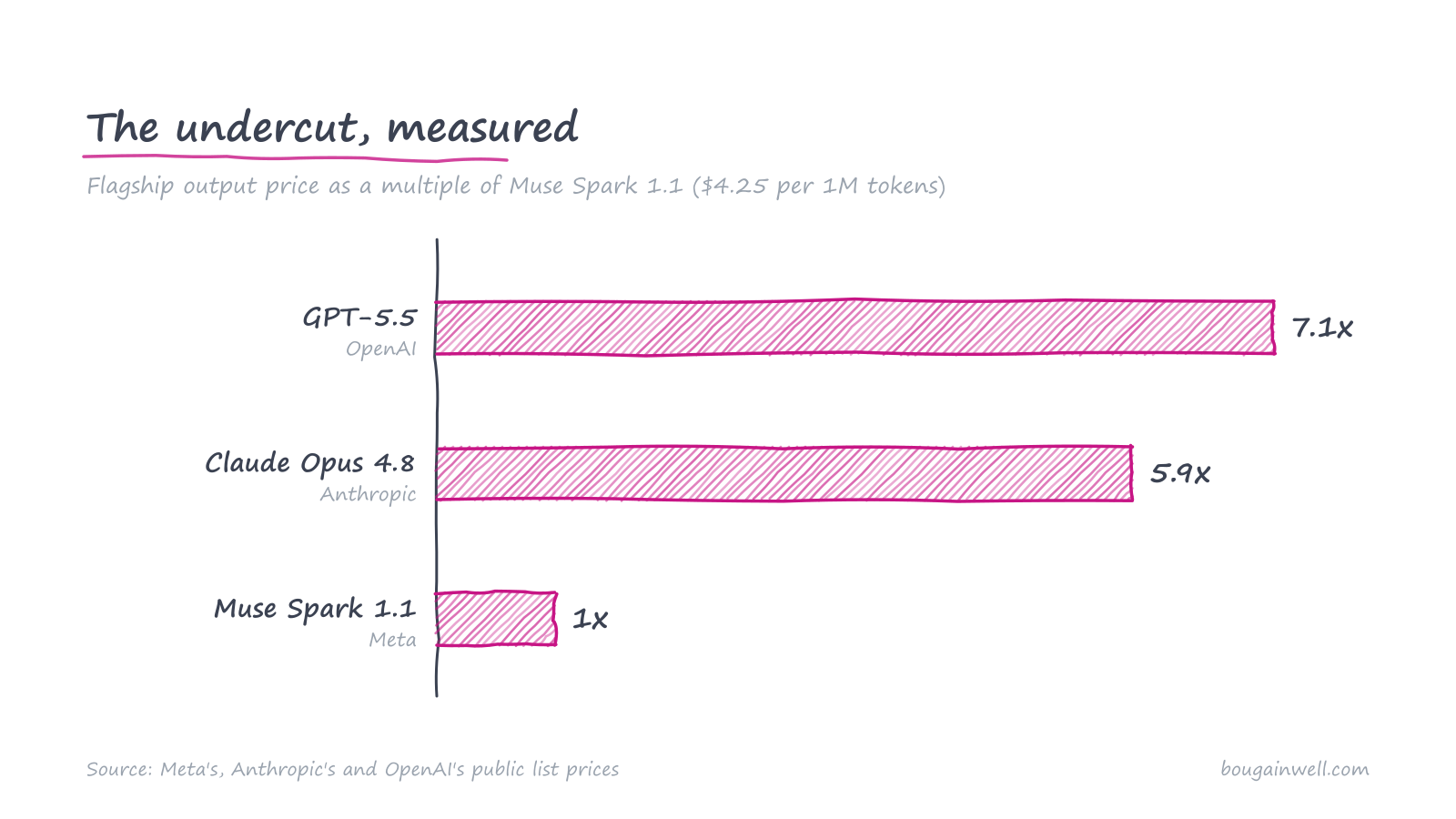 The undercut in one picture: rival flagships charge 6–7× Muse Spark's output rate. (Chart: BougainWell · Data: Meta, Anthropic and OpenAI public list prices)
Muse Spark 1.1 is in public preview, currently for US-based developers, and pricing and access terms can change quickly in this market. Benchmark it on your own workload before committing — launch-week claims (from any AI vendor) always deserve independent verification.
Read the Benchmarks Meta Chose to Brag About
You can learn as much from which tests a company headlines as from the scores themselves. Meta's published results for Muse Spark 1.1 lead with agent-flavoured benchmarks — MCP Atlas, JobBench, Humanity's Last Exam, FinanceBench — tests about using tools, completing jobs and working through documents. Not the classic coding leaderboards, not chat quality.
Companies brag about what they built the product to do. A launch that headlines agent benchmarks, prices output tokens for high-volume agent workloads, and — per Zuckerberg's own thread — leads with "agentic performance, tool use, and computer use" is telling one consistent story: this is a specialist for AI that does multi-step work, not a bid for the smartest-model crown. Judge it — and any model — on the job its maker optimised it for.
Why Announce It on X, of All Places?
Now the question we opened with. Zuckerberg has Facebook, Instagram and Threads — over three billion users of his own. Why break a three-year silence on a competitor's platform?
Because the announcement wasn't aimed at three billion consumers. It was aimed at a few million developers and AI insiders, and that conversation lives on X. Posting there put the news directly in front of the exact audience that chooses model APIs — and the novelty of the venue did the promotion for free: "Zuckerberg returns to X" became a second headline carrying the first one. One post, two news cycles.
There's a lesson in that for anyone who ships products: announce where your buyers are, not where you're comfortable. Meta's consumer platforms would have given the news scale; X gave it precision — and a story.
What to Take Away
- The last big open-source holdout now charges for its best model. Meta's first paid API marks the moment frontier AI economics beat ideology — remember Muse Spark 1.1 as the turning point.
- $1.25 in / $4.25 out per million tokens is the number to know — roughly a quarter of flagship input prices and a sixth of their output prices, though reasoning tokens bill as output, so agentic workloads cost more than the sticker.
- Read the benchmark selection, not just the scores. Meta headlines agent tests, not coding leaderboards — a launch's choice of benchmarks tells you what the product was built for.
- Compatibility is the new moat-breaker. Supporting rivals' API formats turns switching from a migration project into a config change — expect every challenger to copy this.
- Watch the venue of an announcement, not just its content. A three-year-dormant account on a rival platform generated a second news cycle for free — distribution strategy is part of the product.
- "Agentic" is where the fight is. Coding, computer use, sub-agents, million-token context: all major labs are now converging on AI that does multi-step work, not just answers.
Chart: BougainWell, built from Meta's, Anthropic's and OpenAI's public list prices. This article is for general information only and is not investment advice.
Sources
- Mark Zuckerberg (@finkd) on X — official Muse Spark 1.1 announcement thread: post 1 · post 2 · post 3
All analysis and opinions in this article are BougainWell's own.