Here is a thought that should make anyone who uses AI at work stop for a second. When you buy AI, the monthly bill is not the real price. There is a second bill — one that never shows up on any invoice, that you pay without noticing, and that you can never get a refund on. It is made of your own know-how.
That is the uncomfortable idea Microsoft's CEO Satya Nadella put into words this week in a short essay he called "The Reverse Information Paradox." It travelled fast, because it named something a lot of people had felt but couldn't quite explain.
— Satya Nadella (@satyanadella) July 12, 2026
Let's translate it into plain English — and then figure out what, if anything, you should actually do about it.
The Whole Idea in Four Numbers
What Nadella Actually Said
His sentence is worth reading slowly:
"You essentially pay for intelligence twice, once with money, and again with something even more valuable: the proprietary knowledge you must reveal to make that intelligence useful."
In everyday terms: to get a good answer out of an AI, you have to feed it good context. Your real numbers. Your customer list. The way your team writes. The specific mistake it just made, and the correction that fixes it. The better you want the answer, the more of your private stuff you have to hand over. And every time you hand it over, a little of your hard-won know-how leaves the building.
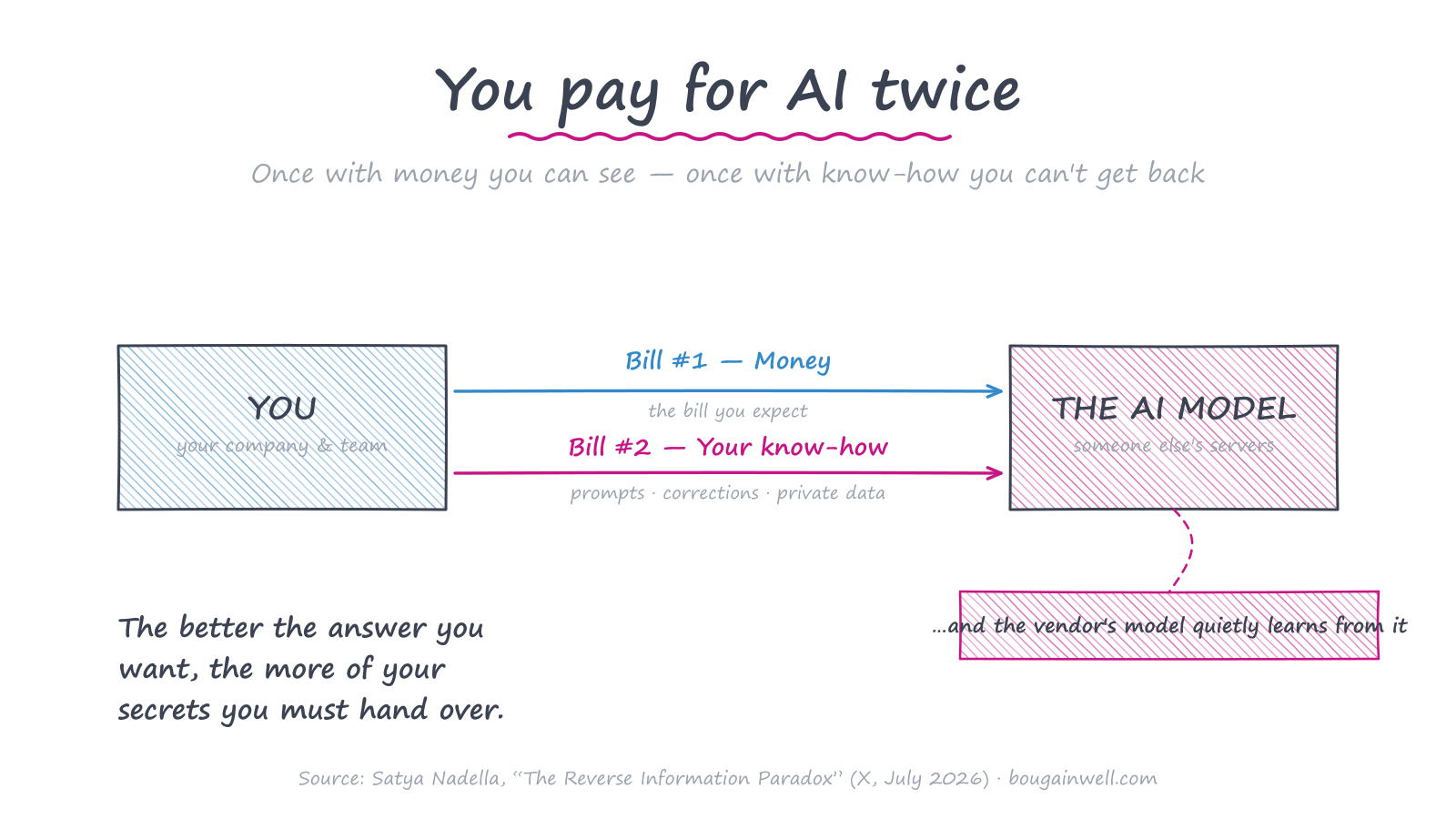 The second bill never arrives in the post — which is exactly why it's easy to miss. (Chart: BougainWell · Concept: Satya Nadella, "The Reverse Information Paradox")
The 60-Year-Old Rule He Flipped
The word paradox isn't decoration. Nadella is playing off a famous puzzle from the economist Kenneth Arrow, who described it back in 1962 (and went on to win a Nobel Prize in economics ten years later).
Arrow's original puzzle was about selling an idea. Imagine you've invented something clever and you want to sell the secret. The buyer says, reasonably, "prove it's worth the money — show me." But the moment you show them, they've got it, and they no longer need to pay. So the seller is the one who risks giving away the goods for free. That's the classic information paradox.
Nadella's twist is to point out that with AI, the risk has flipped to the other side of the table. Now it's the buyer — you — who has to reveal valuable information just to use the thing you already paid for. Same trap, opposite victim. Hence "reverse."
That flip is the whole insight, and it's a genuinely clever way to frame it. Once you see AI as a product where the customer is the one leaking value, a lot of fuzzy worries about "AI and data" suddenly have a clean shape.
Where Does the Know-How Actually Go?
This is the part that sounds abstract until you picture it. Nadella's word for the leak is "exhaust" — the trail a car leaves behind it. In his words:
"Models learn from 'exhaust,' the prompts people write, the tools agents use, and especially the corrections people make when the model is wrong."
Read that last bit again: especially the corrections. When the AI gets something wrong and you fix it, you've just done the single most valuable thing a teacher can do — you've shown it the right answer to a hard, real-world problem. If those corrections flow back to the model's maker, then your team's daily grind of fixing the AI is quietly training a product that your competitors will rent tomorrow.
Nobody is necessarily being sneaky here. It's just how a lot of AI improves: millions of users nudge the model, and the model gets smarter for everyone. The catch is who ends up owning the smarter model. If it's the vendor, then you paid the tuition and someone else keeps the graduate.
So What? Who Wins and Who Loses
The reason a corporate CEO bothered to write this down is that it changes how a serious buyer should shop for AI.
- The AI vendor wins twice — once on your subscription, and again on the free lessons your usage provides. That's a fantastic business to be in.
- The casual user barely loses anything. If you're asking AI to rewrite an email or explain a recipe, there's no secret sauce leaking. Don't lose sleep over it.
- The company with real proprietary know-how is the one exposed. A law firm's judgment, a factory's process, a trader's models — that's the crown-jewel knowledge that makes the AI more useful and is the most painful to give away.
Nadella isn't telling anyone to stop using AI — he's the CEO of a company that sells it. His point is subtler: use it with a boundary, so the learning piles up on your side of the fence instead of silently draining to the vendor's.
What You Can Actually Do About It
The good news is the fix is a mindset before it's a technology. Nadella ends on an almost hopeful note:
"In consuming intelligence, you are creating intelligence. And what you create should belong to you."
For most readers, that translates into a few practical habits:
- Notice the second bill. Before pasting something into an AI tool, ask a one-second question: would I email this to a stranger? If not, it's "Bill #2" material.
- Prefer tools that keep your data yours. Business and enterprise AI plans increasingly promise that your prompts and corrections won't be used to train their models. That promise is the whole ballgame — read it before you type.
- Capture your own corrections. When your team teaches the AI something, write it down somewhere you own — a prompt library, a playbook, an internal guide. That's how the learning compounds for you instead of leaking away.
Not every AI tool treats your data the same way. Free and consumer tiers often reserve the right to learn from what you type; paid business tiers usually don't. Before feeding an AI anything sensitive, check that specific product's data-and-training policy — the default is not always in your favour.
What to Take Away
- You pay for AI twice — once in money, once in the know-how you reveal to make it useful. The second payment is the one that never appears on a bill.
- The better the answer you want, the more you must give up. Good AI output needs good context, and your best context is your most private information.
- Corrections are the crown jewels. The moment you fix the AI's mistake, you've taught it the right answer to a real problem — make sure that lesson lands somewhere you own.
- It's an old puzzle, reversed. Kenneth Arrow (1962) showed the seller of an idea risks giving it away; with AI, it's the buyer who does. That flip is Nadella's whole point.
- Draw a boundary, don't unplug. The goal isn't to avoid AI — it's to use it so the learning compounds on your side of the fence, not the vendor's.
Chart: BougainWell, built as a plain-language illustration of Satya Nadella's "Reverse Information Paradox." This article is for general information only and is not investment or legal advice.
Sources
All analysis and opinions in this article are BougainWell's own.