Anthropic has a new flagship — and for the first time in years, it isn’t called Opus. Claude Fable 5 is the debut model of the Claude 5 family, and Anthropic has given it a tier of its own: a new Mythos-class that sits above Claude Opus in capability. It is, in the company’s words, its most intelligent generally available model.
If you’ve ever left an AI assistant running on a hard problem and come back to a half-finished answer, Fable 5 is aimed squarely at you. This is a model built for the work that used to fall apart: multi-hour coding sessions, deep research, and agents that must keep their story straight from the first step to the thousandth.
Let’s break down what it actually does, what it costs, and why it matters.
The Headline Numbers
A one-million-token context window — which is both the default and the maximum — means Fable 5 can hold roughly an entire codebase, a stack of quarterly reports, or a few novels’ worth of text in its head at once. And with up to 128,000 output tokens per request, it can produce genuinely long deliverables — full documents, large refactors, detailed analyses — in a single pass.
A New Tier, and a Twin Called Mythos
The most unusual part of this launch is that Fable 5 ships alongside a twin: Claude Mythos 5. The two share the same underlying model — same intelligence, same pricing, same 1M context. The difference is who can use them and how they are guarded:
- Claude Fable 5 (
claude-fable-5) is generally available to everyone and includes additional safety measures for dual-use capabilities — the kinds of skills that could be misused in domains like cybersecurity and biology. - Claude Mythos 5 (
claude-mythos-5) ships without those extra measures and is available only to approved organisations through Anthropic’s access programme.
Think of it as one brain with two doors: the public door has extra locks. Anthropic has published the full details in its official announcement.
Feature 1: Thinking That Never Switches Off
Previous Claude models let developers toggle "extended thinking" on and off, and even set token budgets for it. Fable 5 removes the switch entirely: reasoning is always on. The model automatically decides when a question deserves a two-second answer and when it deserves ten minutes of deliberation.
Developers still get a dial — an effort parameter that runs from low up through high, xhigh and max — to trade off depth against speed and cost. But the era of manually budgeting "thinking tokens" is over.
One more change: Fable 5 never reveals its raw chain of thought. Applications can request a readable summary of the reasoning instead — useful for showing users that and roughly how the model worked through a problem, without exposing its full internal monologue.
Feature 2: Agents That Work for Hours, Not Minutes
The signature capability of the Claude 5 family is long-horizon agentic work. Fable 5 is designed to:
- Run single turns lasting many minutes on hard problems — a 15-minute request that gathers context, builds, and verifies its own work is normal behaviour, not a timeout
- Delegate to parallel sub-agents and keep communicating with them while they run — like a tech lead coordinating a small team
- Write and use file-based memory, jotting down lessons in one session and applying them in the next
- Complete overnight coding runs — large migrations and refactors — without a human stepping in to course-correct
For anyone building AI agents, this is the real story. The bottleneck for agents has never been answering questions; it has been staying coherent across hundreds of steps. That is precisely the axis Anthropic optimised.
Feature 3: Sharper Eyes and a Better Memory
Fable 5 inherits and extends the perception upgrades of recent Claude models:
- High-resolution vision — images up to 2,576 pixels on the long edge, with pixel-accurate coordinates. It is even trained to use cropping and shell tools to read flipped, blurry or degraded documents
- Stronger code review and debugging — better at finding real bugs and explaining them clearly, and at digging through repository history
- End-to-end knowledge work — financial analysis, spreadsheets, slide decks and documents produced as complete deliverables rather than fragments
The Safety Trade-offs You Should Know About
Because Fable 5 is the most capable model Anthropic has released publicly, it also ships with the most visible guardrails:
Fable 5 runs safety classifiers on requests in sensitive domains (notably cybersecurity and biology). A flagged request returns a "refusal" instead of an answer — and the API can automatically fall back to Claude Opus 4.8 so legitimate work isn’t left stranded.
Two more practical notes for teams evaluating it:
- Data retention: Fable 5 requires 30-day data retention — it is not available under zero-data-retention agreements.
- False positives happen: benign security tooling or life-sciences work can occasionally trip the classifiers, which is exactly why the Opus fallback exists.
How It Stacks Up Against the Rest of the Claude Family
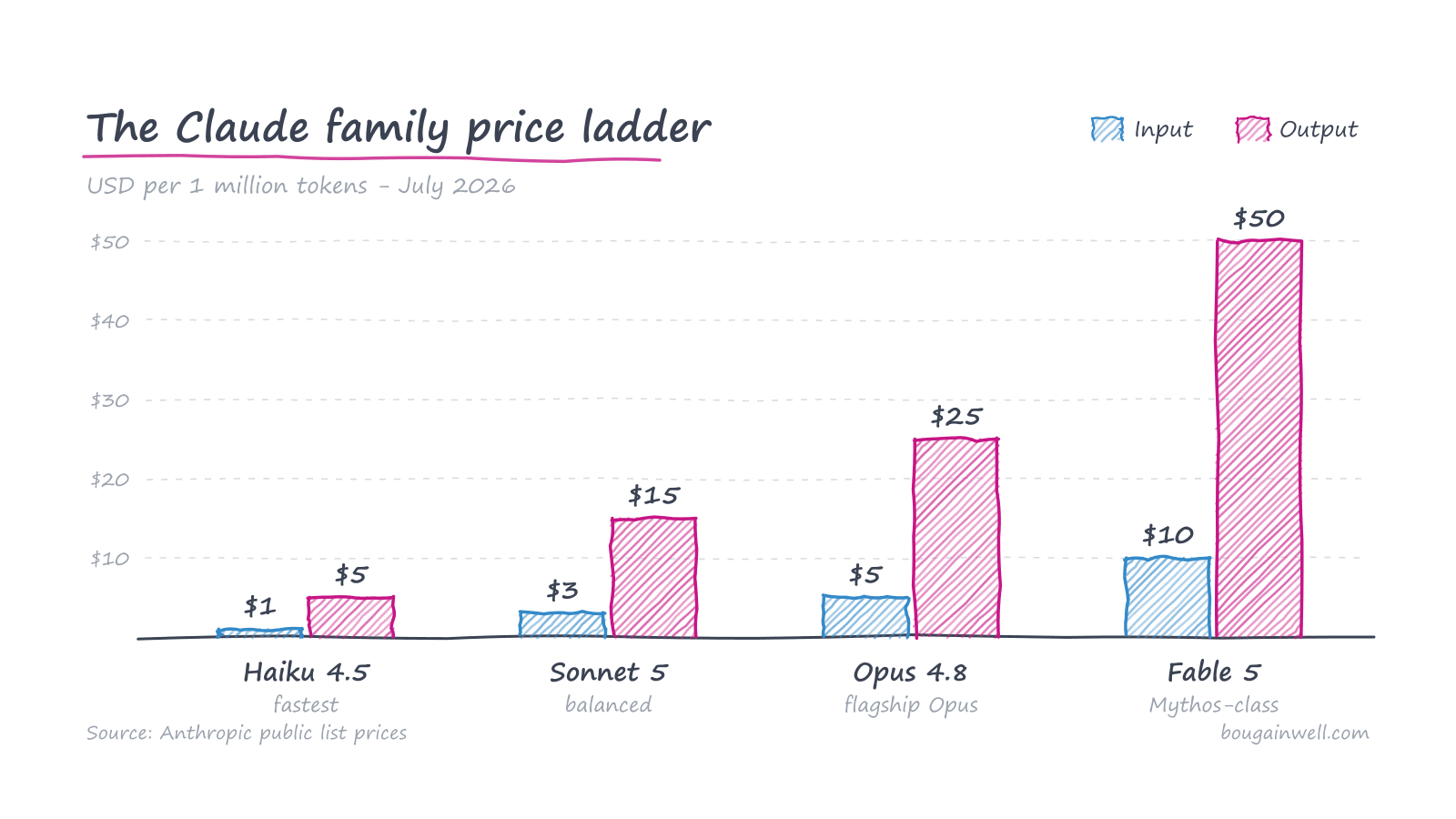
| Model | Tier | Input / Output (per 1M tokens) | Context |
|---|---|---|---|
| Claude Fable 5 | Mythos-class (new) | $10 / $50 | 1M |
| Claude Opus 4.8 | Opus | $5 / $25 | 1M |
| Claude Sonnet 5 | Sonnet | $3 / $15 | 1M |
| Claude Haiku 4.5 | Haiku | $1 / $5 | 200K |
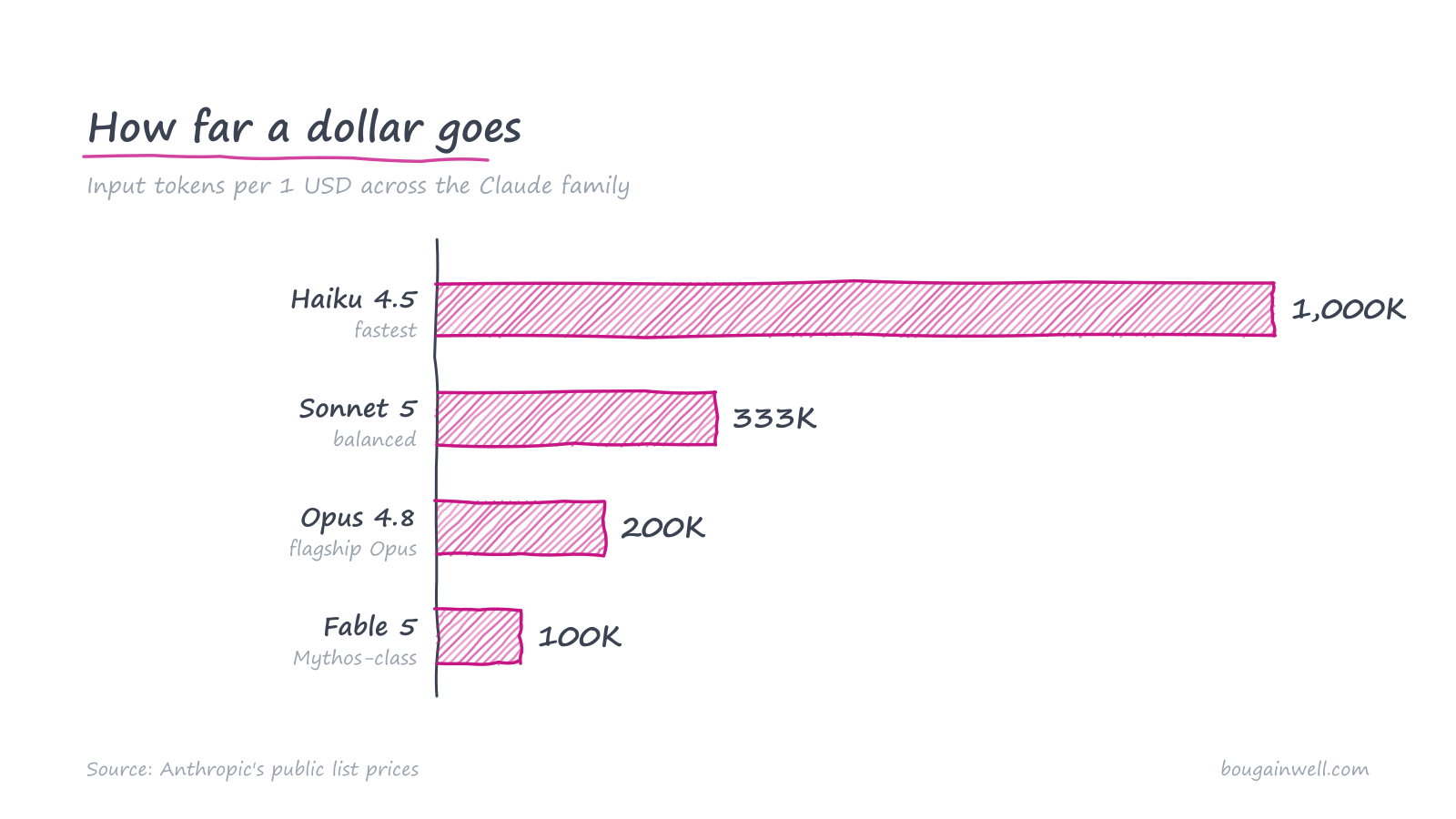 The same dollar buys 10× more tokens on Haiku than on Fable 5 — capability is what you pay for. (Chart: BougainWell · Data: Anthropic public list prices)
The pricing tells the positioning story: Fable 5 costs double Opus 4.8 per token. Anthropic clearly does not expect it to replace Opus for everyday work — it is the specialist you call in for the hardest problems, while Opus remains the daily driver and Sonnet the value workhorse.
What This Means for Indian Developers and Startups
For India’s developer ecosystem — the world’s largest after the US — the interesting angle isn’t the sticker price, it’s the shape of work that becomes automatable:
- Services and GCC teams can point Fable-class agents at legacy-code migrations and multi-day refactors that were previously billed in human-months
- Startups get frontier reasoning through the same API as every other Claude model (
claude-fable-5) — no special hardware, no waitlist - Cost discipline still matters: at $10/$50 per million tokens, the smart pattern is routing — use Haiku and Sonnet for volume, reserve Fable 5 for the 5% of problems that genuinely need it
The Bottom Line
Claude Fable 5 is less a faster chatbot and more a different species of tool: an always-reasoning, long-running problem-solver with a million-token memory and the discipline to check its own work. The dual release with Mythos 5 also signals where the industry is heading — frontier capability increasingly arrives with tiered access and hard guardrails built in, not bolted on.
Whether the 2×-Opus price is worth it will depend entirely on your workload. But for the class of problems that used to be "come back tomorrow and hope" — it may be the first model where you come back and it’s simply done.
Chart: BougainWell, built from Anthropic's public list prices. This article is for informational purposes only and is not investment advice.
Sources
All analysis and opinions in this article are BougainWell's own.