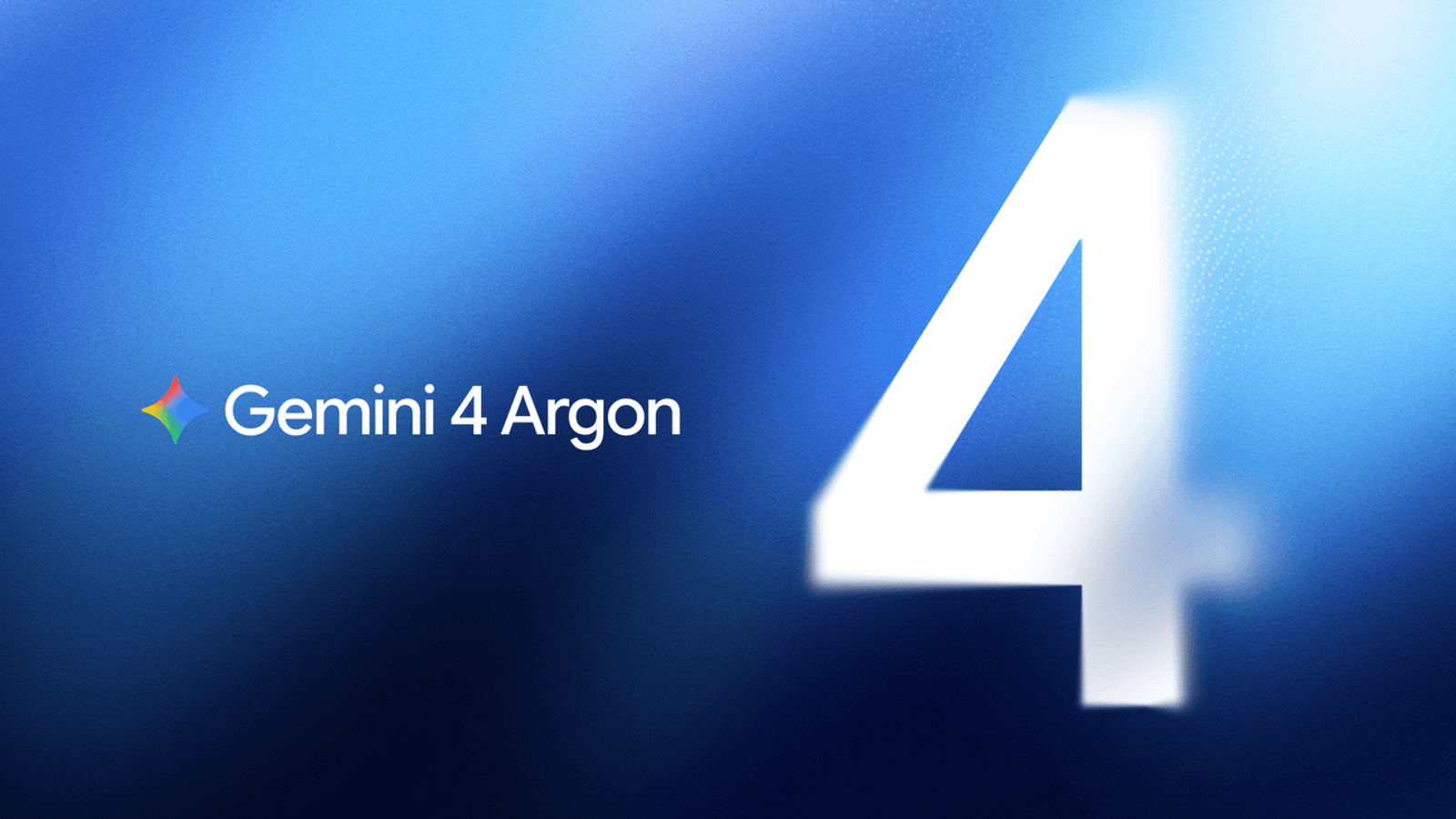
Google DeepMind just made Gemini 4 Argon globally available, and the launch is wrapped in the usual benchmark bunting. But the number that actually changes what developers can build is the dullest-sounding one in the post: the model can now write up to 1M tokens in a single response, up from the previous 64K. That is not a spec-sheet footnote. It is the difference between a model that drafts a function and one that is meant to finish the whole file.
Gemini 4 Argon is now globally available.
— Google DeepMind (@GoogleDeepMind) October 13, 2026
Built to solve your hardest problems from start to finish, the model brings frontier capabilities across coding, enterprise workflows, and cyber defense. pic.twitter.com/N8tOQjwk0x
What Google Actually Shipped
Google describes Gemini 4 Argon as our flagship reasoning model, built for complex software engineering, deep mathematical and scientific problem solving, autonomous multi-step agents, and long decode up to 1M tokens. The framing in the launch post is narrower and more revealing than "frontier model": Argon brings frontier capabilities across coding, enterprise workflows, and cyber defense.
Those three words — coding, enterprise, cyber — are the whole strategy. This is not pitched as a chatbot upgrade. It is pitched at the work that runs for minutes and touches real systems — the same agent-that-finishes-the-task framing behind OpenAI's GPT-6 Astra and Anthropic's Claude Fable 5 — and the benchmark selection follows that pitch exactly.
The Benchmarks, Read Honestly
Google led with four numbers, and each maps to one of its three target domains. Here they are, with what each one is actually measuring:
| Benchmark | Score | What it tests | Google's claim |
|---|---|---|---|
| DeepSWE v1.1 | 77.9% | End-to-end software engineering | New state of the art |
| CWE-bench v1 | 68% | Remediating security vulnerabilities | Ties for first place |
| AutomationBench | 51.3% | End-to-end execution across business functions (Zapier) | Ranks #1 |
| LVBench | 91.7% | Long video understanding | State of the art |
Two of these deserve a second look because they are the ones that matter for the "finish the job" pitch.
CWE-bench v1 at 68% is the honest one. Google does not claim a lead here; it says Argon ties for first place. On a benchmark that measures whether a model can actually patch security vulnerabilities rather than just spot them, a tie at the top is a more defensible statement than a solo record, and the fact that Google published it that way is a small signal of discipline. Note the absolute level too: even at the top of the field, remediating real vulnerabilities is a 68%-of-the-time problem, not a solved one.
AutomationBench at 51.3% is the one that sets expectations correctly. Zapier's benchmark measures end-to-end execution across core business functions — the exact "start to finish" work the launch post promised. A #1 ranking at 51.3% means the best available model completes these multi-step business tasks about half the time. That is genuinely state of the art and genuinely not ready to run unattended. Both things are true, and the number says so plainly.
The 1M-Token Output Jump Is the Real Headline
Now back to that output limit, because it is the most consequential change and the easiest to skim past.
Every model has two size limits that people routinely confuse. The context window is how much it can read — for Argon that is a unified input-and-output window of 1,048,576 tokens. The output limit is how much it can write in one shot, and that is where Argon moved: from the previous 64K tokens to 1M tokens. On the model page the mechanics are spelled out as 65,536 tokens by default (synchronous), stretching up to 1,048,576 tokens with long decode.
Run the division and the shift is about a 16x increase in how much the model can produce in a single response (1,048,576 divided by the 65,536 default is 16). A 64K ceiling is roughly one long file; a 1M ceiling is an entire module, a full test suite, or a multi-hundred-page document generated without the application having to stitch together chunks and manage its own continuation logic.
This is why the "long decode" phrasing matters. A model built for autonomous multi-step agents has to be able to keep going — to hold a plan, execute it, and emit the full result — without a human or a wrapper breaking the task into pieces, the same shift that moved coding agents out of the terminal. Raising the output ceiling 16-fold is the capability that makes "start to finish" more than marketing.
The Pricing, Exactly As Google States It
Argon launches at an introductory price of $2 per million input tokens and $10 per million output tokens, with cached input tokens priced at 95% off the input rate. Google's pricing page frames the schedule by date rather than by a vague "introductory period":
| Token type | Through November 30, 2026 | Starting December 1, 2026 |
|---|---|---|
| Input | $2.00 | $4.00 |
| Output | $10.00 | $20.00 |
| Context caching | $0.10 | $0.20 |
After the introductory period, the standard rate of $4 per 1M input tokens and $20 per 1M output tokens applies. In other words, the numbers on the launch-day quote are the floor, and Google has published the date each line changes. That is useful to know when you are modelling the cost of a workload that writes near the new 1M-token output ceiling: at $20 per million output tokens, a single maximal response is not a rounding error, and the long-decode capability and the output price are two sides of the same decision.
Who Can Use It Today
Global availability does not mean everywhere, for everyone, immediately — Google is releasing Argon to developers, enterprises and consumers starting with paid API customers and Google AI Ultra subscribers. The stable model, gemini-4-argon, is available to try in Google AI Studio and through the Gemini API, with a latest update of October 2026.
Google also credited an initial cohort of cyber defenders and trusted testers whose real-world evaluations fed into the model before this wider release — consistent with the cyber-defense capability it put front and centre, and a reminder that the security claims come with a vetting story attached.
What to Take Away
- The output limit is the story, not the leaderboard. Argon writes up to 1M tokens per response, up from 64K — about a 16x jump — which is what turns a code-completion model into one meant to finish the whole task.
- Read the two size numbers separately. The 1,048,576-token figure is the unified context (what it reads); the 1M output limit (default 65,536, up to 1,048,576 with long decode) is what it writes.
- The benchmarks are domain-targeted, not universal. 77.9% on DeepSWE v1.1, a tie for first at 68% on CWE-bench v1, #1 at 51.3% on Zapier's AutomationBench, and 91.7% on LVBench — strong, but the 51.3% is the honest ceiling on unattended end-to-end business work.
- Price in the real rate. $2 / $10 per million tokens is introductory; Google lists $4 / $20 from December 1, 2026, with cached input at 95% off.
- Access is staged. Available now via the paid API, AI Studio and Google AI Ultra, with cyber defenders and trusted testers having tested it first.
Sources
Cover image: Google, via the Gemini 4 Argon announcement.
All analysis and opinions in this article are BougainWell's own. Benchmark scores, limits and pricing are Google's own published figures.