The International Monetary Fund says the world economy will grow 3.1% in 2026. It is the kind of number that fits in a headline and tells you almost nothing. Underneath it, India is expanding at 7% while an entire region — the Middle East and Central Asia — is set to shrink 0.3%. One average, two economies that may as well be on different planets.
The October 2026 World Economic Outlook landed on October 13, presented by IMF Chief Economist Silvana Tenreyro at the Fund's press briefing. The global figures are quietly steady. The country figures are anything but.
The Average Is the Least Interesting Number
Global growth of 3.1% in 2026, rising to 3.4% in 2027. Say it fast and it sounds like a steady-as-she-goes world. It isn't. A world average is a weighted blend, and when the pieces move in opposite directions the blend can sit perfectly still while the parts tear apart beneath it.
Look at the spread the Fund published for 2026 alone:
| Economy / region | 2026 growth | 2027 growth |
|---|---|---|
| India | 7% | 7% |
| China | 4.5% | 4% |
| United States | 2.3% | 2.3% |
| Euro area | 1.1% | 1.2% |
| Middle East & Central Asia | −0.3% | 6.3% |
| Saudi Arabia | −3.3% | — |
That is a range from +7% to −3.3% folding into a single 3.1% headline. The divergence is the story; the average is the thing that hides it.
India Is Doing the Heavy Lifting
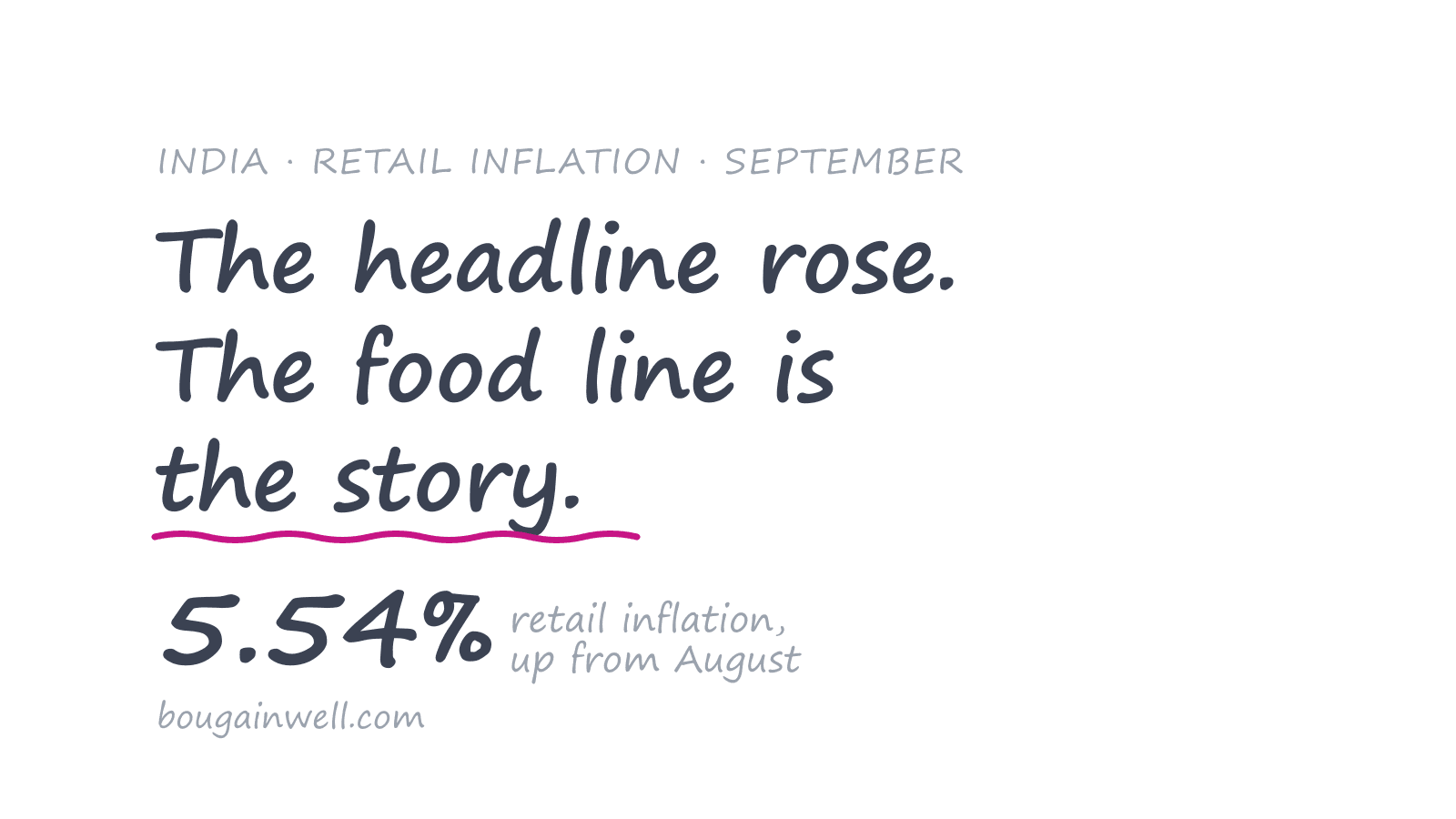
At 7% for both 2026 and 2027, India sits at the top of the Fund's country table — ahead of China's 4.5% and nearly three times the pace of the United States at 2.3%. When the world average holds up despite a stalling Europe and a contracting Middle East, this is a large part of why: a fast-growing, populous economy pulls the mean up even as others drag it down. (The domestic picture is messier than the headline rate suggests — India's retail inflation jumped to 5.54% in September, with food doing most of the work.)
The simple ratio makes the gap concrete. India at 7% against the US at 2.3% is roughly a three-to-one difference in pace. Against the euro area's 1.1%, it is closer to six-to-one. Growth at that distance compounds into very different places within a decade.
China Steps Down, Not Off
China's 4.5% in 2026 is still fast by rich-world standards, but the trajectory is what matters: the Fund has it easing to 4% in 2027. A half-point step down in the world's second-largest economy is not a crisis — it is the slow normalisation of a once-double-digit growth engine into something that looks more like a large mature economy. The question that haunts every forecast of China is whether 4% is a floor or a waypoint.
Europe Is the Flat Line
The euro area is projected to grow 1.1% in 2026 and 1.2% in 2027 — a flat line dressed up as a forecast. There is no acceleration story here and no collapse either; just low, grinding growth that leaves little room for error. For a bloc of high-income economies, 1.1% is the kind of number that keeps unemployment debates and fiscal arguments alive for years.
The Number That Should Stop You: −0.3%
Here is the figure the headline buries. The Middle East and Central Asia region is projected to contract 0.3% in 2026 — an outright fall in output across a whole region while the world as a whole grows 3.1%.
Saudi Arabia is the sharp edge of it, with GDP seen shrinking 3.3% in 2026. For an oil economy, a contraction of that size usually points to production and price dynamics rather than a broken domestic economy — and the Fund's own numbers hint at exactly that kind of swing factor: the same regional aggregate is projected to rebound to +6.3% in 2027. A region that contracts 0.3% one year and grows 6.3% the next is not telling a steady-state story. It is telling a commodity-cycle story, where a single sector can flip a regional average from red to deep green inside twelve months.
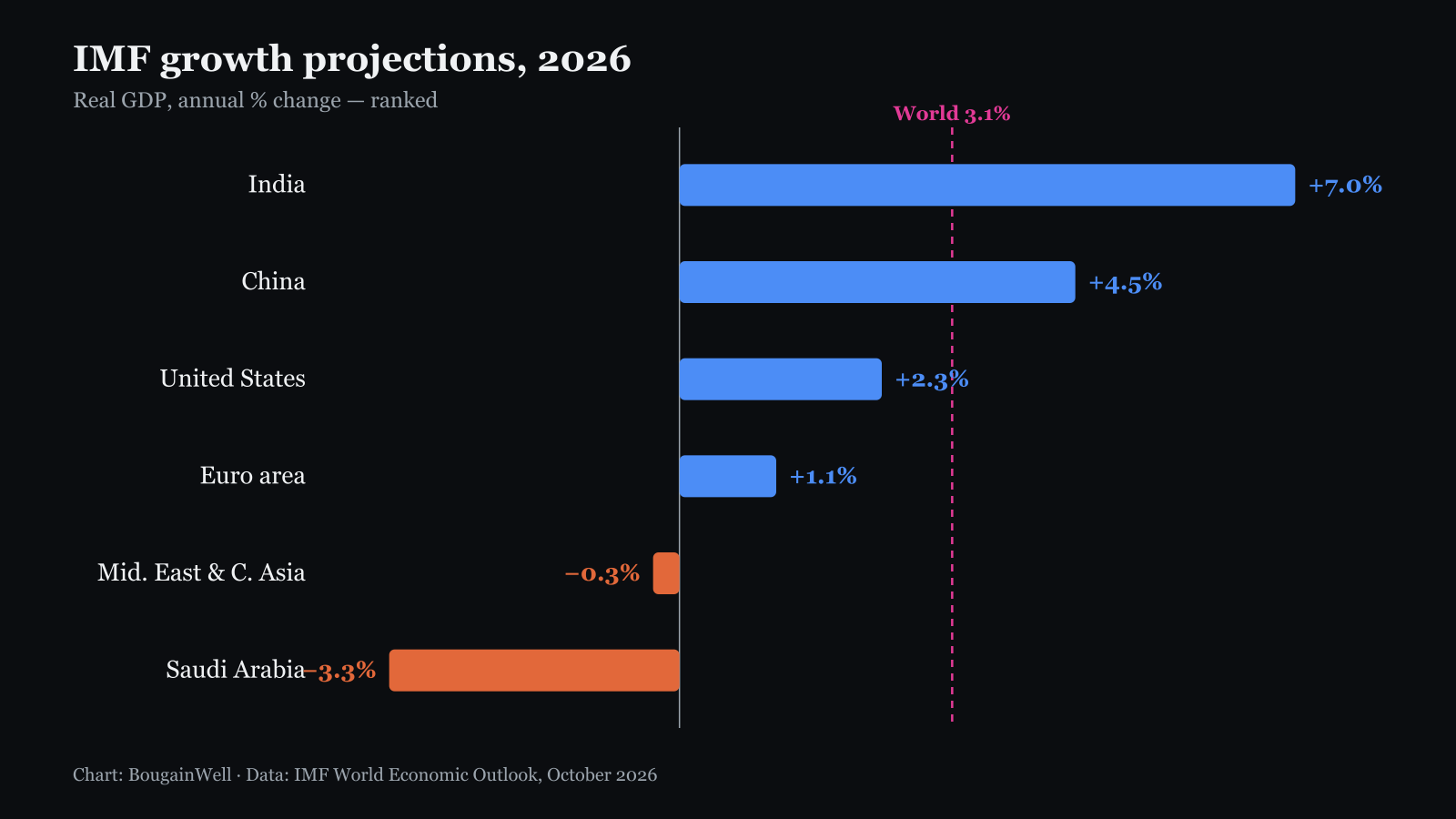 From +7% to −3.3%, folded into a 3.1% world average. The spread is the story. (Chart: BougainWell · Data: IMF World Economic Outlook, October 2026)
Inflation Is Still the Other Problem
One more figure complicates the calm. Global headline inflation is projected at 4.7% in 2026, before easing to 4.1% in 2027. A world that cannot yet get prices back to target is a world with less room to respond to a growth gap.
That matters because it constrains the policy response to the divergence above. A central bank in slow-growing Europe would normally lean toward looser policy to lift growth; inflation that is still running above comfort makes that harder. The world is being asked to manage a growth gap and a price problem at the same time, and the two pull monetary policy in opposite directions.
So What Does a Divergence This Wide Mean?
A world growing at one average rate is easy to govern in the abstract and impossible to govern in practice when the parts diverge this far. Capital, trade and policy all respond to the gaps, not the mean. When one large economy runs at 7% and a whole region runs below zero, the pressures — on exchange rates, on migration, on trade balances — build along the seams between them. The 3.1% headline is the one number almost no actual economy will experience.
What to Take Away
- The world average hides more than it reveals. Global growth of 3.1% in 2026 spans a range from India's +7% to Saudi Arabia's −3.3%. Always read the spread before the mean.
- India is the mean's best friend. At 7% for 2026 and 2027, it pulls the global average up while Europe stalls and the Middle East contracts.
- A whole region is shrinking. The Middle East and Central Asia is projected to contract 0.3% in 2026 — then rebound to 6.3% in 2027, a swing that screams commodity cycle, not steady state.
- Europe is the flat line. 1.1% in 2026 and 1.2% in 2027 leaves the euro area with almost no margin for shocks.
- Inflation is still the brake. Headline prices are seen at 4.7% in 2026 and 4.1% in 2027 — above target, and enough to tie the hands of any central bank that would rather chase growth.
Cover image: IMF, via the IMF's live release of the October 2026 World Economic Outlook on X. Chart: BougainWell, built from the IMF's World Economic Outlook, October 2026 projections. This article is for general information only and is not investment advice.
LIVE: Watch the release of the October 2026 World Economic Outlook, with the latest global growth projections, risks, and policy recommendations. Join IMF Chief Economist Silvana Tenreyro for the press briefing.
— IMF (@IMFNews) October 13, 2026
Sources
- IMF (@IMFNews) — LIVE: release of the October 2026 World Economic Outlook
- IMF (@IMFNews) — IMF Growth Forecast 2026 (country table)
All analysis and opinions in this article are BougainWell's own.