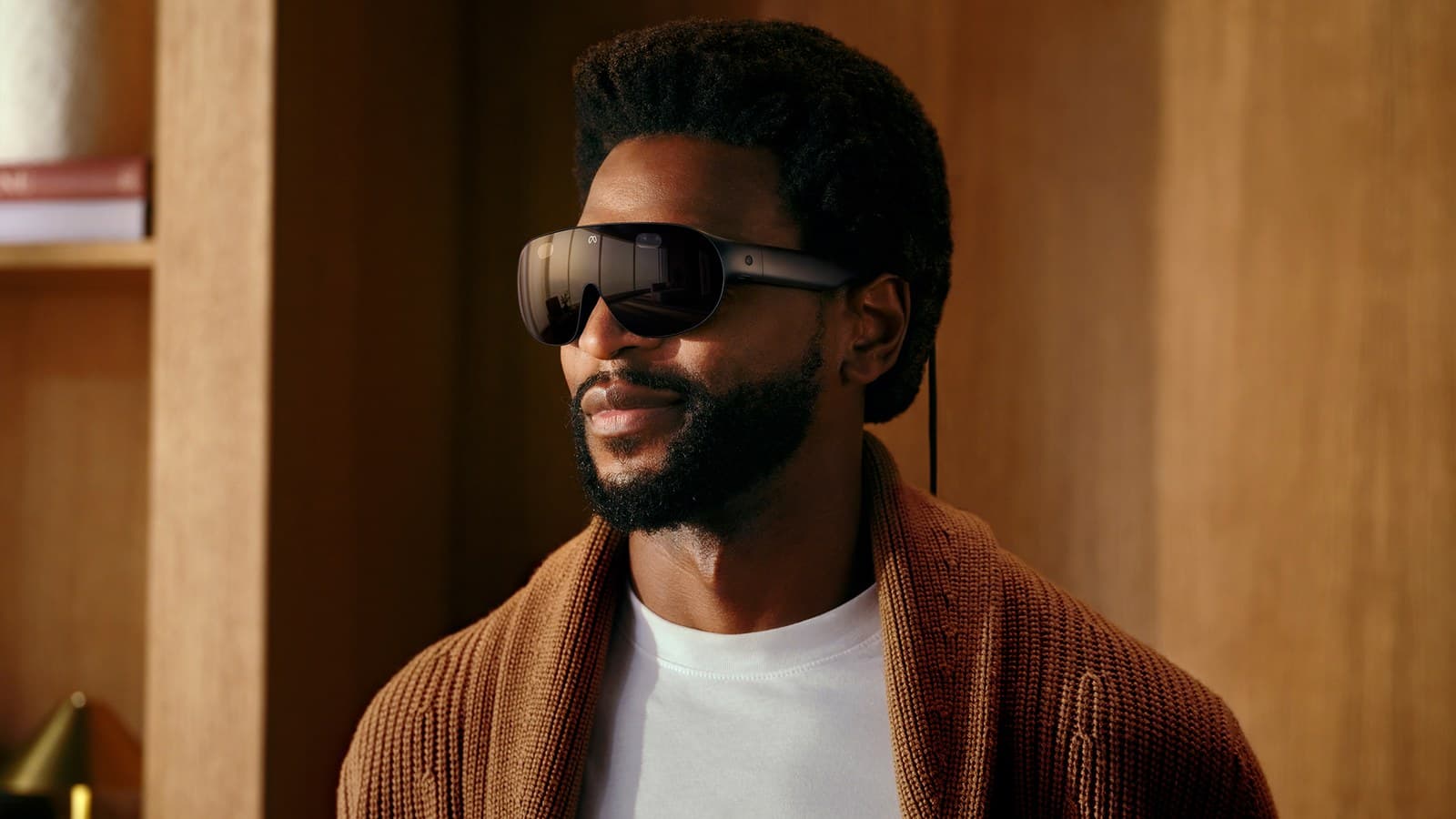
The headline number out of Meta Connect this week was a price. The interesting number was a weight.
Meta's new VR Glasses weigh about 100 grams. That is roughly a deck of cards, sitting on a face that has spent the last decade being asked to hold something closer to a brick. And Meta did not get there by shrinking the computer. It got there by taking the computer off your head entirely.
That single decision explains almost everything else Mark Zuckerberg announced.
Here's everything I announced at Meta Connect today 👇
— Mark Zuckerberg (@finkd) September 24, 2026
The whole trick is a cable
Meta's own description of the VR Glasses is unusually blunt about the architecture: "the puck, connected by an optical tether, handles compute, battery, and storage" — and it clips to your pocket or bag. The thing on your face holds the sensors and the displays. Everything that generates heat, drains charge and adds mass lives somewhere else, connected by a thin optical cable.
This is worth sitting with, because it inverts the assumption the whole category has been built on. Headsets have been heavy for a structural reason, not a sloppy one. A self-contained headset has to carry a processor, the battery to feed it, and the thermal mass to stop it cooking your forehead. Those three things scale together. Make the chip faster and you need more battery and more cooling, so the device gets heavier, so it gets less comfortable, so you wear it less.
Moving the compute into a pocket puck cuts that loop. The glasses stop competing on grams against their own silicon. Meta can now make the puck faster next year without making the glasses heavier — the two halves upgrade on separate clocks.
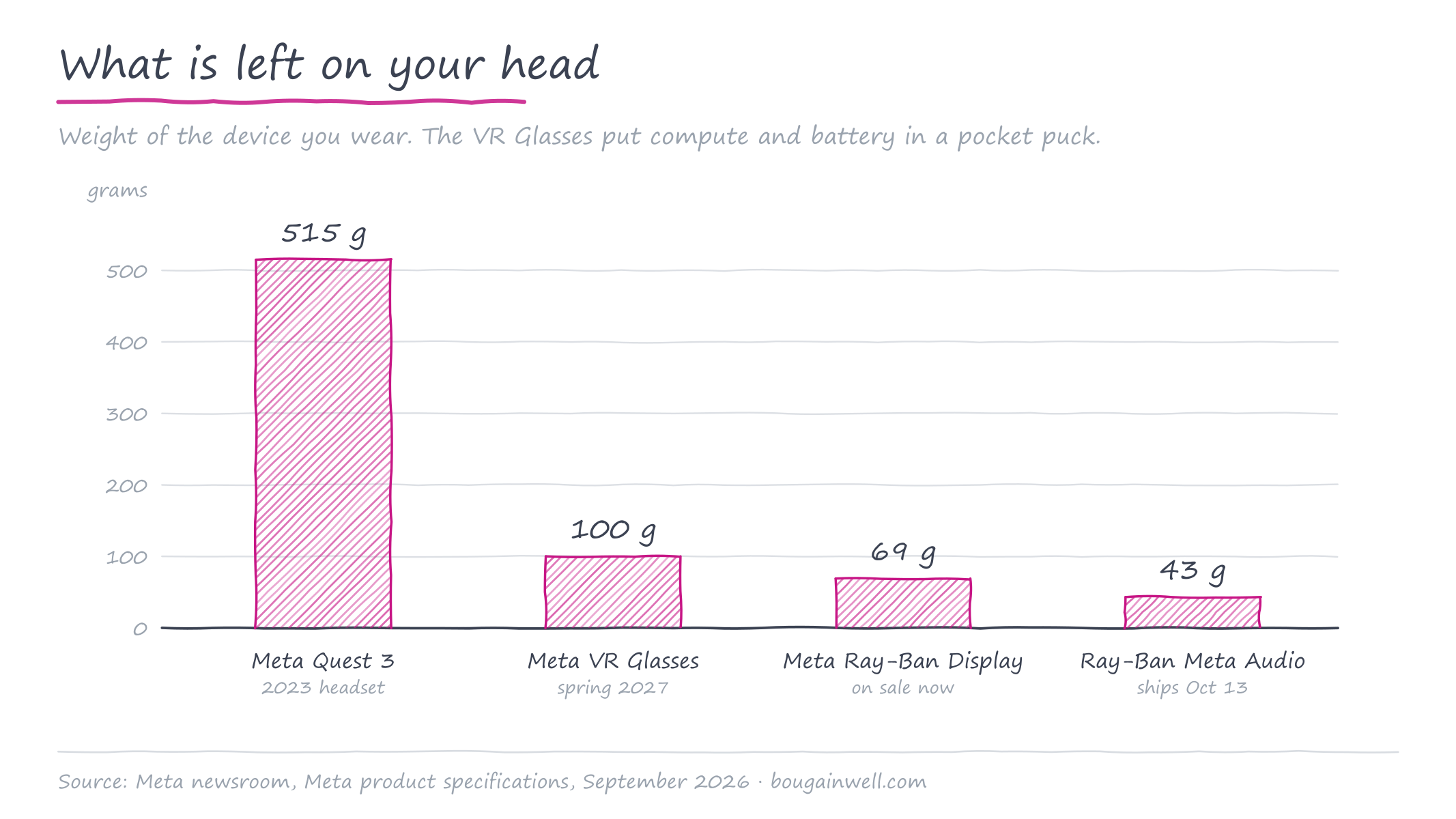
Meta Quest 3 carries its computer on your head. The VR Glasses do not, and weigh about a fifth as much. (Chart: BougainWell · Data: Meta newsroom and published product specifications)
There is a cost to this arrangement, and we will come back to it.
Meta stopped selling a device and started selling a shelf
For most of the last decade, "Meta hardware" meant one thing you could buy: a headset. Quest 3 arrived in 2023 at $499 and was, for a long stretch, the answer to every question about Meta's hardware ambitions.
After Connect, there is no single answer. There is a ladder.

Meta's AI glasses now span several frame families and dozens of colour and lens combinations. (Image: Meta, via the Meta Newsroom)
The rungs start at $249 for the Meta Adventurer and climb through $349, $399 and $449 before the Ray-Ban Display and, eventually, the $1,299.99 VR Glasses sit on top.
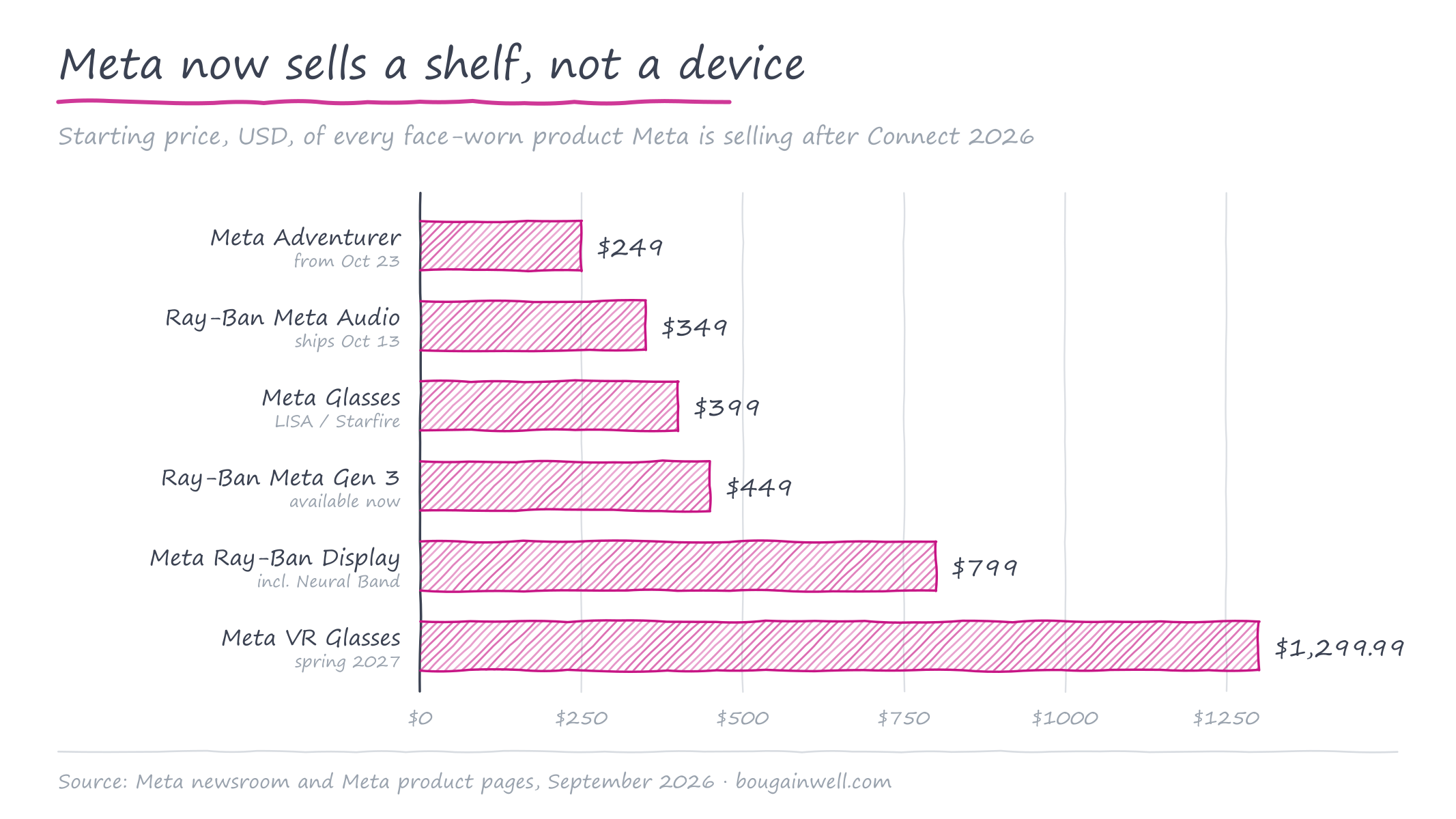
Every rung of the ladder removes something the rung above it has. (Chart: BougainWell · Data: Meta newsroom and Meta product pages)
Read that ladder as a product strategy and a pattern appears: each cheaper rung is defined by what it takes away, not by what it shrinks. The top rung moves the computer off your face. The rung below removes the immersive display and leaves a small one. Further down, the display goes entirely. And on one rung, the most interesting subtraction of all happens.
The camera came off — on purpose
Ray-Ban Meta Audio, at $349, has no camera.
On a spec sheet that looks like a downgrade, and most write-ups will file it as the budget option. It is not. The camera is the single feature that makes smart glasses socially difficult. It is why people get asked to take them off in gyms, schools, clinics and other people's kitchens. It is the reason the category has spent years apologising for itself.
Take the camera away and the glasses stop being a recording device that happens to play audio. They become headphones you do not have to put in your ears, with an assistant attached. That is a far easier product to explain, a far easier one to wear into a meeting, and — at $349 with battery measured in a full day of use rather than hours — a far easier one to justify buying.
The higher rungs keep their cameras and get better at using them. Ray-Ban Meta Gen 3, at $449, pairs its camera with a six-microphone array that Meta says cuts more than 90% of background noise. But the fact that Meta is now willing to sell a pair with no camera at all is the more telling move. It means the company has stopped treating the camera as the point of the product.
The glasses are a delivery route, not the destination
Here is the frame that makes the whole lineup cohere: Meta is not really in the glasses business. It is building distribution for an assistant.
Every rung of the ladder connects to Muse, the personal agent we looked at when Meta first opened it up. The glasses are how Muse gets a microphone, a speaker, a camera when you want one, and — crucially — a claim on the moments when your phone is in your pocket.

Meta Ray-Ban Display pairs the glasses with a wrist-worn Neural Band — input moved off the face, too. (Image: Meta, via the Meta Newsroom)
That explains why the price ladder goes as low as $249. An assistant's value compounds with how often you can reach it. A company optimising for hardware margin builds one excellent expensive device. A company optimising for agent reach builds a ladder and lets people self-select onto it.
Now the catch
The tether is a genuine trade, not a detail. A cable running from your temple to your pocket is a snag risk, a thing to unplug, and a second object to remember. Meta has moved the discomfort rather than eliminating it — from the weight on your nose to the cable down your collar. Whether that is a good trade is exactly the sort of thing you cannot know from a keynote.
Battery is the other one. Pocket puck or not, high-resolution playback runs for around three hours. That comfortably covers a film or a match; it does not cover a working day.
And the VR Glasses do not go on sale until spring 2027. Announcing hardware roughly half a year out is a choice with a cost: it tells developers and content partners to start building, and it tells anyone thinking about a competing headset exactly what they have to beat.
What to Take Away
- When a device suddenly gets dramatically lighter, ask what moved rather than what shrank. Meta's 100 grams is a relocation, not a miniaturisation win. The computer still exists; it is in your pocket.
- Self-contained hardware has a compounding weight problem. Faster chip needs more battery needs more cooling needs more mass. Splitting the device is the standard escape, and it is why wireless earbuds, smartwatches and now these glasses all lean on something else nearby.
- A cheaper model that removes a feature is not always a worse model. Dropping the camera fixes a social problem that no amount of engineering on the camera itself could fix.
- Read a product ladder as a distribution strategy. When a company stretches from $249 to $1,299.99 in one event, it is usually buying reach for something that is not the hardware — here, an assistant.
- A launch date far in the future is a signal to the market, not just to buyers. Spring 2027 gives Meta's partners a runway, and its rivals a target.
Charts: BougainWell, built from Meta's newsroom posts and published product specifications. Cover image and in-article product photography: Meta, via the Meta Newsroom. This article is for general information only and is not investment advice.
Sources
All analysis and opinions in this article are BougainWell's own.

