Almost every AI model you have used works by writing. Ask it a yes/no question and it still composes an answer one token at a time, sampling word after word, even when the useful output is a single label. Liquid AI’s new release attacks exactly that waste: two models that produce an answer without generating any text at all.
The company calls them decision models, and on October 7, 2026 it open-sourced two of them under the name Open d1. The pitch is speed where speed is the whole point — routing, classification and the quiet plumbing inside agents, running on hardware from a data-center rack down to a credit-card-sized edge board.
Today we release Open d1: two open-weight multimodal models in our d1 decision model family.
— Liquid AI (@liquidai) October 7, 2026
> d1-3B: text + vision
> d1-omni-600M: text + image or text + audio
> Real-time decision making anywhere, from data centers such as @nvidia DGX to RTX workstations to Jetson at the edge.… pic.twitter.com/aE4rnBfIkL
What a “decision model” actually is
Start with the word Liquid AI uses to draw the line. In its own framing, "Unlike our generative Liquid Foundation Models (LFMs), our d1 decision models don’t produce tokens. Instead, they produce an answer in a single forward pass."
Unpack that. A chat model answers by running the network once per output token — generate a word, feed it back in, generate the next, repeat. A short reply is dozens of passes; a reasoning trace is thousands. A decision model runs the network once, reads the activations, and emits the answer directly: a class, a route, a score. One pass, done.
So the useful question is not whether it is smart enough to chat — it is not trying to chat. It is trying to answer a closed question fast and the same way every time. Think of the difference between asking a colleague to write you a memo versus asking them to point: left or right. For the second task, the memo is pure overhead.
Why skipping token generation is the whole story
The cost of a generative model scales with how much it says. That is why a verbose model feels slow and why asking a chatbot to answer in one word rarely makes it meaningfully faster — the machinery is still built to generate. A single-forward-pass model removes the loop entirely, so its latency is fixed by the network size, not by the length of the answer.
Liquid AI leans hard on that fixed cost. It reports that d1-3B answers a question in 8 ms on an NVIDIA GeForce RTX 4090, 16 ms on a Jetson AGX Thor, and 26 ms on a Jetson AGX Orin — and that even the Jetson Orin Nano runs it in 50 ms. Read those as the company’s single-question measurements, not independently audited throughput, but the shape is the point: single-digit-to-double-digit milliseconds, consistent per call.
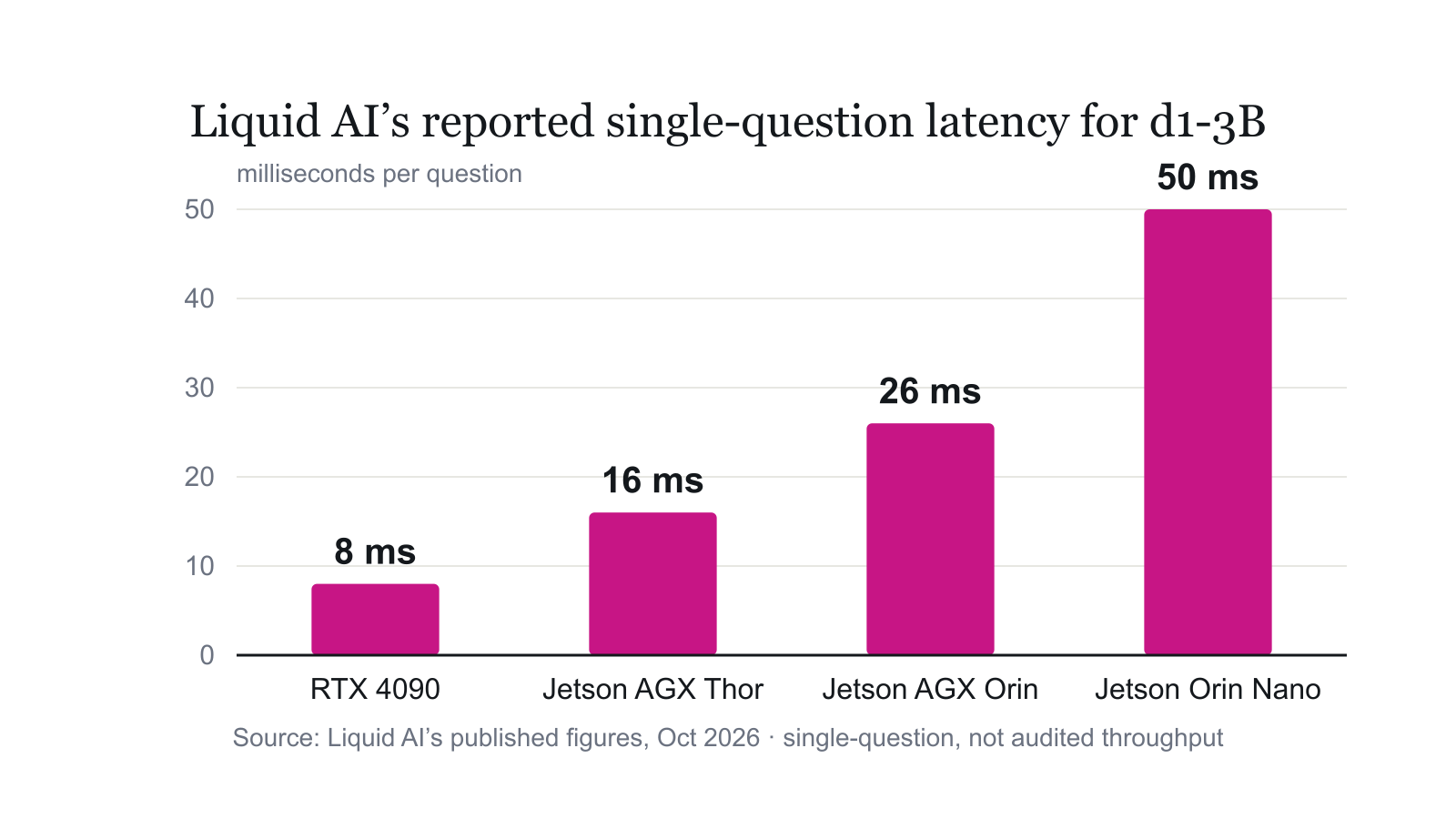 The same model, four tiers of NVIDIA hardware — from a gaming GPU to the smallest edge board. (Chart: BougainWell · Data: Liquid AI’s published figures, Oct 2026)
At 50 ms a decision fits inside a video frame budget on hardware you could bolt to a drone or a camera. At 8 ms you can call it in the hot path of a request without a human noticing. Fixed, low, predictable latency is exactly what you want from a component that other software waits on — and it is the same pull toward running models on your own silicon rather than a cloud endpoint.
The benchmark claim, read carefully
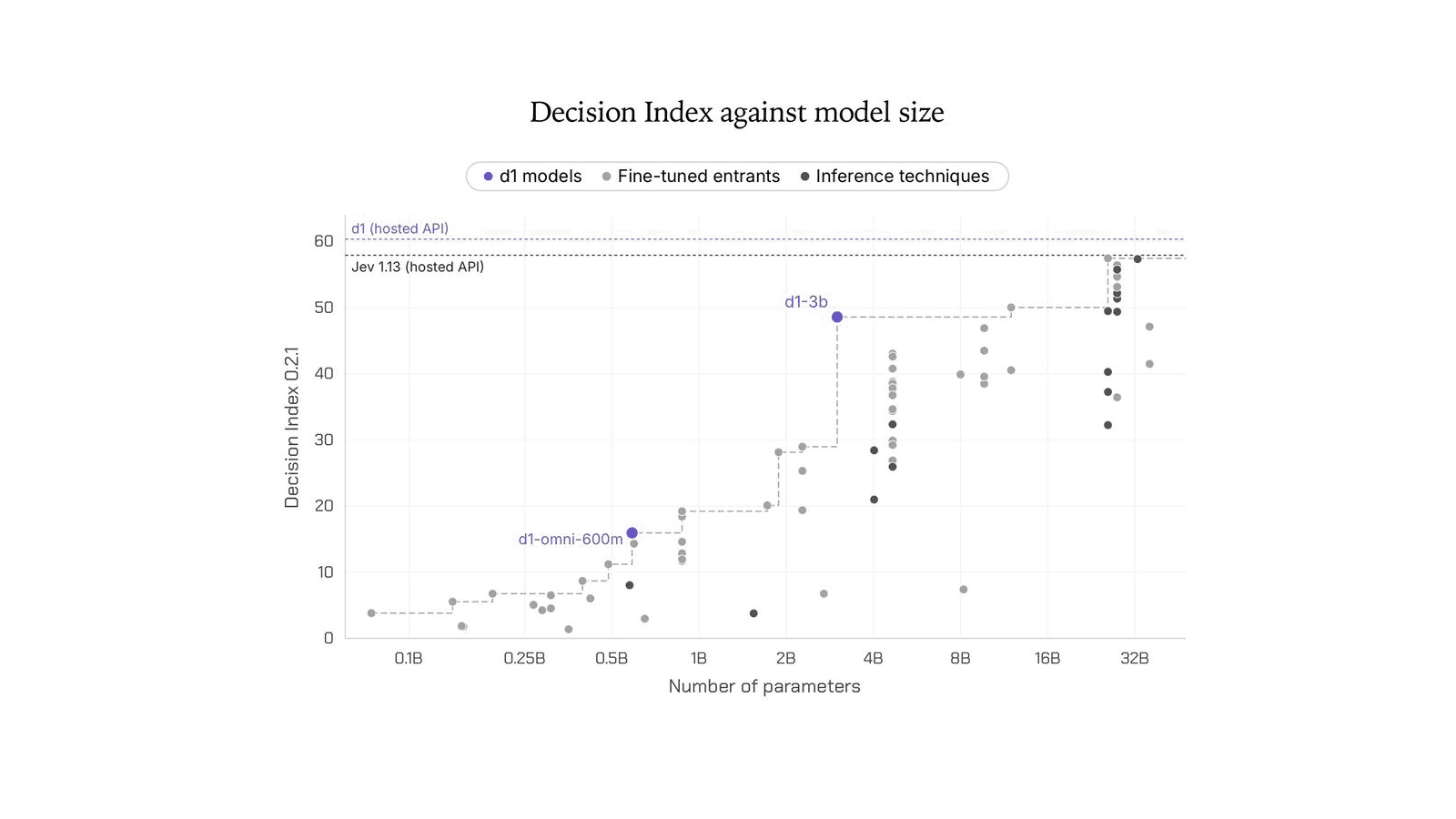
Liquid AI scores its models on its own yardstick, the Decision Index. The company says d1-3B scores 48.57 on the Decision Index (public split), ahead of every model under 10B and on par with Decider 35B-A3B, a decision model 12x its size. The smaller, experimental d1-omni-600M scores 15.95 on the same index.
Two cautions a careful reader should hold. First, this is a vendor benchmark on a vendor index — "ahead of every model under 10B" is Liquid AI’s claim, not a neutral leaderboard result. Second, note what it does not say: not first overall, not best in class — the honest comparison is parity with a model twelve times its parameter count. If that parity holds up to outside testing, a model you can serve on one GPU doing the work of a far larger one is the genuinely interesting result. The number to distrust is any that implies a clean crown; the number that matters is the 12x.
The two models, and what “omni” adds
The release is a pair, and they are not the same maturity.
| Model | Inputs | Decision Index | Role |
|---|---|---|---|
| d1-3B | text + vision | 48.57 | The workhorse |
| d1-omni-600M | text + image, or text + audio | 15.95 | First experimental checkpoint |
d1-3B is the one to build on. d1-omni-600M is smaller and, in Liquid AI’s own words, "our first experimental checkpoint, handling both text and image, as well as text and audio" — so treat it as a preview of where the family is heading, not a drop-in for production. Its headline feature is audio: a model that can take sound in and emit a decision without transcribing to text first collapses two steps into one, which is the same efficiency argument as skipping token generation, applied to the input side.
Where it fits in an agent stack
Here is the practical mental model, and it is where the open-weight part earns its keep. Modern agents are not one giant model call — they are a pipeline of decisions: which tool to use, is this input safe, does this request need the expensive model or the cheap one, which of five documents is relevant. Today those routing calls are often made by a full chat model, paying generation cost to emit one label.
A decision model is built to be that router. Put it in front of the expensive generative model and it decides, in milliseconds, whether to even make the expensive call — the same kind of plumbing that lets a coding agent escape the terminal and juggle real tasks. Because Liquid AI describes the weights as open — "Download, fine-tune, and deploy without restrictions" — a team can fine-tune the router on its own traffic and run it on its own hardware, including the edge, rather than paying per API call to classify.
Both models are available today on Hugging Face, which means the testing can start immediately rather than waiting on an API waitlist — the fastest way to find out whether the 12x-parity claim survives contact with a real workload.
What to Take Away
- A decision model answers in one forward pass — no token generation. That makes its latency fixed by network size, not answer length, which is why Liquid AI can quote single- and double-digit millisecond numbers.
- The number that matters is the 12x, not a ranking. Liquid AI says d1-3B (48.57 on its Decision Index) is on par with a decision model twelve times its size — it never claims to be first overall.
- Read the speed figures as the vendor’s own. 8 ms on an RTX 4090 up to 50 ms on a Jetson Orin Nano are Liquid AI’s single-question measurements, not audited throughput.
- The natural home is an agent router. A cheap, fast, fine-tunable classifier in front of an expensive generative model is where decision models pay for themselves.
- d1-omni-600M is a preview, not a product. At 15.95 it is Liquid AI’s first experimental checkpoint; the audio-in, decision-out idea is the direction, not yet the workhorse.
Cover image: Liquid AI, via its Open d1 announcement. Latency chart: BougainWell, built from Liquid AI’s published figures for Open d1 (October 2026). This article is for general information only.
Sources
All analysis and opinions in this article are BougainWell’s own.