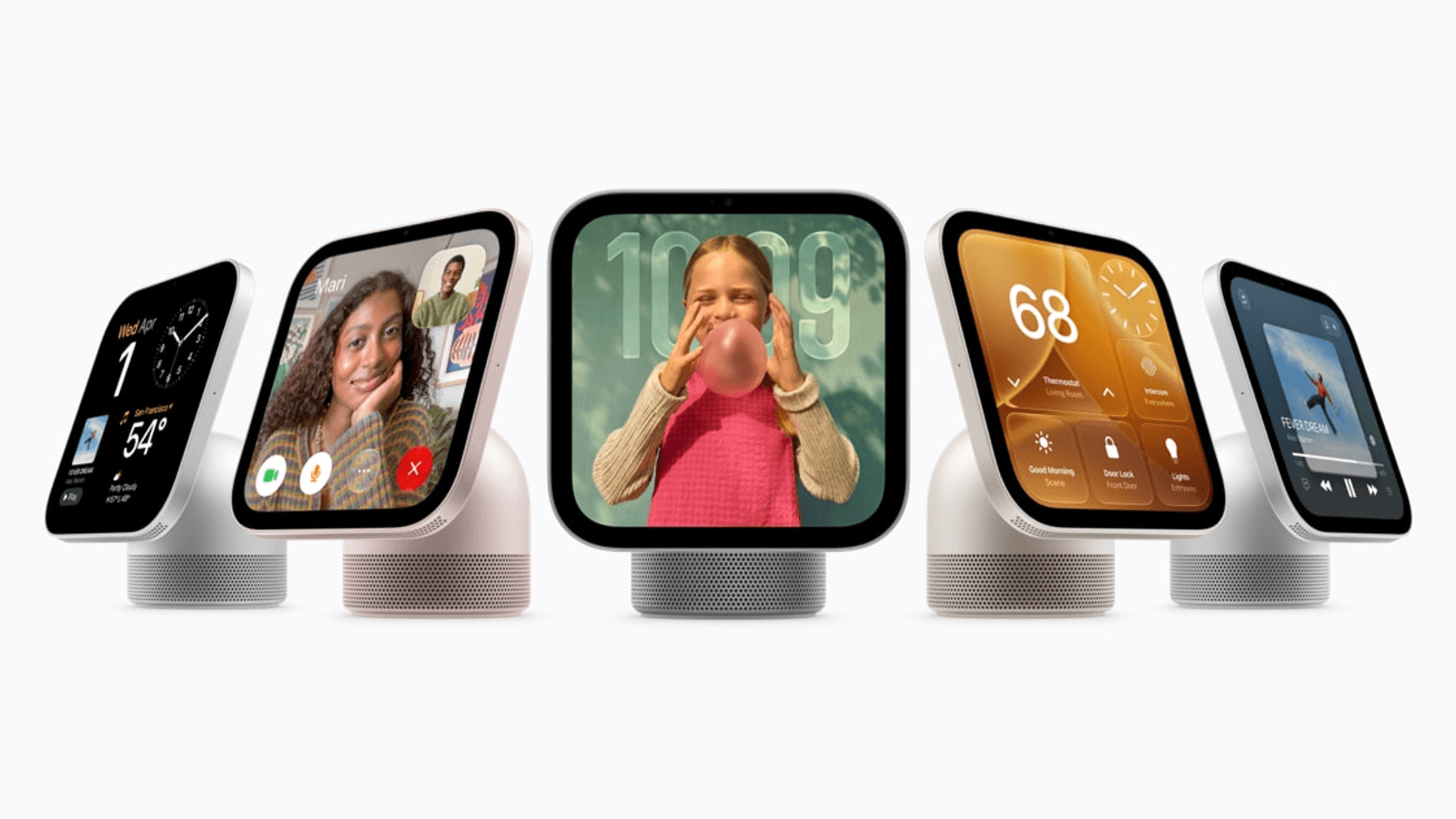
Apple has built a camera that watches your kitchen and asked you to pay $299 for the privilege. HomeView is a 7-inch screen that memorizes up to six faces and runs an entirely new Siri. The hardware is unremarkable; the real product is a bet that Apple can put a lens in the most private room of the house and have people trust it.
Introducing Apple HomeView!
— Greg Joswiak (@gregjoz) October 13, 2026
It recognizes up to six people, connects seamlessly across your Apple devices, and makes managing your home easy with Siri AI. All in a stunning, elegant design with privacy built right in. pic.twitter.com/S83Rzt4H6A
The Spec Sheet Is Beside the Point
On paper, HomeView is modest. A 7-inch Liquid Retina display, an A18 chip, a 12MP Center Stage camera that keeps you framed on video calls, a down-firing woofer with two force-cancelling passive radiators in the base, and two custom full-range drivers in the display for Spatial Audio. None of that is a reason to buy one — the way Meta's latest hardware moved the computer off your face was. The spec sheet is not where this product is won.
The reason is the software. HomeView runs Siri AI, an entirely new version of Siri powered by the next generation of Apple Intelligence, and the A18 is there to run it locally. Apple has shipped underpowered home hardware before and let the assistant disappoint. Putting a phone-class chip in a $299 screen only makes sense if the assistant is finally the point — the silicon exists to serve the software, not the other way round. It is the same logic Apple made explicit with the M6 and M5 Ultra, where the spec that mattered was the one that let a model run on the device instead of in someone else's cloud.
Why Six Faces Is the Whole Idea
HomeView recognizes up to six people and delivers a personalized experience for each one. That is not a bonus feature on a shared screen — it is the feature that makes a shared screen worth owning at all.
A display that sits on a kitchen counter is used by everyone and belongs to no one. Without recognition, it shows one generic home screen and one person's calendar. With it, the same body becomes six private profiles that switch on sight. Six people, one device, six experiences: that is the product, and the camera is how it works.
Which is also the problem.
Apple's Defence Is Architectural
Here's the open loop paid off. A camera-equipped, always-aware screen that memorizes six faces is, on paper, a surveillance device aimed at the most intimate room in a home. Apple's entire defence is architectural.
HomeView uses what Apple calls Secure Exclaves — protected, compartmentalized runtimes that process camera and microphone data separately from everything else on the device. The claim Apple makes about that compartment is unusually absolute:
Data that is processed and analyzed in Secure Exclaves cannot be accessed by the HomeView software, apps, the user, or Apple.
Read that list again. Not the apps. Not the user. Not Apple. For anything that does need to leave the device, Apple routes it through Private Cloud Compute, with a matching promise:
When processed in Private Cloud Compute, data is not stored nor made accessible to Apple or anyone else.
Why does this matter commercially? Apple's pitch, as we read it, is that a screen watching your kitchen only sells if people trust the watcher — so Apple is making the fact that it architecturally cannot see your data the product's main differentiator, not a footnote.
Price, Colors, and When You Can Get One
Both versions cost the same: $299 (U.S.). Apple offers two form factors — a countertop Apple HomeView and an Apple HomeView (Wall Mounted) — and charges identically for each, which keeps the choice about where it goes rather than what you can afford.
- Countertop: silver, starlight, rose pink, and space gray
- Wall-mounted: space gray and silver
Pre-orders opened October 13, with availability beginning November 13.
What to Take Away
- Apple HomeView is a $299 bet that the new Siri is finally good. The A18 chip only makes sense if Apple Intelligence runs locally — the hardware exists to serve the software.
- Face recognition for six people is the product, not a feature. A shared screen is worthless without it; six private profiles in one body is the whole idea.
- Privacy is the differentiator by design. Secure Exclaves and Private Cloud Compute are Apple's answer to an obvious objection — a camera in your kitchen — and its edge over ad-funded rivals.
- Apple's claim that the data cannot be accessed is a claim, not yet a verdict. Treat the security model as a promise to be tested, not a proven fact.
- One price, two shapes. $299 whether it sits on a counter or hangs on a wall; pre-order now, in hand from November 13.
All analysis and opinions in this article are BougainWell's own. Specifications and pricing are from Apple's own published materials.
Cover image: Apple, via its Apple HomeView newsroom announcement.