
A privately held rocket company does not have to show anyone its books. SpaceX did it anyway. On October 20, 2026 it put a full quarterly earnings report on the public internet and then streamed a live call to talk through it — the kind of thing listed companies are forced to do and private ones almost never bother with.
The headline number is the one everyone will repeat: $14.6 billion in revenue, up 161% year over year. The number that actually explains the quarter is a different one, and it flew to orbit.
Our Q3 2026 earnings report is now public → https://t.co/IRQs4EDBsS
— SpaceX (@SpaceX) October 20, 2026
The live webcast with @ElonMusk, @Gwynne_Shotwell, and @BretWJ will begin in 30 minutes https://t.co/CGrKBe0lfo
The 161% is bigger than it looks
A 161% jump means revenue didn't grow — it nearly tripled. Work it backwards and the prior-year quarter comes in at roughly $5.6B ($14.6B divided by 1 plus the 161% gain). So in twelve months SpaceX added about $9.0B of quarterly revenue — more than the entire business was taking in a year earlier.
That is the part worth sitting with. Growth percentages flatter small companies and embarrass large ones, because a bigger base is harder to double. SpaceX is not a small company, and it nearly tripled anyway. The open loop here: a jump that size almost never comes from running the existing machine harder. Something structural changed. More on that below.
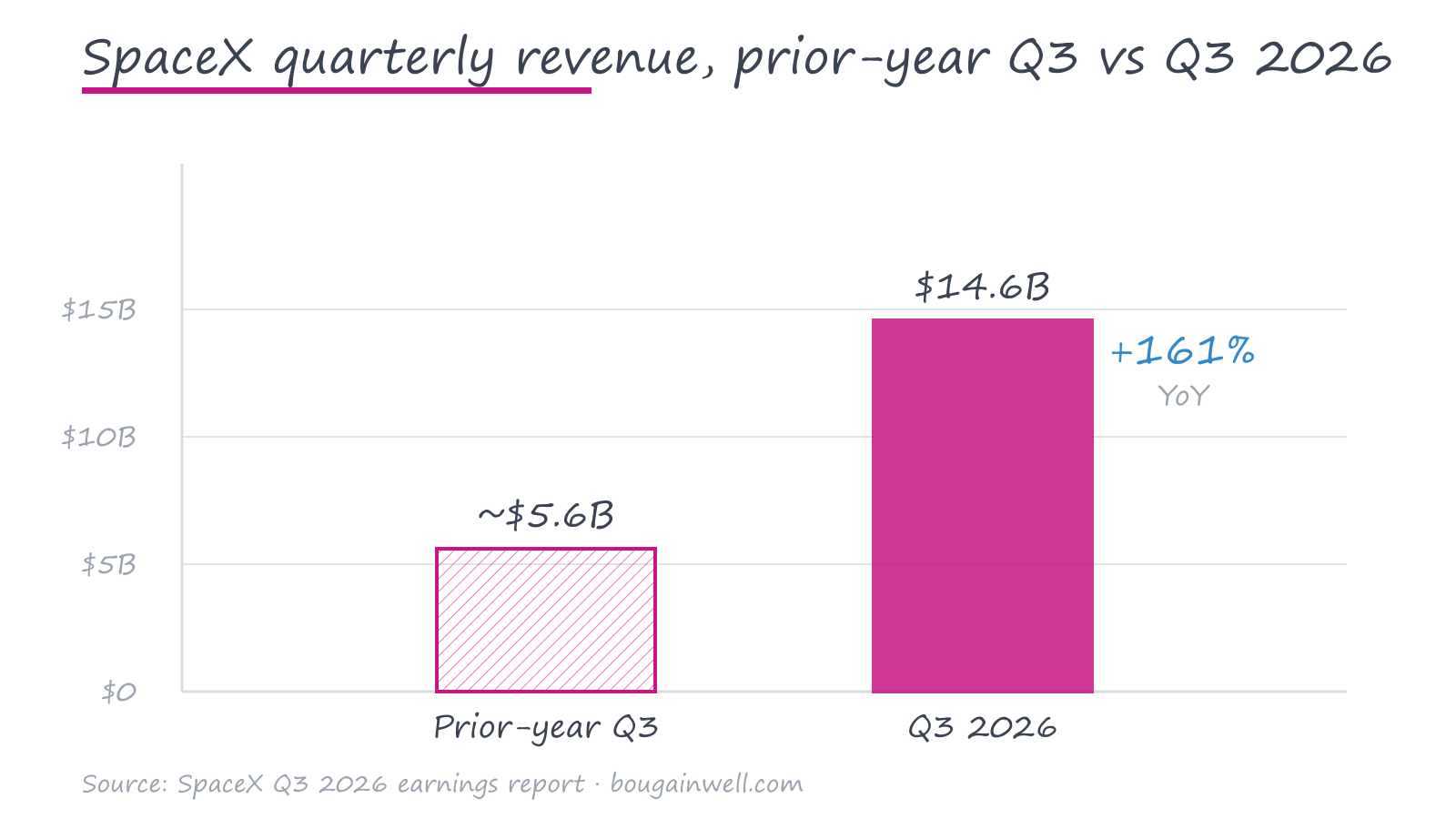 Revenue nearly tripled in a year — the base was already large, which is what makes it unusual. (Chart: BougainWell · Data: SpaceX Q3 2026 earnings report)
The number that flew: one Starship, 26 satellites
Here is the structural change. During the quarter SpaceX ran its first revenue-generating Starship mission — the first time the biggest rocket ever built carried cargo someone was paying to move, rather than a test article. It delivered 26 Starlink V3 satellites to the broadband constellation in a single flight.
Why that one flight matters more than the revenue line: it collapses the cost of getting broadband capacity into orbit. SpaceX says those 26 satellites represent roughly 10x the downlink capacity added versus the previous generation of satellites it had been flying.
Sit with the arithmetic. Ten times the downlink from one launch is not a 10% efficiency gain you negotiate out of a supplier. It is the kind of step-change that resets what a launch is worth. Each Starship flight that works stops being a cost line and starts being a capacity multiplier for the business that actually sells to customers — Starlink. American Airlines recently committed to putting Starlink on every mainline jet in its fleet, a deal that signals how far Starlink's commercial footprint now extends beyond consumer broadband.
Why SpaceX showed its books at all
Private companies guard financials because disclosure invites scrutiny and competition. Publishing a full report and hosting a live webcast with Elon Musk, Gwynne Shotwell and Bret Johnsen is a deliberate choice, not an accident of transparency.
The likely reason is mechanical. A business nearly tripling revenue is raising money, rewarding employees in equity, and fielding constant questions about what it is worth. A clean public number ends a lot of those conversations faster than a non-disclosure agreement does. When the trajectory is this good, showing the books is cheaper than hiding them. It is a logic not unlike Goldman Sachs publishing strong Q3 2026 results the same quarter — when the numbers work in your favour, transparency is leverage.
What the two numbers say together
Read in isolation, each figure is a headline. Read together, they are a thesis.
The $14.6B tells you the current engine — mostly Starlink subscriptions and launch services — is compounding fast. The Starship flight tells you the next engine is lighting. One revenue-generating launch dropping 26 V3 satellites at ~10x the old downlink is the supply side of Starlink getting radically cheaper to expand, right as the demand side is still growing 161% a year.
That is the setup to watch. When the thing you sell is growing triple digits and the thing that makes it just got an order of magnitude cheaper to produce, the two curves push on each other. The quarter isn't the story. The slope is.
What to Take Away
- SpaceX posted $14.6B in Q3 2026 revenue, up 161% year over year — a near-tripling off an already large base.
- Backed out, the prior-year quarter was about $5.6B, meaning roughly $9.0B of quarterly revenue was added in a year.
- The first revenue-generating Starship flight carried 26 Starlink V3 satellites in one go.
- Those satellites added about 10x the downlink capacity versus the prior generation — a supply-side step-change for Starlink.
- A private company publishing a full report and live webcast is a signal in itself: the numbers were good enough to show.
Chart(s): BougainWell, built from SpaceX Q3 2026 earnings report. This article is for general information only and is not investment advice.
Cover image: SpaceX (@SpaceX), via X post on Q3 2026 highlights.
Sources
- SpaceX (@SpaceX) on X — Q3 2026 earnings report now public and live webcast announcement
- SpaceX (@SpaceX) on X — Q3 2026 highlights: revenue and first revenue-generating Starship mission
- SpaceX (@SpaceX) on X — Q3 2026 Financial and Operational Results
All analysis and opinions in this article are BougainWell's own.